Monday, November 25, 2013
Brooks Robinson, 1982 Topps K-mart MVPs #5
As you may have noticed, there is no greater balm for baseball blogger writer's block than the birthday post. Well, here's one better: a birthday post about a birthday post. Chris Jaffe of The Hardball Times has posted a list of trivia tidbits about baseball players and their birthdays. Among the things I learned was that Brooks Robinson, born May 18, 1937, somehow played only a dozen games on his special day in the span of his 23-year career. However, he hit safely in all 12 birthday games, the longest such streak in baseball history. His overall birthday stats included a .435 batting average (20-for-46) with a double, a home run, and five runs batted in. He walked twice and struck out twice and hit into only one double play. His best May 18 game was a 1971 contest at the Yankees. Brooksie had just one hit in four tries, but it was a two-run homer off of Fritz Peterson in the fourth inning. It gave the O's a 3-1 lead which they would not relinquish. So I guess you could say that Baltimore's beloved third baseman was able to have his cake and eat it too.
Saturday, November 23, 2013
Francisco Rodriguez, 2013 Topps Update Series #US78
Here it is: photographic proof that violent twit Francisco "K-Rod" Rodriguez came to Baltimore, pitched 22 mediocre innings in which he allowed five home runs, and presumably (hopefully) left as a free agent. I hope he doesn't let the door hit him in the ass on the way out.
Friday, November 22, 2013
Vintage Fridays: Joe Gaines, 1964 Topps #364
It has been exactly 50 years since President John F. Kennedy was assassinated while riding in a motorcade in Dallas. That day also happened to be the 27th birthday of Orioles outfielder Joe Gaines; I can't imagine that he felt much like celebrating.
Gaines is the type of player that falls through the cracks of baseball history. His major league career spanned the years 1960 through 1966, but in three of those seasons he received little more than a cup of coffee. He played his best ball with the O's in 1963, when he appeared in 66 games as a fifth outfielder and pinch hitter. That year, Joe batted .286 with a .381 on-base percentage and .476 slugging percentage, and had six home runs and 20 RBI. But he started slow in 1964, and was dispatched to the fledgling Astros. By 1965, young Rusty Staub had replaced Gaines in the starting lineup. He prolonged his career by jumping to Japan in 1969, spending one season with the Hanshin Tigers. He's still alive and presumably well at 77 years of age.
Thursday, November 21, 2013
Eddie Murray, 2004 Upper Deck SP Legendary Cuts #35
On this date in 1977, Eddie Murray was named the American League's Rookie of the Year. At just 21 years of age, the native Los Angeleno appeared in all but one of the Orioles' 161 games, starting at designated hitter 110 times and spelling Lee May at first base in 42 contests. He even mixed in a handful of games in left field. Steady Eddie batted .283/.333/.470 (123 OPS+) with 29 doubles, 27 homers, and 88 RBI. He tied May for the team lead in homers, and trailed only May and Ken Singleton in RBI (they had 99 each). All this for a 97-win club that finished just two and a half games behind the Eastern Division champion Yankees. Murray bested Oakland's Mitchell Page (.307/.405/.521, 21 HR, 75 RBI, 42 SB) in a close vote, with Bump Wills and Dave Rozema also receiving consideration. Page had the more impressive numbers overall, but Murray undoubtedly received extra credit for being on a contending team, hitting more dingers, and being a certified, stone-cold badass.
Wednesday, November 20, 2013
Mike Mussina, 2001 Fleer Tradition #147
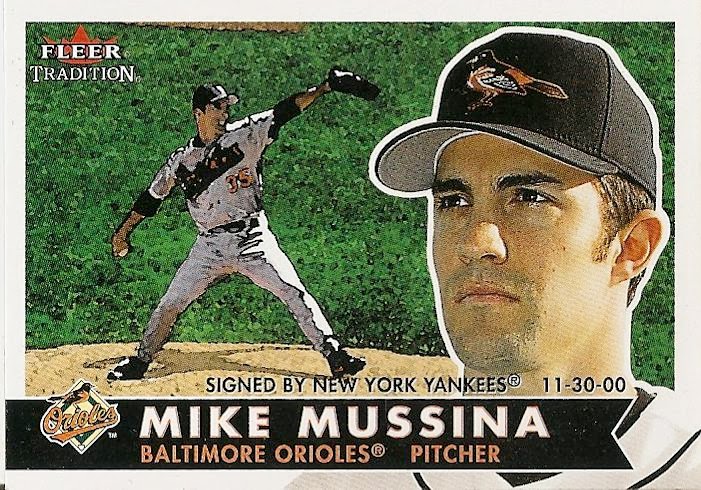
Mail day! I received an unannounced plain white envelope from Max today. It contained some new cards of my favoritest team, including my first O's cards of Bud Norris, Francisco Rodriguez (boo hiss), and Kevin Gausman...to be seen here later, of course. There was also this strange card, which is a thick cardboard punch in the gut to any orange-blooded Baltimore fan. It wasn't enough that Mike Mussina signed with the juggernaut Yankees after the 2000 season, but Fleer had to keep Moose in his Orioles uniform and put the team's banner on the card. It logically belongs in the completist's team set, but there's that stark black lettering under the veteran righty's chin, forever taunting Birdland, a reminder of things lost. I should hate this card, and yet I kind of like it because of the oddity of it all. I must be getting soft in my old age.
Tuesday, November 19, 2013
Monday, November 18, 2013
Geronimo Gil, 2004 Topps #163
I'm posting this one just for my wife, who bellows "Geronimooooooooo Giiiiiilllllllllll!" every time his name is mentioned.
Sunday, November 17, 2013
Brad Havens, 1987 Topps #398
How is the Great Sorting and Storing of 2013 going? I just spent my entire Sunday collating all of the 1980s cards in my collection. It gave me no small sense of accomplishment, but checking out all of the boxes that are still littering my living room and lurking in my spare bedroom closet offered me a reminder that the 1990s cards are waiting with bated breath to kick my ass by the thousands. It's going to be a long week.
Saturday, November 16, 2013
Brady Anderson, 1999 Skybox Thunder #78
I found a Skybox Thunder card that I hadn't posted yet. Do you know what that means? More terrible 90's faux-street verse!
"Goin' yard at Camden is all good for you, B, and you're one of the best at it...gettin' straight jiggy."
How did we ever survive that ridiculous decade?
"Goin' yard at Camden is all good for you, B, and you're one of the best at it...gettin' straight jiggy."
How did we ever survive that ridiculous decade?
Friday, November 15, 2013
Vintage Fridays: Johnny Powers, 1960 Topps #422
I snickered the first time I saw this card. Johnny Powers is rocking that pompadour, leaving his cap tilted high atop his head so his 'do doesn't get mussed. That's quite convenient, since the Reds had sold him to the Orioles the previous December and Topps didn't have any pictures of him in his new uniform. To be honest, Johnny didn't spend much time in any big league uniform, though. The Red Sox signed him as a teenager in 1949, but his development was delayed by military service during the Korean War. He put up some gaudy power numbers in the higher minors, including 39 home runs in 1956 for the Pirates' AA New Orleans squad. Powers got his first taste of the majors in 1955, but struggled in parts of four seasons in Pittsburgh: .190/.275/.303 in 90 games (160 plate appearances). In his lone season in Cincinnati, he was used as a pinch hitter with fair results: .256/.319/.488 in 47 plate appearances. With the O's, Johnny was tabbed as the Opening Day right fielder, but after three games that experiment ended. He appeared in just ten games total, batting .111 with no extra-base hits before being placed on waivers in mid-May. He caught on with the Indians, but after eight games and 14 plate appearances his MLB career was through. He hung on in the minors through 1965, finishing with 298 career homers. That's not nothing.
Thursday, November 14, 2013
Frank Robinson, 1991 Topps #639
A fun fact, courtesy of John Autin at High Heat Stats (and yes, I'm just now catching up to last month's blogroll):
There have been 11 1-0 final scores in postseason history with the only run scoring on a solo home run. Of those 11 games, four involved the Orioles. The bad news first: Sal Bando's round-tripper against Jim Palmer in the top of the fourth inning delivered Game Three of the 1974 ALCS to the Athletics. 23 years later, Tony Bleeping Fernandez took Armando Double-Bleeping Benitez deep in the top of the 11th to help the Indians wrap up both Game Six of the 1997 ALCS and the series as a whole.
But of course, there's good news in the form of astounding happenstance. The O's won their other two solo-homer-only 1-0 contests in postseason play...and they did it on back-to-back days. On October 8, 1966, Paul Blair touched 'em all against Los Angeles pitcher Claude Osteen in the bottom of the fifth inning. Wally Bunker six-hit the Dodgers, and the Birds took a three-games-to-none World Series lead. The following day (October 9, 1966, if you're not good with numbers), it was deja vu all over again. This time the instant offense came from Frank Robinson, against Don Drysdale, in the home half of the fourth. Dave McNally was the beneficiary of Robby's largesse, as he dispatched L.A. on four hits and a couple of walks to complete the sweep. Occasionally I feel like I've mined all the material that I possibly could from Baltimore's most dominating Fall Classic effort, but it seems like there's always another remarkable fact or statistic to be mined. I hope that this guy doesn't think I'm picking on him and his favorite team, especially since the events of October '66 took place before I was born and before he was even rooting for the boys in blue.
There have been 11 1-0 final scores in postseason history with the only run scoring on a solo home run. Of those 11 games, four involved the Orioles. The bad news first: Sal Bando's round-tripper against Jim Palmer in the top of the fourth inning delivered Game Three of the 1974 ALCS to the Athletics. 23 years later, Tony Bleeping Fernandez took Armando Double-Bleeping Benitez deep in the top of the 11th to help the Indians wrap up both Game Six of the 1997 ALCS and the series as a whole.
But of course, there's good news in the form of astounding happenstance. The O's won their other two solo-homer-only 1-0 contests in postseason play...and they did it on back-to-back days. On October 8, 1966, Paul Blair touched 'em all against Los Angeles pitcher Claude Osteen in the bottom of the fifth inning. Wally Bunker six-hit the Dodgers, and the Birds took a three-games-to-none World Series lead. The following day (October 9, 1966, if you're not good with numbers), it was deja vu all over again. This time the instant offense came from Frank Robinson, against Don Drysdale, in the home half of the fourth. Dave McNally was the beneficiary of Robby's largesse, as he dispatched L.A. on four hits and a couple of walks to complete the sweep. Occasionally I feel like I've mined all the material that I possibly could from Baltimore's most dominating Fall Classic effort, but it seems like there's always another remarkable fact or statistic to be mined. I hope that this guy doesn't think I'm picking on him and his favorite team, especially since the events of October '66 took place before I was born and before he was even rooting for the boys in blue.
Wednesday, November 13, 2013
Cal Ripken, Jr., 2001 Fleer Tradition Diamond Tributes #8
WARNING: Graphic images of a messy nature enclosed within. If you are a neat freak, germophobe, or any other variety of Type-A person, you may want to turn back now. This is what my living room currently looks like:
I am showing you this in an effort to shame myself into following through and getting all of these cards merged and stored, once and for all. After all, it's hard to relax on the couch when you've got stacks of loose cards and wayward shoeboxes cluttering up your line of sight. This poor Cal Ripken card has been waiting for a more permanent place for six months! In this instance, I've given myself a week and a half to get on with it. Most of the legions of cardboard pictured above are already sorted by year and brand. It's just a matter of combining them with the rest of my collection and getting them tucked away in a more sane and orderly fashion. A few small clusters of miscellaneous vintage (i.e. old sets that aren't close enough to completion to merit their own binders) need to be paged in the miscellaneous binder. I need to get off of my duff and start a long-overdue Orioles-specific binder...or five. And perhaps most of all, I need to cull out the scads of doubles (and triples, and quadruples, and...) and set them aside so I won't be caught flat-footed the next time I'm looking for trade bait. Piece of cake, huh?
If nothing else, let this serve as a cautionary tale. Whether you're buying a single rack pack at your big-box retailer or absorbing someone else's unwanted collection into your own, never put off the sorting and storage. It tends to snowball.
I am showing you this in an effort to shame myself into following through and getting all of these cards merged and stored, once and for all. After all, it's hard to relax on the couch when you've got stacks of loose cards and wayward shoeboxes cluttering up your line of sight. This poor Cal Ripken card has been waiting for a more permanent place for six months! In this instance, I've given myself a week and a half to get on with it. Most of the legions of cardboard pictured above are already sorted by year and brand. It's just a matter of combining them with the rest of my collection and getting them tucked away in a more sane and orderly fashion. A few small clusters of miscellaneous vintage (i.e. old sets that aren't close enough to completion to merit their own binders) need to be paged in the miscellaneous binder. I need to get off of my duff and start a long-overdue Orioles-specific binder...or five. And perhaps most of all, I need to cull out the scads of doubles (and triples, and quadruples, and...) and set them aside so I won't be caught flat-footed the next time I'm looking for trade bait. Piece of cake, huh?
If nothing else, let this serve as a cautionary tale. Whether you're buying a single rack pack at your big-box retailer or absorbing someone else's unwanted collection into your own, never put off the sorting and storage. It tends to snowball.
Tuesday, November 12, 2013
John Lowenstein, 1983 Fleer #63
I'm still keeping tabs on Night Owl's breezy and informative 1971 Topps set blog, and you should be too. Just yesterday, he posted John Lowenstein's rookie card, which he shares with pitcher Vince Colbert. I've had this card for a couple years, so I was already acquainted with the strange sight of a clean-faced Brother Lo in an Indians uniform. But I guess I didn't pay close attention to the card when I added it to my own collection. Night Owl highlights the odd factoid about Lowenstein on the card back:
"In a Little League game John was once 6-for-6 with 4 Homers & 14 RBI's, & once walked & scored 6 times in Babe Ruth League."
It's funny enough seeing childhood feats highlighted on a major leaguer's card, but especially so because it's a noted loon like Lowenstein. I agree with Night Owl; I think there's a good chance that Lo goosed his numbers a bit to have a laugh at the expense of the folks at Topps. If not...well, I guess he peaked early.
"In a Little League game John was once 6-for-6 with 4 Homers & 14 RBI's, & once walked & scored 6 times in Babe Ruth League."
It's funny enough seeing childhood feats highlighted on a major leaguer's card, but especially so because it's a noted loon like Lowenstein. I agree with Night Owl; I think there's a good chance that Lo goosed his numbers a bit to have a laugh at the expense of the folks at Topps. If not...well, I guess he peaked early.
Monday, November 11, 2013
Sammy Sosa, 2005 Topps Total Silver #110
We've still got something like four and a half months until Opening Day. It seems like an eternity, especially after suffering through a Ravens game yesterday. Football is a bloated spectacle, and I can tolerate the endless commercial breaks and the empty announcing cliches and the blatant corporatism a little less each year. When my home team is taking their lumps as much as they are this season, I just don't have the patience to endure those three-to-four hours every Sunday. It leaves me about as empty as a 2005 swing off the bat of Sammy Sosa.
Sunday, November 10, 2013
Paul Carey, 1994 Donruss #465
I'm not going to lie: I would love a pair of Paul Carey's 1954 Orioles throwback stirrups. The black stirrup with triple orange stripes is a damned sharp look.
Saturday, November 9, 2013
Josh Bell, 2010 Topps Update Series #US225
In retrospect, that whole Josh Bell thing didn't turn out very well. Defense, offense, no matter what he did, he looked about as ugly as those patriotic caps. But the Orioles have Platinum Glover Manny Machado at third base, so all is well that ends well perhaps.
Friday, November 8, 2013
Vintage Fridays: Paul Blair, 1972 Topps #660
I haven't paid close attention to the Orioles Topps want list hosted on my 1965 Topps blog for quite some time. I'll check in on it if I'm out bargain-hunting for vintage cards and I come across a member of the home team, or on the off chance that Ed or another fellow collector finds one of my needed cards. But off the top of my head, I couldn't tell you which cards have proved elusive...except of course the 1957 Brooks Robinson rookie. That's a doozy. Nor have I bothered to take inventory of the base cards I need from the last five Topps flagship sets, which mirrors the way that I've almost completely checked out on the modern product.
But I've spent a lot of time in recent weeks filling holes in some of my 1970s Topps set binders (1972-1974 and 1976-1978), and that piqued my curiosity. How am I doing on my 1970s O's? Not too bad, if my own shoddy record-keeping is to be believed. I have all of the Orioles from 1970 and 1973 through 1979. That leaves me with five suspects on the loose for the whole of the decade. The rundown:
1971 Topps (3): #330 World Series Game 4 (Reds Stay Alive), #595 Davey Johnson, #700 Boog Powell (short print). One postseason recap card left to get, and it's the only World Series game the Birds lost in 1970. I can wait on that one. The others are higher-series cards, and Boog is a dastardly short-print.
1972 Topps (2): #680 Davey Johnson, #731 Orioles Team. Of the 1970s sets that I've put any effort into building, it's 1972 that I have the lowest expectation of completing. With its monstrous-for-its-time 787-card checklist and pricey high-number cards, it's no wonder. If I can at least keep an eye out for this duo, I can earn the satisfaction of completing the team set. For now, though, Paul Blair is the uppermost Oriole in my 1972 set.
But I've spent a lot of time in recent weeks filling holes in some of my 1970s Topps set binders (1972-1974 and 1976-1978), and that piqued my curiosity. How am I doing on my 1970s O's? Not too bad, if my own shoddy record-keeping is to be believed. I have all of the Orioles from 1970 and 1973 through 1979. That leaves me with five suspects on the loose for the whole of the decade. The rundown:
1971 Topps (3): #330 World Series Game 4 (Reds Stay Alive), #595 Davey Johnson, #700 Boog Powell (short print). One postseason recap card left to get, and it's the only World Series game the Birds lost in 1970. I can wait on that one. The others are higher-series cards, and Boog is a dastardly short-print.
1972 Topps (2): #680 Davey Johnson, #731 Orioles Team. Of the 1970s sets that I've put any effort into building, it's 1972 that I have the lowest expectation of completing. With its monstrous-for-its-time 787-card checklist and pricey high-number cards, it's no wonder. If I can at least keep an eye out for this duo, I can earn the satisfaction of completing the team set. For now, though, Paul Blair is the uppermost Oriole in my 1972 set.
Thursday, November 7, 2013
Adam Jones, 2013 Panini Prizm #33
Adam Jones, Chris Davis, J. J. Hardy. Just like that, the Orioles claim ownership to three Silver Slugger Awards in one season for the first time in team history. These awards are given out to the best offensive player at each position in both leagues, and all three Birds are first-time winners. In fact, Jones is the first O's outfielder to ever win a Silver Slugger. Davis and Hardy are in rarified air as well: Eddie Murray and Rafael Palmeiro are the other pair of Baltimore first basemen to be so honored, and Cal Ripken and Miguel Tejada are the two previous shortstops on the team list. As a matter of fact, Aubrey Huff was the last Oriole at any position to claim this prize, based on his strong DH performance in 2008. I don't expect Chris Davis to beat out Mike Trout and Miguel Cabrera for the big prize (American League MVP) when those results are announced in a week, but the rest of the league is serving notice that these aren't the same cruddy Orioles.
Wednesday, November 6, 2013
Jeff Manto, 1995 Stadium Club #597
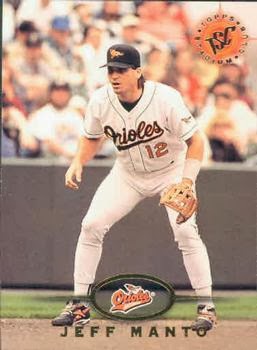
If you're looking for your dose of mid-1990s nostalgia tonight (and aren't we all?), this will do in a pinch. Jeff Manto, recently relieved of his position as Chicago White Sox hitting coach, has rejoined the Orioles as the organization's minor league hitting coordinator. Manto hasn't been seen around these parts since 1995, when he slugged .492 in 254 at-bats for the stunningly mediocre Phil Regan-managed O's. Jeff Manto will be molding the minds and bodies of Baltimore's offensive threats of tomorrow. Who knew?
Tuesday, November 5, 2013
Javy Lopez, 2004 Upper Deck Sweet Spot #39
Today is Javy Lopez's 43rd birthday. Time flies, don't it? The former Oriole catcher played his last game seven years ago, and it's been a few months shy of a decade since he cashed in on an anomalous .328/.378/.687 season (with 43 home runs, no less) and inked a three-year, $22.5 million free agent deal with the Birds. Though Javy was a big-name player and I've got dozens of his cards from his 2004-2006 tenure in Baltimore, I've only featured him seven times in the near-six-year lifespan of this blog. I've come to the realization that I don't have any strong affection for Lopez, nor do I bear any antipathy. He didn't have any strong personality traits that I could tell, and there wasn't much that was memorable about his stint with the Bad Old Orioles of the decade past. He came, he hit well (.293/.343/.468, 46 HR in 329 games), he fielded poorly, he got pushed out the door by Ramon Hernandez. I understand that many fans of the female persuasion found him pleasing to the eyes. But he was not energic and tempermental like Miguel Tejada. He was not an overachieving fan favorite like Melvin Mora. He was just sort of there, until he wasn't.
Monday, November 4, 2013
Bob Milacki, 1990 Donruss #333
Because I know how to drive a posting theme into the ground, here's yet another autograph from the five-pack that Alan sent my way. Bob Milacki had the good sense to sign his name across the bright white of his home jersey for optimal visibility. He's got one of the more legible signatures that I've seen by a baseball player, and yet it still allows for a bit of stylistic flourish. The blue marker contrasts nicely with the blood-red borders of 1990 Donruss, too.
Speaking of Bob Milacki, this blog post from 2012 features some quotes from the former O's pitcher about players he'd coached that season with the Reading Phillies, as well as a modern-day photo of Milacki. He still looks much the same as he did in his playing days, plus a few pounds and a goatee that I think suits him quite well.
Thursday, October 31, 2013
Scott McGregor, 1988 Topps #419
This may be my favorite of the five autographed cards I received from Alan this week. Scott McGregor's 1988 Topps card rekindles a lot of memories; I've owned a copy since childhood, long before I even followed baseball. It's such a unique photo. How often do you see a shot of the pitcher just standing atop the mound to receive the return throw from his catcher? That Scotty's eyes look to be closed makes it stand out all the more. The orange-and-brown color scheme that Topps used for the Orioles in this set complements the picture very well. I think the autograph just adds to the aesthetic: it's very distinct in its own unintelligible way.
In housekeeping news, I will likely be incommunicado blogwise until Monday. My wife and I are spending the weekend visiting her family. See you next week!
Wednesday, October 30, 2013
Manny Machado, 2013 Topps Allen and Ginter #120
Last night, Manny Machado became the second Oriole third baseman to ever win a Gold Glove. Of course, the other guy won 16 at the hot corner, so the O's are still well-represented in the annals. Machado, as always bears repeating, is only 21 years old. Brooks Robinson had to wait until he was 23 to receive his first award. Young Manny's incredible range, sure hands, and super-powered throwing arm helped him to beat out a bumper crop of skilled third basemen. Fellow finalists Evan Longoria and Adrian Beltre already had six Gold Gloves between them. Baltimore's emerging star was drafted and developed as a shortstop, and is still nimble enough to play at his natural position. One can't help but wonder how dazzling he might be at short.
Of course, Manny is playing at third because of the Birds' incumbent shortstop, J. J. Hardy. Hardy just won his second straight Gold Glove, joining the duo of Mark Belanger and Cal Ripken as the only Baltimore shortstops to win multiple Gold Gloves. Another returning Gold Glover is center fielder Adam Jones, who collected his third trophy in the past five years. Paul Blair is the other O's flychaser to earn consecutive Gold Gloves.
The Orioles took home three Gold Gloves, just as they did in 2012. This tied them with the Royals for the most in the major leagues. Two K.C. Gold Gloves came at the expense of Baltimore finalists, with Eric Hosmer beating out Chris Davis at first base and Salvador Perez besting Matt Wieters at catcher. But then, Hardy topped Alcides Escobar and Jones topped Lorenzo Cain, so THERE.
It's always nice to see the home team add a little hardware, especially when they're receiving notice for their record-setting defensive prowess.
Of course, Manny is playing at third because of the Birds' incumbent shortstop, J. J. Hardy. Hardy just won his second straight Gold Glove, joining the duo of Mark Belanger and Cal Ripken as the only Baltimore shortstops to win multiple Gold Gloves. Another returning Gold Glover is center fielder Adam Jones, who collected his third trophy in the past five years. Paul Blair is the other O's flychaser to earn consecutive Gold Gloves.
The Orioles took home three Gold Gloves, just as they did in 2012. This tied them with the Royals for the most in the major leagues. Two K.C. Gold Gloves came at the expense of Baltimore finalists, with Eric Hosmer beating out Chris Davis at first base and Salvador Perez besting Matt Wieters at catcher. But then, Hardy topped Alcides Escobar and Jones topped Lorenzo Cain, so THERE.
It's always nice to see the home team add a little hardware, especially when they're receiving notice for their record-setting defensive prowess.
Tuesday, October 29, 2013
Armando Benitez, 1996 Donruss #513
My mother is retiring next month, so she's been doing a lot of cleaning, organizing, and dumping. Yesterday afternoon she handed me a sealed (but not stamped) envelope that she'd found bearing my handwriting. It was addressed to Dr. Gene Budig, President of the American League from 1994 through 1999. I had no recollection of ever composing a letter to the good doctor, but I had a feeling that it couldn't be anything good. When I got back to my desk and opened it up, my suspicions were confirmed.
The letter, composed in Microsoft Word and printed neatly, is dated October 10, 1996. The day after Game 1 of the ALCS. THAT game. Armando Benitez. Derek Jeter. Tony Tarasco. Jeffrey Freaking Maier. It's a fascinating glimpse into the frustrated mind of a 14-year-old baseball fanatic, and there is contempt dripping off of each and every word. I'm not nearly shameless enough to share the letter in its entirety, but highlights include:
-Referring to myself as "a frustrated ex-baseball fan". 17 years later, I must note that I'm apparently not a man of my convictions. And yes, I underlined "ex" in the letter, just so he would get the point.
-Committing the cardinal sin of the overzealous sports fan and substituting "we" for the team name.
-Describing the umpires as "spiteful" (more on that in a moment) and "incompetent", and Yankee rooters as "nasty, immoral slobs". Gee, young Kevin, tell us what you really think.
-Suggesting that Richie Garcia and the rest of the umpiring crew may have had it in for the Orioles because Roberto Alomar had recently spit on John Hirschbeck.
-Noting that I had stripped my room of all baseball memorabilia. It's a good thing I didn't actually throw those cards out...I suppose.
-Appending a closing salutation of "Worst regards". Oh, BURN.
Obviously, this letter is something that I can laugh at now. Maybe time really does heal all wounds.
On the other hand, I still can't stand Armando Benitez.
The letter, composed in Microsoft Word and printed neatly, is dated October 10, 1996. The day after Game 1 of the ALCS. THAT game. Armando Benitez. Derek Jeter. Tony Tarasco. Jeffrey Freaking Maier. It's a fascinating glimpse into the frustrated mind of a 14-year-old baseball fanatic, and there is contempt dripping off of each and every word. I'm not nearly shameless enough to share the letter in its entirety, but highlights include:
-Referring to myself as "a frustrated ex-baseball fan". 17 years later, I must note that I'm apparently not a man of my convictions. And yes, I underlined "ex" in the letter, just so he would get the point.
-Committing the cardinal sin of the overzealous sports fan and substituting "we" for the team name.
-Describing the umpires as "spiteful" (more on that in a moment) and "incompetent", and Yankee rooters as "nasty, immoral slobs". Gee, young Kevin, tell us what you really think.
-Suggesting that Richie Garcia and the rest of the umpiring crew may have had it in for the Orioles because Roberto Alomar had recently spit on John Hirschbeck.
-Noting that I had stripped my room of all baseball memorabilia. It's a good thing I didn't actually throw those cards out...I suppose.
-Appending a closing salutation of "Worst regards". Oh, BURN.
Obviously, this letter is something that I can laugh at now. Maybe time really does heal all wounds.
On the other hand, I still can't stand Armando Benitez.
Monday, October 28, 2013
Storm Davis, 1986 Fleer #271
I didn't expect to still be receiving wedding gifts six weeks after saying "I do". But today, a plain white envelope arrived from reader Alan, who is much more proactive about collecting Oriole autographs than I am. As he'd promised some days ago, he sent me five autographed O's cards: Tim Stoddard, Scott McGregor, Tom Niedenfuer, Bob Milacki, and ol' George Earl Davis, pictured above. Storm was a better pitcher for the Birds than I'd realized; he only had one subpar season in his initial five-year tenure in Baltimore. Even though he was only 20 years old when he debuted in 1982, Davis posted a 54-40 record and a 3.65 ERA (110 ERA+) in the first half-decade of his career. He completed 27 of his 121 starts. At that juncture, the Orioles traded their young middle-rotation starter for 31-year-old catcher Terry Kennedy and middle reliever Mark Williamson. Kennedy was gone in two years, and Williamson stuck around for eight mostly-competent seasons out of the bullpen. Storm soon landed in Oakland, won 35 games in a two-season span on the strength of the great team behind him, and wound up as a free-agent flop in Kansas City. He had good seasons as a reliever for the Orioles in 1992 and the Tigers in 1994, but never pitched in the majors again after the strike that ended the latter season. That's certainly not the career path that many would have predicted when ex-teammate Mike Flanagan was referring to him as "Cy Clone" due to his similarity to Jim Palmer. But baseball history is rarely tidy.
Sunday, October 27, 2013
Jimmy Key, 1997 Fleer Circa #333
In a little bit, I'll be driving down to the Baltimore Arena to see Pearl Jam in concert for the second time in my life, and the first since 2008. Their newest studio album, released earlier this month, is entitled Lightning Bolt. If that's not reason enough to post this gooberish neon 1990s Fleer card, complete with lightning bolt effects, well...I fear for the future of this planet.
Saturday, October 26, 2013
Matt Tucker, 2010 Bowman Chrome Prospects #BCP72
Out of baseball in 2013. Reached AA Bowie for all of 16 games in 2010, where he posted a .477 OPS at age 27. Bowman, you've done it again.
Friday, October 25, 2013
Vintage Fridays: Joe Ginsberg, 1957 Topps #236
You spend your childhood dreaming about having your picture on a baseball card, and finally it happens. Then some punk-ass kid gets his grubby little hands on that card, and suddenly you've got a "3" written on your back in pencil. The eraser only makes it worse. Kids these days...no respect, I tell you.
Thursday, October 24, 2013
Jeff Conine, 2001 Topps #683
Jeff Conine had many talents as a ballplayer, but chief among them was his ability to look disgusted and vaguely annoyed approximately 100% of the time.
Wednesday, October 23, 2013
Joe Carter, 1998 Fleer Tradition #511
It's been 20 years to the day since Joe Carter hit his famed walkoff three-run homer off of Mitch Williams to clinch the Blue Jays' second straight World Series win. This is pretty damned impossible, since I have distinct memories of watching most of that year's Fall Classic at age 11. It hasn't really been 20 years. Yet, here we are. Stupid passage of time.
Tuesday, October 22, 2013
Melvin Mora, 2003 Upper Deck SP Authentic #20
Melvin Mora never was the fastest runner on his team. Maybe it had something to do with the black metal bar fused to his rear end.
Monday, October 21, 2013
Rick Dempsey, 1987 Fleer #567
Your quote of the day, from a Roch Kubatko interview with Rick Dempsey:
The bit about the Indians is worth a laugh, but Dempsey's been holding that grudge for so long he doesn't even remember the details about his departure. Tettleton wasn't signed until 1988; it was Terry Kennedy that the Orioles acquired after the 1986 season. Let it go, Rick. If you read the rest of his quotes, he also seems to be in denial about his ability to play regularly in the early 1990s, when the Brewers and Orioles both put him at arms' length in short order. It must be tough to be an aging professional athlete; I've heard before that guys like Dempsey are often the last to know when they're finished.
"I go back to 1986 when at the end of the season with the Orioles, I had to get an elbow operation," Dempsey said. "The Orioles weren't going to pick up the option on my contract, and I was so freaking hurt. They were bringing in Mickey Tettleton to play every day, a big home run hitting catcher. I got in a big contract dispute with (general manager) Hank Peters. I was so upset they didn't call me in to talk about this transaction that I said I'd sign with the worst team at the minimum salary rather than come back to the Orioles, and God was listening. I went to the Cleveland Indians."
The bit about the Indians is worth a laugh, but Dempsey's been holding that grudge for so long he doesn't even remember the details about his departure. Tettleton wasn't signed until 1988; it was Terry Kennedy that the Orioles acquired after the 1986 season. Let it go, Rick. If you read the rest of his quotes, he also seems to be in denial about his ability to play regularly in the early 1990s, when the Brewers and Orioles both put him at arms' length in short order. It must be tough to be an aging professional athlete; I've heard before that guys like Dempsey are often the last to know when they're finished.
Sunday, October 20, 2013
Koji Uehara, 2011 Topps Opening Day #77
Last night as I came to terms with the inevitability of a Cardinals-Red Sox World Series, which was the matchup I least wanted to see at the onset of the postseason, I was at least able to take some solace in the successes of Boston closer Koji Uehara. The ex-Oriole saved the clinching Game Six of the ALCS last night with a scoreless inning of relief, striking out a pair of Tigers and doing it all in just 11 pitches. Moments later, Koji was named the Most Valuable Player of the series. He saved three of Boston's wins, and earned the win in the fourth. His totals: six innings, four hits, no runs, no walks, nine strikeouts. Since I'm not crazy about either the Redbirds or the BoSox, I'll just spend the next week and change rooting for Koji rather than the unappealing laundry that he wears.
Saturday, October 19, 2013
Tony Chevez, 1991 Crown/Coca-Cola All-Time Orioles #75
I'm probably repeating myself - after blogging on a near-daily basis for almost six years, I'd be surprised if I wasn't - but the thing I value about the 1991 All-Time Orioles set is that they included everyone. Every Tom, Dick, or Harry who ever threw a single pitch or had a single at-bat in the first 37 years of O's baseball has his own card in this oddball set. That includes Tony Chevez, who was the second player born in Nicaragua to play in the major leagues. Baltimore signed both Chevez and fellow Nicaraguan Dennis Martinez in 1973, and the former was actually the bigger star back home. In the amateur Roberto Clemente League, Tony went 20-1 with a 0.93 ERA and a pair of no-hitters in his final season. His pitching talent translated well to the minor leagues, where he posted a 32-14 record and a 1.93 ERA in parts of three seasons with the Class A Miami Orioles. The club promoted him to AA Charlotte during the 1976 season, and he went 7-3 with a 1.87 ERA. But in 1977, everything changed.
Chevez was 23 when the Birds promoted him to the major leagues in place of the injured Fred Holdsworth in late May of 1977. He was used four times in mop-up relief situations, and gave up runs each time: 13 total (11 earned) in eight innings, for a 12.38 ERA. He allowed 10 hits and eight walks and struck out only seven men. His final appearance came on a cool, wet night in Boston. Chevez says that he slipped during his follow-through after one pitch and felt a pop in his shoulder. He sat unused in the Baltimore bullpen for two more weeks before returning to AAA Rochester. He tried pitching through the pain, but wasn't the same pitcher he had been before. He had a 13-27 record and a 4.52 ERA in parts of three seasons with the Red Wings, and his pro career was finished by 1980. Those four rocky relief appearances comprised the entirety of his major league experience.
But Tony made his happy ending elsewhere, settling in Rochester with his wife Halyma. They became United States citizens in 1982 and raised three children. Their daughter Kelly married then-Rays shortstop Jason Bartlett in 2008. Tony found work for a tool and die manufacturer in Rochester, and Halyma is a social worker. They have not forgotten their roots, either, returning to Nicaragua several times in the past decade with friends from their church to build homes and donate medicine and clothing to the needy.
My source for this blog post was a fine article posted at SABR by Rory Costello.
Chevez was 23 when the Birds promoted him to the major leagues in place of the injured Fred Holdsworth in late May of 1977. He was used four times in mop-up relief situations, and gave up runs each time: 13 total (11 earned) in eight innings, for a 12.38 ERA. He allowed 10 hits and eight walks and struck out only seven men. His final appearance came on a cool, wet night in Boston. Chevez says that he slipped during his follow-through after one pitch and felt a pop in his shoulder. He sat unused in the Baltimore bullpen for two more weeks before returning to AAA Rochester. He tried pitching through the pain, but wasn't the same pitcher he had been before. He had a 13-27 record and a 4.52 ERA in parts of three seasons with the Red Wings, and his pro career was finished by 1980. Those four rocky relief appearances comprised the entirety of his major league experience.
But Tony made his happy ending elsewhere, settling in Rochester with his wife Halyma. They became United States citizens in 1982 and raised three children. Their daughter Kelly married then-Rays shortstop Jason Bartlett in 2008. Tony found work for a tool and die manufacturer in Rochester, and Halyma is a social worker. They have not forgotten their roots, either, returning to Nicaragua several times in the past decade with friends from their church to build homes and donate medicine and clothing to the needy.
My source for this blog post was a fine article posted at SABR by Rory Costello.
Friday, October 18, 2013
Vintage Fridays: Bob Grich, 1974 Topps #109
If anybody needs me today, I'm combing through a 3000-or-so-count box of well-used 1970s Topps commons on loan from my buddy Ed. In exchange for bits of American currency, he's allowing me to do some set-building. I've already got this card, which features Bobby Grich, baserunner Pedro Garcia of the Brewers, and a bunch of empty Memorial Stadium bleacher seats. But perhaps I can give it some company in my partially complete 1974 Topps binder. Everybody wins!
Thursday, October 17, 2013
Cal Ripken, Jr., 2001 Fleer Authority #33
I'm sure I'm preaching to the choir here, but on the off chance that any of you know the parties responsible...
For goodness' sake, stop picking on Vi Ripken. What did she ever do to you?
Wednesday, October 16, 2013
Scott McGregor, 1983 Fleer #66
It has been exactly 30 years since Scott McGregor pitched the game of his life, permitting seven Phillies baserunners (five hits, two walks) and striking out six in nine scoreless innings. Eddie Murray broke out of his Fall Classic slump with a pair of home runs, and Rick Dempsey sewed up MVP honors with a double and a homer. It took the Orioles just two hours and 21 minutes to complete a 5-0 victory, clinching the franchise's third World Series Championship...and to date, their last.
The O's haven't even been to the World Series since their 1983 triumph, though they finally seem to be moving in the right direction for the first time since the late 1990s. But it's a simple fact that there are 18 other franchises that have received that shiny trophy in the time that's passed since Cal Ripken caught the final out three decades ago. Of the 11 teams wandering the wilderness with the Birds, two others (Rays and Rockies) have come into existence in the interim. There are six pre-1983 expansion teams that have never won a Series: Colts/Astros, Pilots/Brewers, Mariners, Expos/Nationals, Padres, and Senators/Rangers. Then there are the truly unfortunate: the Pirates (last champs in 1979), Indians (1948), and of course the Cubs (1908). That's not exactly the company you want to keep.
I consider myself lucky to root for a team that has counted itself as a contender for the past two seasons. But I've made it to 31 without being able to root for a World Series winner, and I'd love to knock that one off of my checklist sooner rather than later.
The O's haven't even been to the World Series since their 1983 triumph, though they finally seem to be moving in the right direction for the first time since the late 1990s. But it's a simple fact that there are 18 other franchises that have received that shiny trophy in the time that's passed since Cal Ripken caught the final out three decades ago. Of the 11 teams wandering the wilderness with the Birds, two others (Rays and Rockies) have come into existence in the interim. There are six pre-1983 expansion teams that have never won a Series: Colts/Astros, Pilots/Brewers, Mariners, Expos/Nationals, Padres, and Senators/Rangers. Then there are the truly unfortunate: the Pirates (last champs in 1979), Indians (1948), and of course the Cubs (1908). That's not exactly the company you want to keep.
I consider myself lucky to root for a team that has counted itself as a contender for the past two seasons. But I've made it to 31 without being able to root for a World Series winner, and I'd love to knock that one off of my checklist sooner rather than later.
Tuesday, October 15, 2013
Jim Palmer, 2005 Upper Deck Sweet Spot Classic #42
It's Jim Palmer's 68th birthday today. He won exactly 268 total games as a major leaguer. He had an earned run average of 2.68 in 1971, when he made the All-Star team and was one of the American League Champion Orioles' record four 20-game winners. He also earned 68.1 WAR (Wins Above Replacement) over his career as a pitcher, 35th-best all-time. From 1965 through 1984, the only season in which Palmer didn't appear in a single game with the O's was 1968, when he was rehabbing from surgery. He came back better than ever in 1969: 16-4, 2.34 ERA in 26 games.
What does this all mean? Nothing, probably. But what if it does?
Monday, October 14, 2013
John Habyan, 1988 Topps #153
This monster cold/virus/whatphlegmyever is wreaking havoc with my blogging schedule. That's my story and I'm sticking to it. With any luck, I'll be breathing normally some time before November. I was actually willing and able to post to both blogs today, and the latest 1993 Topps subject is Mr. John Habyan. In researching that entry, I discovered that Habyan's first big league win came under unusual circumstances. The date was October 3, 1985, and the O's were hosting the nightcap of a doubleheader with Boston. Despite an early two-run homer from Larry Sheets, the Birds had fallen into a 6-4 hole when the rookie righthander was called upon with the bases loaded and nobody out. (Thank the bullpen dream team of Nate Snell and Brad Havens, who made that mess!) Red Sox batter Marty Barrett greeted Habyan with a run-scoring single to make it 7-4, but the youngster was able to retire the next three hitters to strand three runners. Errors by Tom O'Malley and Cal Ripken in the eighth inning saddled Habyan with an unearned run, giving Boston a four-run edge.
Just when things looked bleak, the Boston bullpen intervened. In the bottom of the eighth, a Floyd Rayford pinch single and a Rick Dempsey two-run homer cut the margin to 8-7 and helped chase Tim Lollar from the mound. Steve Crawford fared no better for the BoSox, loading the bases with an assist from backup third baseman Ed Jurak, who had just come in to give Wade Boggs a breather. Eddie Murray did the rest, clubbing a two-run double to give the O's a 9-8 lead. Don Aase nailed down the save with a perfect ninth, and young John Habyan had his first-ever MLB win. All it took was a five-run rally. Piece of cake.
Friday, October 11, 2013
Vintage Fridays: Larry Miller, 1969 Topps #323
(When I was whining about being sick on Wednesday night, I had no idea that I wouldn't be able to keep any food or drink down for most of Thursday. I'm doing much better today than yesterday, so you get a blog post. Everybody wins!)
If you don't remember Larry Miller pitching for the Orioles, that's probably because he never pitched for the Orioles. Miller actually debuted with the Dodgers in 1964 as a 27-year-old rookie. He was a collegiate player at the University of Kansas, and also lost a couple of years to military service. He was 4-8 with a 4.18 ERA in his lone season in Los Angeles before being traded to the Mets. Larry didn't fare so well in New York, going 1-6 with a 5.35 ERA in parts of two seasons. That was the last of it, as far as Miller's big league career was concerned; he threw his last MLB pitch in 1966. It seems that Topps rolled the dice and assumed that the expansion-diluted rosters would open up a spot for Larry on the Baltimore staff, but it didn't happen. He spent the year with the Giants' AAA Phoenix team, and that was the end of his pro career.
Wednesday, October 9, 2013
Billy Ripken, 1992 Topps Gold Winner #752
"Winner*", this card declares. I certainly don't feel like a winner tonight. I've been forced to stay home from work for nine days and counting by the government shutdown, assured that I'll receive back pay as soon as I return to work...with no return to work in sight. And now I've come down with a wicked cold, so anything productive that I could be doing with this unplanned time off takes a back seat to lying around on the couch in a wheezy, congested torpor. It's not been a great week. Billy Ripken, why have you forsaken me?
Tuesday, October 8, 2013
Koji Uehara, 2010 Upper Deck #83
While I am sorry that Koji Uehara was the pitcher to give up the walk-off home run to Jose Lobaton in the bottom of the ninth inning last night in St. Petersburg, I certainly was glad to see Boston lose. I hope the Rays have some more late-inning magic left for tonight's game. There have been some thrilling games in the 2013 postseason thus far, and another winner-take-all Game Five would be ideal.
Monday, October 7, 2013
Dylan Bundy, 2013 Topps #82
Now that the offseason has begun for the Orioles, we could use some reminders that the future is still bright in Birdland. Here's one for starters: Dylan Bundy had his Tommy John surgery on June 27. If his rehab stays on schedule, he could easily be pitching after the All-Star break. Not only do most pitchers make a full recovery from elbow ligament replacement surgery in today's game, but some of them come back throwing harder than they did before. Think about someone with Dylan Bundy's skills and tools...and think about the possibility of him improving on those assets.
Saturday, October 5, 2013
Cal Ripken, Jr., 1997 Upper Deck Predictors #P7
This here is a Predictor card. They were inserted in packs of 1997 Upper Deck, with scratch-off foil covering up the four bats on the front of the card. As you can see, somebody scratched off all four bats, thereby invalidating this card. At any rate, the idea was that you would scratch off one of the four, and if your player achieved the designated feat in any game during the 1997 season, you would win a super-nifty redemption card of said player. Since Cal Ripken's four checkpoints are all revealed to us, let's see if this card would have been a winner.
First off, Cal had no multi-homer games in 1997. He'd had three such games the previous year, including a three-homer game at Seattle on May 28, 1996. He didn't drive in five runs in any single game in '97, either; he peaked with four on three separate occasions. Nor did Junior have any five-hit games. He had a single four-hit game in the nightcap of a doubleheader against Boston. So a grand slam would be our only hope with this card. Survey says: Winner! He had a pair of salamis in 1997. The first was a seventh-inning tiebreaker against the immortal Pep Harris of the Angels on May 6. The other came on June 30 against the Phillies and former Oriole farmhand Calvin Maduro. Cal always did have a knack for the dramatic moment.
Friday, October 4, 2013
Vintage Fridays: Roric Harrison, 1973 Topps #229
I got another just-for-me item off of our wedding registry earlier this week: an Ultra-Pro three-ring binder for baseball cards. Tomorrow I'm hoping to get around to filling it with nine-pocket pages so that I can give Roric Harrison and the rest of my in-progress 1973 Topps set a proper home. Harrison had just completed his rookie season, the only year he'd spend in Baltimore. He pitched out of the O's bullpen in all but two of his 39 appearances, posting a 2.30 ERA, 1.08 WHIP, and four saves. The dark clouds behind the 25-year-old righty might be portending an unsatisfying career arc. Before the 1973 season he was dealt to Atlanta in the Earl Williams trade, and he had a so-so record in two-plus seasons with the Braves: 20-23, 4.45 ERA, 87 ERA+. He was swapped to the Indians in mid-1975 and broke even for his lone partial season in Cleveland: 7-7, 4.79 ERA. Roric spent the following two seasons in the minors before resurfacing with the Twins for a rocky nine-game stint in 1978. That was his last taste of the major leagues. But Harrison does have his own claim to fame, and it's not just that he is the only "Roric"to ever play in MLB. He had only 15 hits in 124 at-bats (.121 AVG), but six of those hits were home runs. In fact, he was the last American League pitcher to hit a home run before the designated hitter rule was introduced. His historical swing came on October 3, 1972 against Ray Lamb of the Indians. With that clout, Harrison helped his own cause in a 4-3 win over the Tribe. And now you know, and knowing is half the battle.
Thursday, October 3, 2013
David Segui, 1993 Topps #82
Don't forget to check out my 1993 Topps blog, which I launched in May. Despite recently taking a couple of weeks off for my wedding and honeymoon, I have already posted 82 cards, roughly one-tenth of the base set. It just so happens that I posted this David Segui card on that blog this afternoon! In the perfect partnership between my 1990s navel-gazing and my Oriole-centric card collecting, David Segui also hit a two-run homer in the first game I ever attended at Oriole Park at Camden Yards: July 9, 1993. Everything comes full circle...at least for one day.
Wednesday, October 2, 2013
B. J. Surhoff, 1997 Upper Deck #304
For their 1997 base set, Upper Deck took some of the guesswork out of puzzling out when the pictures on the cards had been taken. It was a neat idea that was gone completely by 1999. Their reporting checks out here; on April 29, 1996, the Orioles did indeed host the Rangers, and B. J. Surhoff "went yard", lining a ball over the right field fence off of Rick Helling in the bottom of the seventh inning. It was a game-winning shot, as it broke a 7-7 tie and neither team scored for the rest of the contest. This game was as wild as the score suggests, with the Rangers jumping out to a 5-0 lead by the third inning, sending O's starter Kent Mercker to an early shower. Baltimore charged back with a three-spot in the third, but reliever Jimmy Haynes gave a pair of runs back in the fifth to make it 7-3. A Mike Devereaux solo homer and a Surhoff two-run double narrowed the deficit to one in the home half of the fifth, and set the stage for the Orioles to rally for the decisive runs in the seventh. Roberto Alomar led off with a double, stole third base, and scored the tying run on a Rafael Palmeiro sacrifice fly. Then it was over to Surhoff for his big blast, and the Baltimore bullpen combo of Haynes, Jesse Orosco, and Randy Myers successfully walked a tightrope to get the last six outs. Texas stranded 13 men on base, including four in the last two innings. So I guess what I'm saying is that this was a good choice by the Upper Deck folks.
Tuesday, October 1, 2013
Ben McDonald, 1996 Pinnacle #120
The last time the U. S. Government shut down was 1996. The idea of a government shutdown as a negotiating tactic has aged about as well as these gray Oriole hats.
This time, I am one of the scores of federal employees who has been furloughed. The House of Representatives can't get their act together, so they've sent me home to think about what they did. I don't know how long I'll be barred from working, but I hope to make the best of it by doing some of the organizing and cleaning that this house so desperately needs. If I should happen to catch up on my sleep as well...so be it.
Subscribe to:
Posts (Atom)