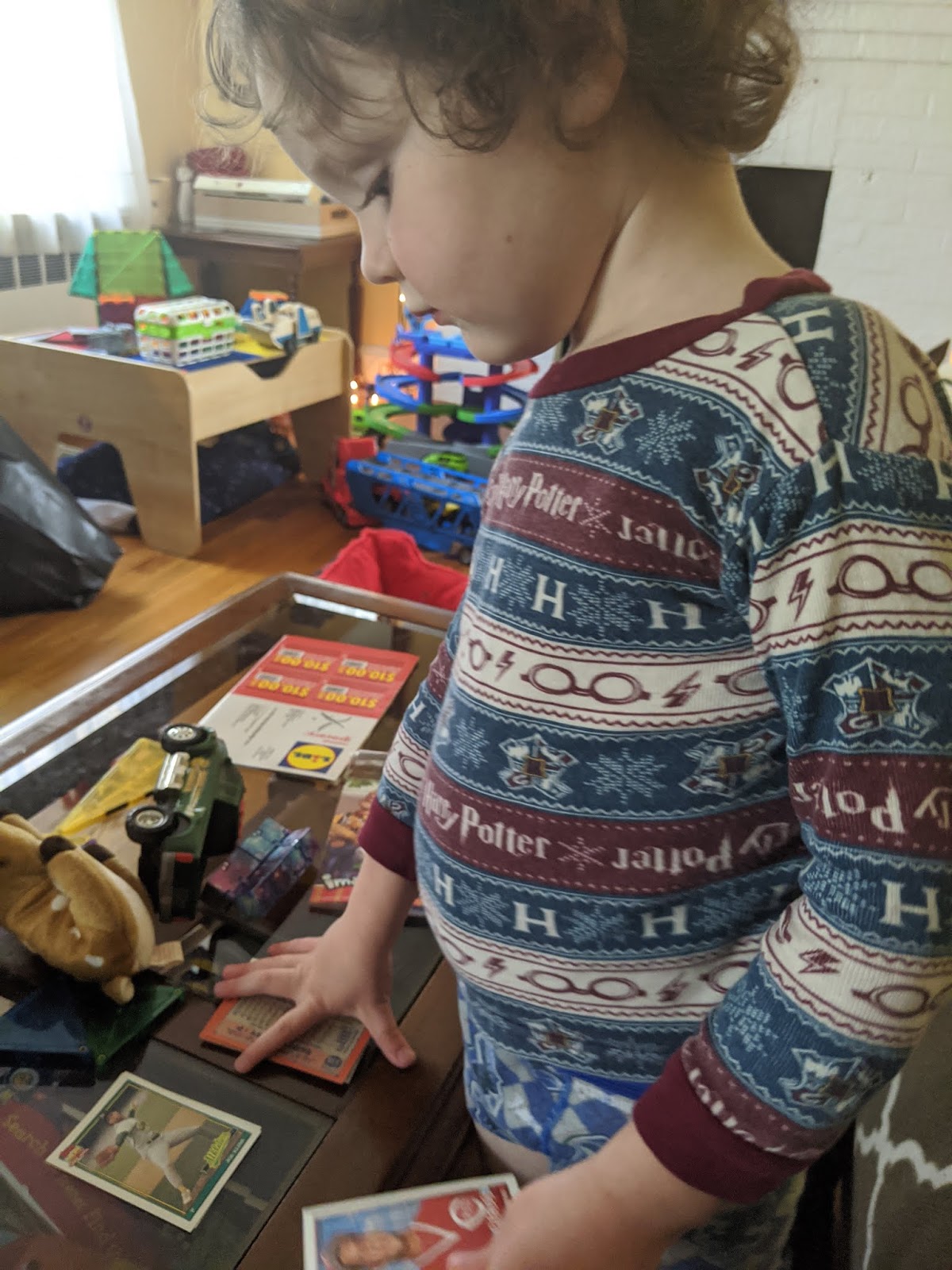
I was hoping he'd pull at least one Oriole from the pack, but nada. Not even Ron Kittle, with his .498 OPS and his "What did I just step in?" facial expression. He did get a couple of guys who played for the O's at other points in their careers: Phil Bradley, who had just been traded from Baltimore to the White Sox for Kittle in the previous season, and future Hall of Famer and 1994's All-Star closer, Lee Smith. Finn also pulled a couple cards of journeyman pitchers with all-time fun names: Paul Assenmacher and Joe Klink. I don't think he's caught the collecting bug just yet, but that's probably just as well. There's enough of his stuff spread all over the floors of our house right now.
Monday, March 30, 2020
Ron Kittle, 1991 Topps #324
I was hoping he'd pull at least one Oriole from the pack, but nada. Not even Ron Kittle, with his .498 OPS and his "What did I just step in?" facial expression. He did get a couple of guys who played for the O's at other points in their careers: Phil Bradley, who had just been traded from Baltimore to the White Sox for Kittle in the previous season, and future Hall of Famer and 1994's All-Star closer, Lee Smith. Finn also pulled a couple cards of journeyman pitchers with all-time fun names: Paul Assenmacher and Joe Klink. I don't think he's caught the collecting bug just yet, but that's probably just as well. There's enough of his stuff spread all over the floors of our house right now.
Monday, March 2, 2015
Jeff McKnight, 1991 Topps #319
Thursday, November 14, 2013
Frank Robinson, 1991 Topps #639
There have been 11 1-0 final scores in postseason history with the only run scoring on a solo home run. Of those 11 games, four involved the Orioles. The bad news first: Sal Bando's round-tripper against Jim Palmer in the top of the fourth inning delivered Game Three of the 1974 ALCS to the Athletics. 23 years later, Tony Bleeping Fernandez took Armando Double-Bleeping Benitez deep in the top of the 11th to help the Indians wrap up both Game Six of the 1997 ALCS and the series as a whole.
But of course, there's good news in the form of astounding happenstance. The O's won their other two solo-homer-only 1-0 contests in postseason play...and they did it on back-to-back days. On October 8, 1966, Paul Blair touched 'em all against Los Angeles pitcher Claude Osteen in the bottom of the fifth inning. Wally Bunker six-hit the Dodgers, and the Birds took a three-games-to-none World Series lead. The following day (October 9, 1966, if you're not good with numbers), it was deja vu all over again. This time the instant offense came from Frank Robinson, against Don Drysdale, in the home half of the fourth. Dave McNally was the beneficiary of Robby's largesse, as he dispatched L.A. on four hits and a couple of walks to complete the sweep. Occasionally I feel like I've mined all the material that I possibly could from Baltimore's most dominating Fall Classic effort, but it seems like there's always another remarkable fact or statistic to be mined. I hope that this guy doesn't think I'm picking on him and his favorite team, especially since the events of October '66 took place before I was born and before he was even rooting for the boys in blue.
Monday, January 7, 2013
Tim Hulett, 1991 Topps #468
If you think that I just opened up Tim Hulett's Baseball Reference page because it's been a slow news day/month/offseason for the O's...you're right. Have a cookie.
Wednesday, August 8, 2012
Dave Johnson, 1991 Topps #163
In a delicious bit of cosmic alignment, Dave's son Steve is being called upon as the Orioles' emergency starter tonight at Camden Yards. Though he debuted in Baltimore with a two-inning relief outing on July 15, the 24-year-old rookie will be making his first big league start in Charm City against Kevin Millwood and the Mariners. His promotion was necessitated by last night's marathon 14-inning win, the 12th straight in extra frames for the absurdly resilient and fortunate O's. Tonight's scheduled starter Tommy Hunter was not used, but did warm up in the 14th in the likely event that he'd be needed. That's how we've arrived at a landmark moment for Steve Johnson, whose hometown team looks to keep pace in the tightly-packed American League wild card race after pulling into a three-way tie with the Athletics and Angels early this morning.
I've given up worrying about the return to Earth. It may still come. But with every weird bounce of the ball, every heroic play by a replacement-level guy, every nail-biting and run-differential-confounding win, this season gets funnier and more delightful. I'm trying not to lose sight of that. All that I can do is laugh.
Thursday, March 29, 2012
Dave Gallagher, 1991 Topps #349
Sunday, May 22, 2011
Rene Gonzales, 1991 Topps #377
Sure, I'm being facetious. By the end of the season I would certainly expect Vladi to have more home runs as an Oriole than Steve Barber, Mike Cuellar, Larry Haney, and Marv Throneberry. But as much fun as it's been watching the former Expos slugger slash line drive singles all over the place, the homers have been missing in action. I watched with increasing frustration as Nationals starter Jordan Zimmermann shut down the O's for six innings this afternoon, yielding only a walk and a Mark Reynolds double. The young pitcher had set down 13 in a row before Nick Markakis led off the seventh with a single. That allowed Guerrero to step to the plate representing the go-ahead run in a 1-0 game. A home run would be nice, I thought, but I quickly lowered my expectations as Vlad took a couple of wild hacks to fall behind 0-2. I would have been even less optimistic if I had realized that the designated hitter hadn't left the yard yet in the month of May. But a moment later, he roped a 76-mph curveball from Zimmermann four rows deep in the left field box seats to put the Birds ahead 2-1. That would be the final, as Koji Uehara and Kevin Gregg each tossed a scoreless inning of relief to seal the win and give Baltimore the three-game series over the Nats.
Thanks for the power surge, Vlad. Feel free to make it a habit.
Sunday, April 19, 2009
John Mitchell, 1991 Topps #708
Only the most die-hard O's fans might remember John Mitchell, who pitched 24 games for the team in 1990 (6-6, 4.64 ERA). I've posted this card because he was born in 1965, the same year that Michael Francis "Mick" Foley came into this world. Whereas Mitchell's major league career ended after that 1990 season (and his pro career ended eight years later), Foley is still a somewhat active athlete, in a much different arena. Today, I'm taking a bus trip from Baltimore to Philadelphia to see the three-time WWF World Champion (and New York Times best-selling author) compete in a steel cage match at TNA's Lockdown pay-per-view event.While most rational adults roll their eyes at professional wrestling, you'd be surprised at the physical toll that it takes on a person's body. Sure, the match outcomes are pre-determined and many of the moves are designed to look more painful than they actually are, but it's the cumulative effect of the matches that breaks down a performer's body. The canvas mat is not exactly a mattress, and falling on it fifteen times a night, for five or six nights a week, 52 weeks a year, adds up. Aside from that, accidents happen. These guys are much more than "phony actors", or any of the other derogatory phrases that are hurled their way.
It's amazing to me to think about the physical conditioning that it must take for a 43-year-old like Mick Foley to do his thing at a high level, and his opponent, Steve "Sting" Borden, is even older (having just turned fifty last month). I'm very excited, because Foley is one of my personal favorites and I've never seen him wrestle live. I'm appreciative of the opportunity, even while I fight the nagging doubts in the back of my head that somebody his age with four children at home should be risking his health. That's the daily dilemma of a wrestling fan.
Wednesday, January 23, 2008
Mickey Tettleton, 1991 Topps #385

Today we have Baltimore's own version of the Mick: he of the towering home runs, the incredible walk totals, and the legendary love of Froot Loops. He was also, like Rafael Palmeiro, a part of the impressive guest cast of the film Little Big League. Mickey is one of the more villainous major leaguers in the movie; in Billy Heywood's first game as manager of the Twins, they drop a home game to the Tigers. Tettleton is playing catcher, and as he snags a pop foul in front of the home dugout for the last out, he looks over at Billy and sneers, saying something to the effect of, "Welcome to the Big Leagues, kid".
Though he was kind of a jerk on screen, I think this card best represents Mickey as most fans remember him. The powerful Oklahoman with a cheek stuffed full of chaw, grinning boyishly. By the time this 1991 Topps set rolled out, he was gone from Baltimore. The day after the O's infamously traded for Glenn Davis, they sent a catcher one year removed from a 26 home run performance (who had just walked 106 times in an otherwise down year offensively) to Detroit for Jeff M. Robinson and his 5.96 ERA. All Mickey did was hit 30-plus home runs in four of the next five years. The winter of 1990-1991 didn't exactly represent Roland Hemond's finest hour as a GM.
I want to take a moment to talk about some of the movies I've discussed this week. None of them could be considered classics in the conventional sense. There is no Field of Dreams, no Eight Men Out, no A League of Their Own in this crop. They're all goofy comedies, some intended for children. But I saw them all as an impressionable, baseball-mad adolescent, and they hold a sentimental value for me, much like the cards I've discussing each day. So whether they're good or just so-bad-that-they're-good, I just can't help but put the remote down when I find one of them playing on TV.