Showing posts with label 1960 topps. Show all posts
Showing posts with label 1960 topps. Show all posts
Friday, January 8, 2016
Vintage Fridays: Willie Tasby, 1960 Topps #322


Friday, August 21, 2015
Vintage Fridays: Paul Richards, 1960 Topps #224

Friday, April 17, 2015
Vintage Fridays: Rip Coleman, 1960 Topps #179

Friday, March 13, 2015
Vintage Fridays: Bob Mabe, 1960 Topps #288

Friday, July 11, 2014
Vintage Fridays: Barry Shetrone, 1960 Topps #348

Answer: They were both born in Baltimore, and played for the hometown Orioles. Of course, the Bambino played for the International League team, and Barry played for the American League club that we all know and love. Also, Barry finished his illustrious 60-game big league career 713 home runs shy of Ruth's one-time record. Details, details.
Barry Shetrone's rookie card is the flimsy pretense I'm using to talk about Babe Ruth on this, the 100th anniversary of the Sultan of Swat's major league debut. Two days earlier, the Red Sox had purchased the contracts of Ruth and pitcher Ernie Shore and catcher Ben Egan from the minor-league Baltimore Orioles for a sum of over $25,000. On Saturday, July 11, 1914, 19-year-old George Herman Ruth took the mound at Fenway Park to face the Cleveland Naps (known today as the Indians). He earned the win by limiting the visitors to three runs (two earned) on eight hits, while striking out a single batter and walking none. He was hitless in two trips to the plate, and was actually removed in favor of pinch hitter Duffy Lewis, who singled and took over in left field for Olaf Henriksen the next inning. Dutch Leonard earned the save by relieving Ruth and tossing two spotless innings, as Boston prevailed 4-3 in an hour and 33 minutes. The Babe appeared in only five games for the BoSox in 1914, four as a pitcher and one other as a pinch hitter. He became a more regular fixture in the following year, going 18-8 with a 2.44 ERA in 32 games on the bump (he also completed 16 of his 28 starts) and batting .315/.376/.576 in 103 plate appearance with the first four homers of his career. I wonder how many of the fans in attendance at Fenway on that Saturday afternoon in midsummer realized that they were witnessing history.
Friday, November 15, 2013
Vintage Fridays: Johnny Powers, 1960 Topps #422

Friday, October 26, 2012
Vintage Fridays: Gordon Jones, 1960 Topps #98

I'm not necessarily rooting for Jones' Giants in this year's World Series, but I'm not rooting against them either. I'd just like to see the Tigers get a chance to celebrate for the first time since Sparky Anderson's 1984 powerhouse. Most importantly, I hope it's a long and competitive Fall Classic. How about you?
Friday, December 9, 2011
Vintage Fridays: Billy Klaus, 1960 Topps #406

Saturday, March 19, 2011
Vintage Fridays: Harry Brecheen, Lum Harris, Eddie Robinson, 1960 Topps #455

This trio represents manager Paul Richards' brain trust. At bottom left is Harry "the Cat" Brecheen, so nicknamed for his dextrous fielding of bunts during his pitching days. The southpaw won 133 games for the Cardinals and the Browns in parts of 12 seasons with a 2.92 career ERA. He retired in 1953 and soon caught on as Baltimore's pitching coach, spending more than a decade advising younger hurlers such as Milt Pappas, Steve Barber, Billy O'Dell, and Jerry Walker.
To Harry's right is Chalmer Luman "Lum" Harris, 1940's Athletics and Senators pitcher. He was not Brecheen's equal on the mound, walking more batters than he struck out overall and leading the American League with 21 losses in 1943. He had made Paul Richards' acquaintance during the pair's minor league playing days, and they had a close working relationship for the next thirty-plus years. Harris was on Richards' staff for the latter's seven seasons with the O's, often coaching third base. When the skipper resigned in late 1961 to take the general manager's job for the expansion Houston Colt .45s, Lum managed the Birds on an interim basis. The following season, he was hired as a coach in Houston. Richards later gave him managerial posts with the Colts (now known as the Astros) and Braves.
Lastly we have Eddie Robinson, a former power-hitting first baseman and four-time All-Star who played with 7 teams in 13 seasons, chiefly the White Sox. His career wrapped up with a four-game cameo for the 1957 Orioles. He then went straight to the team's coaching staff, and was briefly promoted to a player development system before Richards also poached him to Houston and later Atlanta. He worked as a farm system director and eventually replaced his ex-boss as Braves general manager. Eddie did a turn as Rangers' GM as well.
Contrary to what this card might lead you to believe, Brecheen, Harris, and Robinson were not in fact floating disembodied heads. At least I don't think they were.
Friday, February 11, 2011
Vintage Fridays: Gene Woodling, 1960 Topps #190

That day, a 30-year-old man named Ernie Tyler worked his first game as the Orioles' umpire's attendant. He had been an usher at Memorial Stadium since the team debuted in Baltimore in 1954. In his new role, he would work each and every O's regular season and postseason game (as well as an All-Star Game and a few assorted exhibitions) through July 27, 2007. He only deigned to take a day off when Cal Ripken, Jr., a man with a similar work ethic, requested his presence at the shortstop's Hall of Fame induction ceremony. Tyler worked 3,819 consecutive home games in all. Though he encountered health problems in the subsequent years, he was still working for the club through the 2010 season.
Sadly, Ernie passed away at age 86 last night. He had been in a long-term care facility in North Baltimore since December, when he began rehabilitation after having a benign brain tumor removed in October. If you doubt the impact that Tyler had on the fans, players, coaches, and anyone else associated with the Orioles, just stop by the websites of the Baltimore Sun or MASN. The remembrances are pouring in from all over: Cal Ripken, Brian Roberts, Dave Trembley, and Jeremy Guthrie, and of course the various Sun and MASN reporters. The Orioles and the city have lost a great man and a living embodiment of the team's history. If you're interested, you can find out how to pass along your sympathies to Ernie's family and friends here.

I previously wrote about Tyler after spotting him on a Charles Johnson card, and lamented that he'd never been recognized with a card of his own. Fellow blogger Steve of White Sox Cards was kind enough to put together a custom card for the occasion, so I'll pay tribute by posting it now. Thanks for always being there, Ernie.
Friday, December 24, 2010
Vintage Fridays: Walt Dropo, 1960 Topps #79

I'd like to wish a Happy and healthy Christmas to all who celebrate it. I hope that you are spending the day with loved ones, and thinking of those who are no longer with you. Unfortunately one of the departed is former Orioles first baseman Walt "Moose" Dropo, who passed away a week ago at age 87. I talked a bit about his amazing rookie season and his embarrassing moments on Walt Dropo Day in one of my earliest Vintage Fridays entries. The only things that I'd like to add:
1) I'm glad to see that his grandchildren still sponsor "Grampie Walter"'s Baseball Reference player page. I'm sure he'll be missed.
2) Since Walt was playing out the end of his career by the time he became an Oriole, I wanted to call attention to one of his great games in Baltimore. On July 4, 1959, he went 3-for-5 with three runs scored, two homers, and four RBI as the Birds beat the Red Sox 11-5. His two-run home run in the second inning gave the O's a lead they wouldn't relinquish.
Rest in peace, Walt.
Friday, October 22, 2010
Vintage Fridays: Hoyt Wilhelm, 1960 Topps #115

In May 2009, I told you about ageless knuckleballer Hoyt Wilhelm's run of dominance against New York. I'll elaborate now by giving you his career numbers vs. the Yanks, which are almost as impressive. Hoyt faced the Bronx Bombers 75 times in all, including 13 starts. He won only 9 of 20 decisions, but totaled six complete games and three shutouts. He racked up 209.1 innings, his most against any opponent, yet his 1.98 ERA and 1.01 WHIP against the Yankees were lower than his marks against almost any other club. In 67 career meetings with Mickey Mantle, he frustrated the slugger to the tune of a .192 average and .327 slugging percentage. Other New Yorkers that Wilhelm handled easily include Bobby Richardson (.403 OPS), Elston Howard (.371 OPS), Tony Kubek (.446 OPS), Tom Tresh (.250 SLG), and Roger Maris (.154 AVG). So it's safe to say that the old knuckler wasn't easily intimidated.
Roy Face never actually faced the Yankees in the regular season, as all but two of his career games were as a National Leaguer. However, he played a prominent role in one of New York's most memorable postseason series defeats. In the 1960 World Series, Face's Pirates squeaked by the Yanks in seven games despite being outscored 55-27 overall. As you may have guessed, they prevailed in some tight games, and leaned heavily on their relief ace to do it:
-In Game One, he relieved Vern Law in the eighth inning with Pittsburgh ahead 6-2. He stranded two inherited runners, but surrendered a two-run homer to Elston Howard in the ninth. Tony Kubek followed with a single to bring the tying run to the plate in the form of Hector Lopez. Face coaxed a game-ending double play ball to earn the save. The Yankees blew out the Pirates in the next two games, but the Bucs clung to a lead in the seventh inning of Game Four. Law ran into trouble again, and Roy got the call with one out and the go-ahead runs on base. He set down the final eight batters for another save. The next day was nearly the same situation. 4-2 Pirates in the seventh, Harvey Haddix puts two runners on with one out, Face is summoned, allows only a walk in 2.2 scoreless, save number three. New York romped again in Game Six to set up a winner-take-all Game Seven. For the third time, Face was called upon to preserve a Vern Law lead. This time it was the sixth, and Pitt led 4-1 with two on and none out. This time he was not sharp, surrendering the lead via a Mickey Mantle single and a three-run Yogi Berra homer. He got through the seventh unscathed, but was touched up for two more runs in the eighth and left his team in a 7-4 hole. You probably know what happened next. Five-run Pirates rally, Yanks fight back to tie it, Bill Mazeroski walks 'em off in the bottom of the ninth. The Bucco bats really let Face off the hook, so all is well that ends well.
Up-to-the-moment status: 5-1 Rangers after six. Cautiously optimistic.
Tuesday, July 27, 2010
Vintage Tuesday: Jim Gentile, 1960 Topps #448

Vintage Tuesday, you ask, eyes agog? That's right...some rules are made to be broken. But don't worry; Vintage Fridays will continue this week and every week. This is a one-time thing. Onward...
It may have taken 50 years, but Jim Gentile has been vindicated.
You may remember 1961 as the year that "Diamond Jim" made a run at the American League's Most Valuable Player Award by finishing fifth in batting average (.302), third in on-base percentage (.423), third in slugging (.646), third in home runs (46), and second in runs batted in (141). All those gaudy numbers and nothing to show for it. It's a shame he couldn't have eked out just one more RBI to catch league leader and MVP winner Roger Maris, isn't it?
Hold the phone.
The Society for American Baseball Research (SABR)'s Records Committee has discovered that an extra RBI was erroneously given to Maris on July 5. It has been determined that his total should have been 141, not 142, and therefore SABR, the Elias Sports Bureau, and the various online baseball encyclopedias are now acknowledging Gentile as the co-RBI leader of the American League for the 1961 season. You can read all about it on the Baseball Reference Blog.
Congratulations, Jim! It's not every day that a 76-year-old wins an RBI crown.
Friday, August 14, 2009
Vintage Fridays: Albie Pearson, 1960 Topps #241
 I've featured some of the larger players in Orioles history, but never the smallest. Listed at 5'5" and 141 pounds, Albie Pearson (referred to as "little Albie" on this card back) was four inches shorter and thirty pounds lighter than Brian Roberts, who I tend to think of as a tiny sprite of a man as far as modern-day players go. He is a full foot shorter and 180 pounds lighter than Walter Young (the heaviest all-time Oriole), and sixteen inches shorter than current O's reliever and former NBA player Mark Hendrickson. But you get the point. In spite of his size, Albie was the 1958 Rookie of the Year with the Senators and played in the majors for nine seasons, hitting .270 with a .369 on-base percentage. So hats off to him.
Oh, and FYI - the gentleman in #24 who is standing behind Albie is pitcher Arnie Portocarrero, who was 6'3" and 196 pounds. Pearson was probably grateful that he was standing so deep in the background when this photo was taken.
Friday, April 24, 2009
Vintage Fridays: Chuck Estrada, 1960 Topps #126
 Chuck Estrada is a name that gets lost in the shuffle of Orioles lore. Among his contemporary "Baby Birds", the big name was Milt Pappas, but Steve Barber and Jerry Walker also loomed large. By the time the O's were finally ready for prime time, Wally Bunker, Dave McNally, and Jim Palmer were the fresh faces and homegrown arms. But for a few years, Estrada seemed primed to go toe to toe with them all.
In 1960, the righthander from California was 22 years old and was thrust into the rotation as a rookie. He responded by tying Jim Perry for the American League lead in wins (18) and allowing fewer hits per nine innings (7.0) than any other junior circuit pitcher. He completed 12 games and notched a 3.58 ERA. Together with Walker, Pappas, Barber, and Jack Fisher, he gave manager Paul Richards five promising moundsmen - all 22 or younger. Estrada was the best, making the All-Star Team and being named The Sporting News' Pitcher of the Year. Despite these accolades, he was a distant second behind O's shortstop Ron Hansen for Rookie of the Year honors. Baltimore first baseman Jim Gentile was the only other A.L. player to receive a vote. (Is it any wonder they jumped from 74 to 89 wins that year?)
Chuck defended his H/9 crown in 1961, lowering the mark to 6.8. At 15-9, he had less wins but a slightly better win percentage. His 3.69 ERA represented only a handful of extra runs allowed over an entire season, pretty remarkable considering that his 132 walks led the league. But the cracks in the armor appeared the next year. At 3.83, he had his first below-average ERA. Of greater concern were his league-worst 17 losses, against just 9 wins. Of course, his run support was lousy: the Birds scored three or less runs for him in 20 of his 33 starts, and tallied an average of 3.38 runs per start. Sadly, it would be his last healthy season.
Despite the popular conception that Paul Richards babied his young pitchers (Milt Pappas in particular), the stats tell a different story. In Estrada's case, he threw over 200 innings in his first three seasons, all before the age of 25. That's a total of 644 frames. Elbow injuries cropped up in 1963, and from that season until his retirement in 1967 he racked up only 120.1 innings. His earned run average climbed each year, from 4.60 to 9.41, and his career was over at 29.
So the next time you hear about how much more durable pitchers were in the good ol' days, just remember that there were still plenty of casualties.
Friday, January 23, 2009
Vintage Fridays: Jack Fisher, 1960 Topps #46
 Jack Fisher had a knack for giving up historic home runs. During his playing days he was known as "Fat Jack", but as you can see from the three-quarters' photo at left, that was a tongue-in-cheek moniker, as some of the best ones are. Of course, it could also refer to the "fat" pitches that he offered up from time to time. It wasn't as though he had an exceptionally high gopher ball rate; with 193 HR in 1975+ innings, he surrendered less than one clout per nine innings. He just allowed opposing hitters to get the best of him in memorable situations. To wit:
-September 28, 1960, Fenway Park, Boston, MA. 41-year-old Ted Williams is playing in his last game, having previously announced that he will not accompany the Red Sox on their final road trip to New York. Fisher enters the game in the first inning in relief of Steve Barber and inherits a 2-0 deficit. The Orioles rally to take a 4-2 lead as Jack blanks the BoSox into the eighth inning. With one out in the frame, the Splendid Splinter steps to the plate. His rookie season was 1939, the year of Fisher's birth! The lanky righty fires a strike past Williams, and makes the mistake of thinking that he can do so again. His second pitch is walloped to deep center field and over the fence for Ted's 521st career home run, in his last at-bat. In the ninth inning, Fisher would be hung with the loss after second baseman (and ex-Bostoner) Billy Klaus threw away a potential game-ending double play ball.
-September 26, 1961, Yankee Stadium, Bronx, NY. Almost a year to the date of the Williams homer, Fat Jack does it again. The baseball world has been captivated all season long by the M and M boys, Mickey Mantle and Roger Maris, and their twin pursuit of Babe Ruth's hallowed single-season home run record. The Mick had been slowed by injuries and would finish the year with 54 dingers. With five games left in the season, Maris was stuck on 59, one short of the mammoth mark. There wouldn't be much waiting around this time: in the bottom of the third inning with the Birds up 2-0, Roger belted a two-out solo home run to right field for the big six-oh. Once again, Fisher lost a one-run game in agonizing fashion, with center fielder Jackie Brandt dropping a Hector Lopez fly ball in the seventh inning to allow the eventual winning run to score. 3-2, Yankees.
-April 17, 1964, Shea Stadium, Flushing, NY. Three seasons later, Fat Jack took the mound on Opening Day for the woeful Mets. It also happened to be the inaugural game at the team's brand new stadium. In the top of the second in a scoreless game, the righthander served up a leadoff home run to Pirates left fielder Willie Stargell. It was the first roundtripper ever hit in Shea. Though the Mets lost 4-3, Fisher was not charged with the loss. Coincidentally, one of Fisher's teammates that season was Tracy Stallard, who gave up Roger Maris' record-breaking 61st home run in 1961.
So there you have it. Jack Fisher was on the receiving end of home run history several times...or maybe that should be the giving end.
By the way, any guesses as to who hit the most home runs off of Fat Jack?
That would be Hank Aaron, who blasted six of his 755 circuit clouts off of the poor guy. Go figure.
Friday, August 22, 2008
Vintage Fridays: Hoyt Wilhelm, 1960 Topps #395
 A week ago Thursday, I was driving down the mountain with my father to catch a Scranton/Wilkes-Barre Yankees vs. Lehigh Valley IronPigs game at PNC Field (the former Lackawanna County Stadium, a name I will always prefer). We were nearing the end of our weeklong vacation, and I was a bit surprised when Dad asked me a question.
"Did you want to go to Cooperstown tomorrow?"
I had made an offhand comment to my mother earlier in the week that I hadn't been to the Baseball Hall of Fame since our family trip in the summer of 1995. I suppose it had come to mind because our cottage in Northeastern Pennsylvania is about two and a half hours south of Cooperstown, which is generally as close as I get to the apocryphal birthplace of baseball. I wasn't exactly asking to go, but it might have been a subconscious request. So I told Dad that I'd like to go, and the next morning we set off on a thoroughly monotonous drive up I-81 to I-88, the latter of which we stayed on for 60 mind-numbing miles before exiting onto Route 28. The one landmark that stuck in my mind was the signboard outside of a small church near our destination: "GOD IS THE POTTER, NOT HARRY". It referenced a passage from the book of Isaiah, which I'd assume is the one about mankind being roughly akin to a lump of clay. I wonder if there are books or websites that the ministers and their staffs pull these semi-clever marquees from.
One of the major impressions that Dad and I both drew from our second visit to baseball mecca was just how little the exhibits had changed since our initial trip thirteen years ago. Sure, there was some new stuff, like an excellent art gallery that could probably be expanded, and a great statue of Buck O'Neill near the entrance. But for the most part, the three-story building on Main Street is as timeless as the National Pastime itself. I did make it a point to photograph nearly every piece of Orioles memorabilia that I came across, and as such I got a few snapshots related to the wily, mean-looking gunfighter pictured above, reliable knuckleballer Hoyt Wilhelm. His bronze plaque in the Hall of Fame members' gallery was a no-brainer, even though he's pictured with a New York Giants cap.
 As you can see above, it makes particular mention of his no-hitter against the Mickey Mantle-led Yankees on September 20, 1958. I of course took a special joy in being reminded of one of the greatest feats in the decades of battle between my favorite team and the Evil Empire from New York. This no-hitter was referenced in a few other places, including a display of White Sox items from the mid-20th century that had a Wilhelm jersey from his Pale Hose days. There was also the brightly-colored display commemorating all complete-game no-hitters since 1936 (I assume that's because the Hall was founded that year and started collecting memorabilia) with a game ball from each separate performance. In the picture below, Hoyt is wedged between former Dodgers headhunter Sal "The Barber" Maglie and former Braves star Lew Burdette.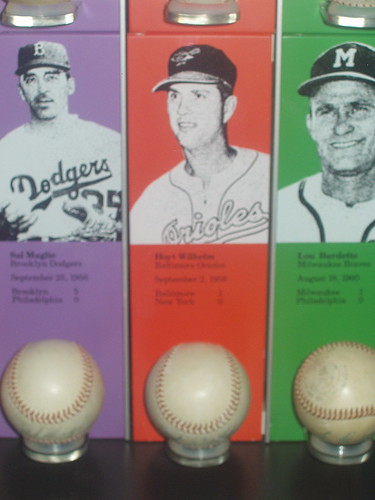
Surprisingly, I declined to pick up any baseball cards while I was in Cooperstown. This was mostly because it was after 4:00 when we finished sightseeing and there was homemade lasagna waiting for us at the cottage. There wasn't really much time for shopping. I did take time to gawk at all of the baseball cards displayed at the Hall, of course, especially the old tobacco cards (which includes a copy of the famous Honus Wagner, labeled as "the Holy Grail" of card collecting). Heck, I even posed for my very own Cracker Jack card! I'm off to cheer on the Birds against those Yankee invaders, and I need to get a head start if I'm going to properly welcome Mike Mussina back to Baltimore. So I'll leave you with the next hot chase card in collecting circles.

Friday, January 11, 2008
Vintage Fridays: Arnie Portocarrero, 1960 Topps #254

What's in a name? Sure, many of the pitching greats in baseball history didn't have names that struck fear in their opponents. Christy. Walter. Cy. Hell, even Nolan Ryan's first name was "Lynn". But those names still had a certain ring to them. If you ever take a trip to Cooperstown, chances are good that you won't find any Arnies in among those bronze plaques.
Nope, Arnie is a name that I associate with slow children. But I have to admit that half the enjoyment that I derive from owning this card comes from the name, writ large in alternating yellow and white block letters: Arnie Portocarrero. It doesn't make you think of pitching mastery, but it rolls off the tongue and is good for a laugh.
But what does it mean? Well, first of all, it's Italian, I'm guessing; Arnie was born Arnold Mario Portocarrero in New York, NY. In Italian, "Porto" designates a person who lives near the harbor. As for "Carrero", the nearest name I could find was "Carrara", which is the famous "city of marble" in Tuscany, or perhaps another town near Padova that bears the same name. So, he's Arnold, from a town near the harbor in Italy. Not terribly exciting.
Then again, "Arnold" is German in origin, and means "Strong as an Eagle". That's more like it.
Besides, who am I to talk? My last name means "Bread maker".
Subscribe to:
Posts (Atom)