Orioles Card "O" the Day

An intersection of two of my passions: baseball cards and the Baltimore Orioles. Updated daily?
Showing posts with label 1974 topps. Show all posts

Friday, January 19, 2018

Vintage Fridays: Boog Powell, 1974 Topps #460

One of the things that I've missed most during my recent blogging hiatus is the Vintage Fridays feature. It has been nine months since I've featured a pre-1981 card on this site, and it is my firm belief that old cards are the best. So let's make things right with good old Boog, and recap my most recent meeting with the 1970 American League MVP.

As I recently mentioned, I celebrated my 35th birthday last August 5 with a family trip to Oriole Park at Camden Yards. There were four of us in all - my sister, my wife Janet, our son Finn, and myself. The O's were kind enough to give out Jonathan Schoop bobbleheads for the occasion. After we collected our freebies, we headed down Eutaw Street for some pit beef. As is often his wont, Boog Powell was holding court in front of his eponymous barbecue stand, seated on a tall chair with an umbrella for shade. I couldn't pass up a photo op on my special day, so we waited in Boog's line before getting our sandwiches. Number 26 was gracious as always, and even tried to give Finn a high-five. Unfortunately, my baby boy had stopped paying attention by that point. But before he lost interest, we did get this excellent picture.
It's not really apparent from the photo, but I was wearing my Danny Valencia game-worn jersey...because he was #35 during his 2013 stint in Baltimore. And because you're probably wondering, yes, Finn enjoyed the pit beef. We're trying to raise him right.

Friday, August 28, 2015

Vintage Fridays: Tommy Davis, 1974 Topps #396

Sometimes baseball is fun, like a miscut 1974 Topps card featuring Tommy Davis swinging from the heels, showing off his sharp sideburns and his high, striped orange-and-black-and-white stirrups for the home crowd on a sunny afternoon in Baltimore. But then again, there are times like August 2015, when most Orioles fans are enjoying baseball about as much as a drab gray 1989 Fleer Terry Kennedy card. But I'm engaging in a bit of therapeutic activity tonight in the aftermath of the Birds' ninth loss in 11 games. Vin Scully has just announced that he will be returning to the Dodgers' broadcast booth for a 67th season in 2016 ("God willing," he says), so I'm watching Los Angeles host the Cubs on MLB Network with one of sport's greatest treasures calling the action. Even when it's awful, baseball can be better than most things.

Friday, December 5, 2014

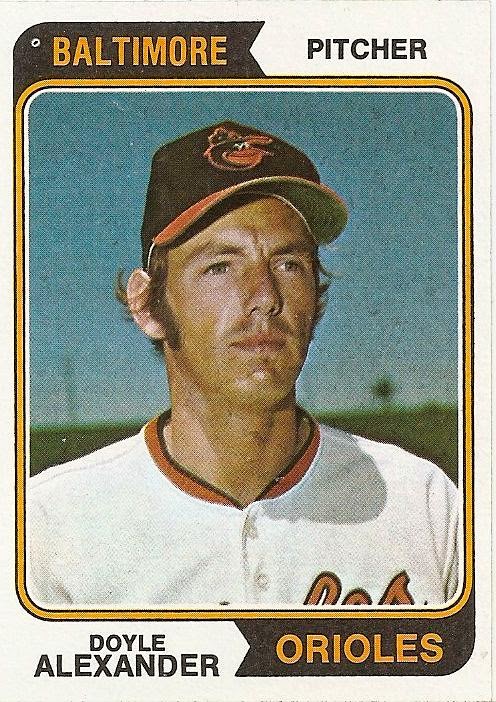
Vintage Fridays: Doyle Alexander, 1974 Topps #282

Those are some pretty choice sideburns on Doyle Alexander, but I still prefer him with the 'stache.

Friday, November 7, 2014

Vintage Fridays: Mark Belanger, 1974 Topps #329

Mark Belanger wonders why all of the old Topps photos from Yankee Stadium were shot on the third-base side. He also probably wonders why they snapped so many pictures of him holding a bat, when his glove is what kept him gainfully employed in the major leagues for 18 seasons. There's no accounting for the quirks of Topps, I suppose.

Friday, October 24, 2014

Vintage Fridays: Rich Coggins, 1974 Topps #353

This is a card that I intend to upgrade some day, especially since I intend to complete the 1974 Topps base set. You can see the shmutz (technical term) on the left border, and the print is a bit out of focus. I've been staring at the card, and I still can't tell whether it's miscut or if I just scanned it crooked. Like most things in life, a baseball card collection is forever a work in progress.

In 1974, Rich Coggins must have felt as fuzzy as he looks on this card. A year earlier, he had batted .319/.363/.468 (134 OPS+) in 110 games as a 22-year-old rookie. His nine triples were second on the club only to fellow rookie Al Bumbry's 11. He was also the Orioles' first runner-up to Bumbry (.337) in batting average. But the hits didn't fall in for Coggins as a sophomore. He had a brutal April (.154/.241/.250), and things didn't get a whole lot better from there. Aside from a .354 average in July, the outfielder didn't bat above .250 in any single month. He finished the year at .243/.299/.319 (81 OPS+), which didn't really cut it. The year ended on a particularly sour note for Coggins, as he took an 0-for-11 collar in the team's ALCS loss to the Athletics. He did steal 26 bases in 32 tries, combining with Don Baylor and Paul Blair to give the O's a trio of outfielders with at least 26 steals apiece. But Rich wouldn't get a chance to reverse his fortunes in Baltimore, as the Birds shipped him north to Montreal with Dave McNally in exchange for Mike Torrez and Ken Singleton.

As bad as 1974 seemed for Coggins, things were worse beyond Charm City. His major league career had only two more seasons and 103 games left to it, as he compiled a measly .498 OPS (43 OPS+) for three teams. I've read that a thyroid condition was to blame for his abbreviated and downward-trending career. How frustrating it must have been to be robbed of his livelihood at age 25.

Friday, August 15, 2014

Vintage Fridays: Earl Weaver, 1974 Topps #306

This is a momentous day in Orioles history, though really, aren't they all? With 60 years of history to choose from, there's always something to celebrate or lament. On August 15, 1975, Earl Weaver managed to get ejected from both ends of a doubleheader for the first time. He'd repeat the feat twice more in his Hall of Fame career.

It was a Friday twinbill at Memorial Stadium. Things didn't go well for the Birds in the opener, as Mike Torrez was chased in the third inning. Wayne Garland allowed a few inherited runners to score, putting the home team in a 5-0 hole. The visiting Rangers scored a sixth run in the fourth inning on an odd play. First base umpire Ron Luciano, a longtime Weaver nemesis, initially called Jim Spencer out at first to complete a would-be double play. Then Luciano quickly reversed himself, ruling that first baseman Tony Muser failed to touch the bag. Cesar Tovar scored from third base, and Earl had a conniption and earned an early shower. The O's rallied to tie the game in the bottom of the seventh, but it was all for naught. Garland and Dyar Miller combined to allow four runs in the very next inning, giving Texas a 10-6 lead. That would be the final score.

Baltimore's skipper was still fuming when he brought out the lineup card before the second game, and he let Luciano know about it. Weaver insisted that the ump, who ejected him from a total of four minor league games and eight more in the majors, had a vendetta against him. Ron gave Earl more fuel for his fire, as he delivered a second heave-ho before the first pitch could be thrown in the nightcap! Fortunately, the Orioles salvaged a split by battering Texas 13-1. They pounded 18 hits off of Clyde Wright and Tommy Moore. Doug DeCinces homered, tripled, and drove in five runs. Lee May and Tommy Davis had three hits each. Mike Cuellar was the beneficiary, cruising to a complete-game, five-hit victory. It's a shame the manager wasn't around to see it.

Friday, July 4, 2014

Vintage Fridays: Mike Cuellar, 1974 Topps #560

On July 4, 1971, Mike Cuellar won his tenth straight decision with a complete game victory over the Tigers, 3-2. Cuellar and Detroit starter Joe Coleman each went the distance, allowing six hits apiece. But Coleman allowed a two-run homer to Boog Powell in the first inning and a leadoff shot to Elrod Hendricks in the sixth to make the difference. Cuellar kept the Tigers off the board until the bottom of the sixth, when Aurelio Rodriguez doubled and Tony Taylor singled him home. A Bill Freehan solo homer with one out in the ninth gave Detroit a glimmer of hope, but Cuellar snuffed that out by retiring the next two batters to finish off the game. He'd also win his next start on July 8 to improve to 13-1 before his luck evened out and he posted a 7-8 record in the second half of the season. Nevertheless, Mike wound up at 20-9 with a 3.08 ERA for the year, as the Orioles rotation boasted four 20-game winners en route to the American League pennant.

Friday, June 6, 2014

Vintage Fridays: Merv Rettenmund, 1974 Topps #585

Today is Merv Rettenmund's 71st birthday. Though I've featured a handful of his cards on my blog, I've written next to nothing about Merv himself. Mervin Weldon Rettenmund (there's a mouthful) is one of only three "Merv"s in major league history, and the only one to play in the post-World War II era. A Michigan native, he turned down a contract offer from the Detroit Tigers after high school and attended Ball State University on a football scholarship, breaking the school's single-season rushing record. Though he was drafted by the Dallas Cowboys, baseball was his preferred sport. He hit .321 at Ball State, and also earned a bachelor's degree in education. When the Orioles came calling in 1964, Merv signed on for a $15,000 bonus.

Rettenmund battered minor league pitching for four seasons before making it to Baltimore to stay. In 1968, he was the International League MVP. Competing at AAA for the first time, he hit .331 with an astounding .459 on-base percentage and a .588 slugging mark. He scored 104 runs and had 25 doubles and 22 homers in just 114 games with Rochester. His first major league home run was also the only walkoff blast of his career: a tie-breaking, pinch-hit two-run shot off of Oakland's Warren Bogle on August 27, 1968. The heroic feat came in his eighth career game and the fourth appearance in his second stint with the club that season.

It wasn't easy to crack the O's lineup in those days, so Merv was something of an outfield super-sub, rotating at all three positions and pulling pinch hit duty as needed. He was at his best for the 1970 World Champion Orioles, with a batting line of .322/.394/.544 and 18 home runs in 338 at-bats. Those numbers were boosted by a torrid second half in which he put up a .373/.452/.559 triple-slash. Despite those lofty numbers, he started only twice and had one other appearance as a pinch hitter in the 1970 postseason. Undaunted, the outfielder reached base five times in 11 tries overall and drove in two runs in the Birds' title-clinching 9-3 romp of the Reds in Game Five of the World Series.

In 1971, the Orioles were the class of the American League for a third straight year, and Rettenmund had a big hand in that. Playing in a career-high 141 games, he batted .318, trailing only Tony Oliva and Bobby Murcer for the AL crown. He drew 87 walks to boost his on-base percentage to .422, scored 81 runs and drove in 75, and earned a few down-ballot MVP votes. This time he appeared in all ten of Baltimore's postseason games and started nine of those. Although he batted just .200 (7-for-35) with an uncustomary lack of walks, his three-run homer off of Dock Ellis was the key hit in a 5-3 win in Game One of the Fall Classic.

Merv would never again reach the height of those prime years in Charm City, with injuries and batting struggles marking his final two seasons in orange and black. At age 30 he was traded to the Reds in the deal that brought Ross Grimsley to Baltimore. But the outfielder spent the latter years of his career as a pinch-hit specialist with the Padres and Angels, and in 308 trips to the plate over the 1977-1978 seasons he reached base at a .432 clip. After retiring in 1980, Rettenmund got right into coaching, embarking on a quarter-century of work as a highly-regarded batting instructor. The Oakland A's won the 1989 World Series under his tutelage, and during nine seasons as the Padres' hitting coach he worked with multiple-time batting champ Tony Gwynn. Currently Merv is enjoying a well-deserved retirement.

Friday, October 18, 2013

Vintage Fridays: Bob Grich, 1974 Topps #109

If anybody needs me today, I'm combing through a 3000-or-so-count box of well-used 1970s Topps commons on loan from my buddy Ed. In exchange for bits of American currency, he's allowing me to do some set-building. I've already got this card, which features Bobby Grich, baserunner Pedro Garcia of the Brewers, and a bunch of empty Memorial Stadium bleacher seats. But perhaps I can give it some company in my partially complete 1974 Topps binder. Everybody wins!

Friday, March 1, 2013

Vintage Fridays: Grant Jackson, 1974 Topps #68

Some stray observations:

1. Fashion-wise, today's ballplayers are missing out. When was the last time you saw a card with a player who had to flatten his hair to make his cap fit? I've always imagined that when Grant Jackson or Bake McBride (or yes, Oscar Gamble) took off their caps, their hair would spring back into shape. That might not be entirely true, but it's certainly one way in which life should be more like cartoons.

2. This is not even remotely the most badly miscut card in my half-completed 1974 Topps set. On a few, you can read a mismatched team name and position at the bottom. When you're grabbing from the dime boxes, there are no regrets.

3. Over Grant's right shoulder, there is an ad for milk. Over his left shoulder, there is an ad for Yoo-Hoo. That's kind of like an ad for Angus beef being juxtaposed with an ad for Spam.

Friday, July 15, 2011

Vintage Fridays: Al Bumbry, 1974 Topps #137

Today I thought we'd jump into the Wayback Machine and see what the O's were up to 35 years ago on this date. It was Thursday, July 15, and the Orioles were having an uncharacteristically subpar season by their standards. They were 40-42 despite having won 4 straight games, and were in a distant third place, trailing the rejuvenated Yankees by 11 games. The Angels were in town for a four-game series following the All-Star Break; prior to the break, the Birds had swept a three-game set from the Halos in Anaheim.

Earl Weaver's charges kept the good times rolling in front of a scant weeknight crowd of 9,182. After a scoreless frame by starter Jim Palmer, Al Bumbry got the O's started in the bottom of the first with a walk and a stolen base, and two batters later Lee May touched up Angels pitcher Gary Ross for a run-scoring single. Bumbry did his job again with a leadoff double in the third, and Reggie Jackson thrilled the Memorial Stadium spectators with a two-run homer, his tenth as an Oriole following a monthlong holdout in April. The Birds tacked on a seventh-inning insurance run, also scored by (who else?) Al Bumbry. He singled as the first batter of the inning, stole his second base of the night, and advanced to third on a wild throw by old friend Andy Etchebarren. Reggie was the straw that stirred the drink once more, picking up an RBI single (his third hit of the night) and stealing second (his second swipe of the night) before being stranded.

Four runs was plenty for Jim Palmer, who disposed of the Angels without much trouble despite striking out only two batters. He allowed only three hits - all singles. In the top of the sixth, he walked the first two batters; those were his only free passes of the night, and it was the only inning with more than one Halo batter reaching base. He then promptly retired the next three hitters. The O's also turned a pair of double plays behind him. "Cakes" went the distance to boost his record to 12-8 with a strong 2.85 ERA. It was his 39th career shutout, and kicked off a second half in which he went 11-5 with a 1.91 ERA to finish the year at 22-13 with a 2.51 mark. He captured his third and final career Cy Young Award.

Friday, April 1, 2011

Vintage Fridays: Jim Palmer, 1974 Topps #40

A few days ago the Commish (Bob) asked if the Orioles had ever opened the season on a Friday. It certainly didn't seem like the usual practice to me, so I decided to do a little digging. It turns out that they've played six Opening Day games on Fridays, but none in my lifetime:

April 6, 1973: The Orioles beat the Brewers 10-0 in Baltimore. Dave McNally three-hit the Brew Crew while striking out only one! Don Baylor (4-4, 3 RBI) fell a single short of the cycle and Brooks Robinson homered twice and drove in four.

April 5, 1974: The O's topped the Tigers 3-2 in Baltimore. Jim Palmer pitched around 11 base runners and Grant Jackson struck out Jim Northrup with the bases loaded to earn the save. Baylor was the hero again, driving in the winning run in the top of the ninth with a single off of Mickey Lolich.

April 9, 1976: In a matchup of Hall of Fame pitchers, Palmer and the Birds squeaked past Fergie Jenkins and the Red Sox 1-0 in Memorial Stadium. A Bobby Grich single and a Fred Lynn throwing error allowed the only run to score. Dyar Miller retired Jim Rice, Carl Yastrzemski, and Carlton Fisk in order in the ninth inning to record an impressive save.

April 7, 1978: The Orioles proved fallible in Friday openers, as they traveled to Milwaukee and got pounded 11-3. Mike Flanagan and Tim Stoddard were both hit hard, and errors by Lee May and Mark Belanger led to runs. It took a three-run gasp by the O's bats in the ninth to avoid a shutout. Eddie Murray homered.

April 6, 1979: What do you know? Palmer wins again, 5-3 over the visiting White Sox. This time he went the distance, with a two-run single by Rich Dauer lending a helping hand. The Birds clawed for their runs, as a Ken Singleton double provided the only extra-base hit.

April 10, 1981: Orioles 5, Royals 3. Reigning Cy Young Steve Stone picks up the W in what would be his final season, but allows eight hits (including two home runs) and two walks and has to be pulled after five innings. Sammy Stewart does the heavy lifting, tossing four innings of shutout relief for the save. Singleton and Rick Dempsey contribute solo home runs, and the host O's take the lead for good on consecutive bases-loaded walks by Murray and Doug DeCinces in the fifth inning.

So there you have it. The Birds are 5-1 in Friday openers, though they did lose their only previous Friday opener on the road. Jim Palmer notched three of his team-record five Opening Day wins in these situations. If you're worried about an April 1 game being a bad omen, I can tell you that the O's have had two games that counted on that date and both were blowout wins: 10-1 over the Royals in 1998 and 10-3 over the Yankees in the 2002 opener. Of course, the team finished both of those seasons with losing records, so the outlook is hazy for 2011. What say we just win tonight and worry about the meaning of it all later?

Friday, June 11, 2010

Vintage Fridays: Jesse Jefferson, 1974 Topps #509

This was a big week for major league debuts by pitchers in the Baltimore-D.C. Metro area. On Tuesday, Stephen Strasburg took to the mound at Nationals Park amid hype that made the Matt Wieters craze look like Bingo Night at the old folks' home. The young righthander rose to the occasion, though, striking out an eye-popping 14 Pirates batters in seven innings to earn the win. Two days later, Jake Arrieta made his long-awaited first start for the Orioles. The third member of the "Big Three" (say it with me: Tillmanmatuszarrieta!) had the unenviable task of facing the powerful Yankees, but he acquitted himself well with a quality start (3 ER on 4 H, 6 IP, 6K), punctuated by a bases-loaded strikeout of Marcus Thames to end the sixth inning. But as auspicious as the introductions of Strasburg and Arrieta were to the big leagues, neither one managed to match the feat acheived by Jesse Jefferson nearly four decades ago.
It was June 23, 1973, and the Orioles had just promoted the 24-year-old Virginia native from AAA Rochester. He was tabbed to start the back end of a doubleheader at Fenway Park, which meant facing a Red Sox team that featured a 3-4-5 of Carlton Fisk, Carl Yastrzemski, and Reggie Smith in their lineup. Jesse walked a tightrope early, relying on three double plays to keep Boston off of the scoreboard. He settled down as the game went along, and he and opposing starter Marty Pattin traded zeroes until the top of the seventh inning, when the O's broke through with a two-out single by Larry Brown to score Don Baylor. With no margin for error, Jefferson took a five-hit shutout into the ninth inning. The first two batters grounded out before Rico Petrocelli resuscitated the Fenway fans with a game-tying home run. Danny Cater flew out to center, and the game headed to extra innings tied at one apiece.

In a circumstance that would be unheard of today, both starters stayed in for the tenth inning. Pattin didn't last long, however; Paul Blair led off with a double and Earl Williams singled him home to restore Baltimore's one-run lead. Reliver Don Newhauser came on to retire the side, and Jefferson tried once more to secure the win in his first major league game. He had an easier go of it the second time around, pitching around a Luis Aparicio single to earn a 10-inning complete game. In total, he yielded seven hits, walked three, and struck out only one batter.

As you might imagine, it's a very rare occurrence for a starting pitcher to last past the ninth inning in his major league debut; Minnesota's Allan Anderson was the last such example back in 1986. It's even rarer to earn a complete game victory in extra frames in your initial game - Jefferson is the last pitcher to do it, and is in fact the only one to do so in the past sixty years.

Of course, Strasburg and Arrieta must hope for more sustained success than Jesse Jefferson enjoyed. Though his career lasted for nine seasons, he had a losing record by a wide margin (39-81, a .325 win percentage) and a lofty 4.81 ERA. But Jesse did manage to top his amazing debut not once, but twice. In 1978, he went all 12 innings for the Blue Jays in a 2-1 win over (who else?) the Red Sox, allowing seven hits and a walk. Two years later, he tossed an 11-inning shutout over Oakland, winning by a score of 1-0 while permitting four hits and four walks and whiffing 10 batters! If only he had been allowed to pitch more than nine innings each time out, he might never have lost.

Friday, April 23, 2010

Vintage Fridays: Don Hood, 1974 Topps #436

Few people realize that the Orioles allowed famed actor Burt Reynolds to suit up and travel with the team for portions of the 1973 and 1974 seasons. He was a big sports fan, having briefly played college football at Florida State University, and he was eager to dodge gambling debts and a series of paternity suits. He assumed the fictitious name "Don Hood", and even pitched now and then in mop-up duty. Ultimately, he left the O's to star in the film The Longest Yard. It was just as well, as team executives were tiring of his nightly attempts to drink Earl Weaver under the table.

Friday, February 12, 2010

Vintage Fridays: Earl Williams, 1974 Topps #375

When examining the worst trades in Orioles history, there's a temptation to begin and end with Glenn Davis. Actually, it's usually necessary to stop at Glenn Davis, because the mere mention of his name causes foaming at the mouth and blackouts. But I'm here to give the devil his due...and that devil is Earl Williams.

It's been 37 years since the O's acquired the moody catcher, and Earl Weaver is still refusing to accept blame for the deal. That should tell you everything you need to know. Still, legend has it that the Hall of Fame manager lobbied for Williams to be the offensive force that the Birds were missing behind the plate. So the team surrendered four players, including former 20-game winner Pat Dobson and All-Star second baseman Davey Johnson, to the Braves to land their man. They banked on Williams replicating his fine 1971 season, when he won Rookie of the Year honors with a 33 home run, 87 RBI effort. But they got more than they bargained for.

Earl turned off many of his teammates with his cocky attitude. While he dubbed himself "Big Money", others referred to him as "Small Change" behind his back. Once during spring training, he entered the clubhouse to find his name penciled into the starting lineup for the third straight game. He moaned, "Aren't there any other catchers on this damn team?". As you might suspect, that work ethic was reflected on the field. In his first season with the Orioles, he batted just .237 with 22 home runs and he slugged .425, 66 points lower than his peak. The O's won the East but were dispatched in the ALCS by Oakland. What of the departed Davey Johnson? He hit 43 homers and slugged .543 in one of the all-time fluke seasons.

Williams' game further deteriorated in 1974. Weaver used him in only 118 games and his production dipped to 14 home runs and 52 RBI with a paltry .395 slugging percentage. Once again, Oakland bounced the Birds in the postseason. That was all of Earl Williams that Baltimore cared to see, as they parted ways with the malcontent that offseason. He would play for three teams over the next three seasons, and his career was over at age 28.

If there is a lesson here, I think it's to steer clear of guys who give themselves nicknames.

Friday, October 23, 2009

Vintage Fridays: Frank Baker, 1974 Topps #411

How much must it suck to be a baseball player named Frank Baker? No matter what you accomplished, you'd always be "the other one". It's hard to eclipse your predecessor when he's a Hall of Famer and a three-time World Champion. The first Frank Baker, a native of Maryland's Eastern Shore, is better known as "Home Run" Baker. While the former Athletics and Yankees third baseman did lead the league in homers for four straight years (1911-1914), he hit only 96 total dingers in his deadball era career. He actually earned his moniker by hitting a pair of clutch longballs in the 1911 World Series off of legendary Giants pitchers Christy Mathewson and Rube Marquard. Baker hit .307 in his 13-year career, and also led the A.L. in triples once and RBI twice, and was renowned as a daring fielder and strong baserunner.

Meanwhile, the Frank Baker who played shortstop with the Yankees and O's from 1970 through 1974 hit .191 with one career homer and 24 RBI. He played in four career postseason games without a single at-bat. But that one lonely home run was a grand slam, so he's got that going for him, right?

Friday, April 3, 2009

Vintage Fridays: Don Baylor, 1974 Topps #187

Things I like about this card:

-Don Baylor's bright blue batting glove. Did he ever wear it in a game? Where did he even get it?

-The wear and tear on the card's surface. This card could tell some tales, but it has just enough scratches and creases to give it character. Any more damage and it would almost lose something.
-The real original Yankee Stadium in the background. Most old Topps photos taken in Yankee Stadium were shot either on the left field or right field side, and you could see that white gatework facade that remained after the mid-1970s renovation. But here you can see the big classic scoreboard looming in center field.

-The barely-visible metal snaps on the front of Don's waistband. The best thing to happen to baseball in the 1990s was the return of belted pants.

-This isn't really related to the card per se, but it's been reported that Don Baylor cried when he learned that the Orioles had traded him to Oakland in the Reggie Jackson deal. In a day and age when players are largely seen as mercenaries, it's heartening to remember someone who was so appreciative of his teammates, coaches, and fans in Baltimore that he wept upon learning that he'd a) been traded for one of the biggest stars in the game and b) was headed to a team that had just won 98 games.

Friday, May 23, 2008

Vintage Fridays: Paul Blair, 1974 Topps #92

This card comes from the days when Topps still printed a player's full name (first, middle, last) on the card back. In my childhood, this was the domain of Donruss. In the days before Baseball Reference, these cards provided an endless source of amusement. One of my favorite embarrassing middle names belonged to Mr. William Nuschler Clark. "Will the Thrill", indeed. I also remember the Ripken boys, Calvin Edwin and William Oliver. To see their uncommon middle names, you'd have to imagine that Mama Vi was a fan of Charles Dickens. Then there's the occasional error that would slip through Donruss' quality control. Bruce Lee Hurst is a pretty cool name, reminiscent of the kung fu film legend. But in 1991, his card back read Bruce "Vee" Hurst. That's just silly.

The back of this particular card lends an air of mystery to the defensively gifted center fielder lovingly known as "Motormouth". His name reads, "Paul L D Blair". No name, just initials. But are they even initials? You'll notice that there are no periods after "L" or "D". Quick trips to Baseball Reference and Wikipedia have his name in the same format, with no explanation as to why it is so. The Internet is not infallible, so I've consulted my bookshelf: one encyclopedia reads "Paul L. D. Blair", but Total Baseball is sans periods.

None of this brings me closer to an answer. Is this a Harry S Truman situation, in which his parents couldn't agree on a middle name and compromised with the enigma of a letter or two? Or did he have some embarrassing Nuschler-esque monikers that he worked hard to bury at the onset of his baseball career? Inquiring minds want to know.

In the meantime, we can attach our own interpretations to Paul L D Blair. Might I suggest "Long Drive"? He was never much of a power hitter, though his solo home run clinched the Orioles' first World Series over the Dodgers in 1966. How about "Lord of Defense"? It's a little haughty, but if Michael Flatley gets to lord over something, then surely an eight-time Gold Glover should be able to flaunt it. Perhaps "Leather Dazzler"? Nope, that sounds more like an exotic dancer or a soap opera character. I'll open this one up to the rest of you.

What DOES the L D in Paul L D Blair signify?