Showing posts with label 1969 topps. Show all posts
Showing posts with label 1969 topps. Show all posts
Friday, April 24, 2020
Vintage Fridays: Brooks Robinson, 1969 Topps #421


Friday, March 16, 2018
Vintage Fridays: "Rod" Hendricks, 1969 Topps #277

Friday, February 26, 2016
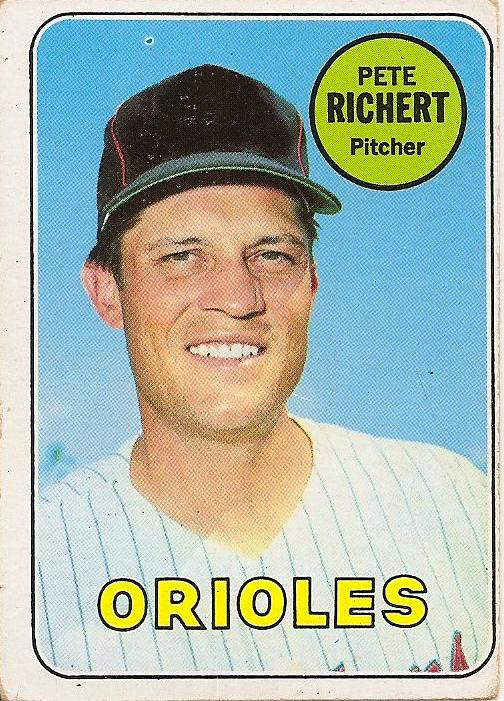
Vintage Fridays: Pete Richert, 1969 Topps #86
Friday, December 20, 2013
Vintage Fridays: Clay Dalrymple, 1969 Topps #151

Friday, October 11, 2013
Vintage Fridays: Larry Miller, 1969 Topps #323

If you don't remember Larry Miller pitching for the Orioles, that's probably because he never pitched for the Orioles. Miller actually debuted with the Dodgers in 1964 as a 27-year-old rookie. He was a collegiate player at the University of Kansas, and also lost a couple of years to military service. He was 4-8 with a 4.18 ERA in his lone season in Los Angeles before being traded to the Mets. Larry didn't fare so well in New York, going 1-6 with a 5.35 ERA in parts of two seasons. That was the last of it, as far as Miller's big league career was concerned; he threw his last MLB pitch in 1966. It seems that Topps rolled the dice and assumed that the expansion-diluted rosters would open up a spot for Larry on the Baltimore staff, but it didn't happen. He spent the year with the Giants' AAA Phoenix team, and that was the end of his pro career.
Friday, June 21, 2013
Vintage Fridays: Dave May, 1969 Topps #113

Friday, October 5, 2012
Vintage Fridays: Frank Robinson, 1969 Topps #250

If you needed any cosmic themes for the evening, it was 46 years ago today that the Orioles played their first postseason game, stunning the Dodgers with a 5-2 road win in Game One of the 1966 World Series. In the first inning, Frank Robinson and Brooks Robinson hit back-to-back home runs off of Don Drysdale; it was all that the O's would need, thanks to 6.2 innings of one-hit, 11-strikeout relief from Moe Drabowsky. The pair of runs that Los Angeles scored in that game were the only two they would get in the Fall Classic, as Baltimore's young pitchers blanked them for the last 33 innings of the Orioles' Series sweep. It all started with one game...
Friday, April 27, 2012
Vintage Fridays: Tom Phoebus, 1969 Topps #185

The O's gave Tom a little wiggle room with a four-run third inning. The pitcher actually sparked the rally himself with a one-out single off of his opposite, Boston starter Gary Waslewski. Paul Blair also singled, and a two-out grounder by Blefary was booted by Sox first baseman George Scott, loading the bases and keeping the inning alive for Brooks Robinson, who cleared the sacks with a double to right field. A wild pitch moved Brooks over to third, at which point Boog Powell was intentionally walked to bring up Davey Johnson. Davey singled to knock in Robinson and make it 4-0.
The Orioles added single runs in the fifth on another Johnson hit and the eighth on Phoebus' second single. Davey scored on the latter after doubling for his team-high third hit of the game, as he and his pitcher were the only Birds with multi-hit games that day. Tom picked up momentum as he got deeper into the game, shrugging off the leadoff walk of Oliver in the sixth inning to mow down the final 12 Red Sox to come to bat. The biggest threat to the feat was a one-out sinking line drive hit by Rico Petrocelli in the eighth inning. Naturally, Brooks Robinson lunged to his right and plucked it off of his shoetops. Phoebus sealed his no-hit gem by striking out Foy for the final out, giving him his ninth whiff against three walks. The pitcher's final Game Score was 93, matching Hoyt Wilhelm's 1958 blanking of the Yankees (8 K/2 BB) for the highest mark by an Oriole in a no-hitter.
Tom, who grew up playing stickball in the Hampden neighborhood, now lives in Palm City, FL. He is a retired physical education teacher who enjoys golfing.
Friday, April 20, 2012
Vintage Fridays: Don Buford, 1969 Topps #478

There are a few factors working against Don. He had a fairly short career in the major leagues, just nine full seasons. The White Sox signed him in 1959 after a collegiate career at the University of Southern California, and he was 27 by the time he cracked Chicago's starting lineup in 1964. But he was a league-average hitter in his four years manning second and third base on the South Side, posting a 103 OPS+ and stealing a total of 114 bases. (Of course he was also caught stealing 57 times, giving him a sub-optimal 67% success rate.)
But Buford truly thrived after being traded to Baltimore in the deal that reunited Luis Aparicio with the ChiSox. His lowest OPS+ from 1968 through 1971 was 126, which came in the 1970 championship season. That year, he led the club with 99 runs scored and 109 walks, and his .406 on-base percentage trailed only AL MVP Boog Powell (.412) for the team lead. He also set a career best with 66 RBI. Again, that was the least-successful of Don's first four seasons as an Oriole. And he still got some down-ballot MVP consideration, just as he had in 1968 and would again in 1971.
That 1971 season was Buford's masterpiece. He made his only All-Star team, topped the American League with 99 runs scored (the third straight year he'd had exactly 99), tied Frank Robinson with a team-high 153 OPS+, and also reached personal bests with 19 home runs, a .413 OBP, .477 slugging percentage, and an .890 OPS. All this for an Orioles squad that topped 100 wins and reached the World Series for the third consecutive year. Not bad for a 34-year-old guy. Of course, a big theme in sports is "what could have been", and for all of their dominance from 1969 through 1971, the O's won just that one World Series. If they had been dealt a bit more luck in '69 and/or '71, they might hold an ever higher place of esteem in baseball history and Buford might be talked about more today.
Getting back to the relative brevity of Don Buford's career, he had an unbelievably poor season in 1972. His slash line was only .206/.326/.267, meaning that his OPS tumbled nearly 300 points and his OPS+ (76) was exactly half of what it had been the preceding year. He had just 13 extra-base hits and 22 RBI in 485 plate appearances. The Orioles released him the following February and he played the final four seasons of his career in Japan for the Taiheiyo Club Hawks and the Nankai Hawks. The abrupt end of his O's tenure doesn't change the fact that "Buf" was an excellent table setter for the greatest teams in Oriole history.
Friday, July 22, 2011
Vintage Fridays: Bill Dillman, 1969 Topps #141

Bill Dillman was a Trenton, NJ native who the Orioles drafted out of Wake Forest University with their sixth-round pick in 1965, the first year of the June amateur draft. He was taken 18th in that round, one pick behind Hal McRae and one pick ahead of Sal Bando. Two years later, Bill was on Baltimore's Opening Day roster, and his big league career got off to an auspicious beginning. He debuted on April 14, 1967, working long relief against the A's after Earl Weaver yanked Tom Phoebus for walking his fourth batter to lead off the fifth inning. The rookie reliever, handed a 7-1 lead, induced a double play grounder from Danny Cater, walked Ed Charles, and then set down the final 13 Kansas City batters in order to get credit for the win. Eight days later, Earl again called on Dillman to mop up against the Athletics. Despite having a 7-2 lead, Wally Bunker had allowed 11 men to reach base in 6 innings. Once again, Bill retired the first batter he faced, allowed the second to get on base (a Bert Campaneris single), and was perfect for the rest of the game. Three innings of one-hit ball, and he had his first career save despite a 12-2 final.
In fact, Dillman reeled off 12.2 scoreless innings in his first half-dozen appearances before he proved human. On May 10, the White Sox clobbered him for 5 runs in 1.1 innings. From there, his performance was up-and-down. He won his first four decisions, including a complete-game 5-2 duke over the Twins on June 11, but lost his last six to finish at 5-9. In all, he totaled 124 innings in 32 games (15 starts) with a 4.35 ERA. Among the team's regular pitchers, only Dave McNally (4.54 in an injury-shortened season) had a higher earned run average that year.
Bill spent the entirety of the 1968 and 1969 seasons at AAA Rochester, with ERAs of 4.29 and 4.95 respectively. The Cardinals purchased his contract, but traded him to Montreal a month into the 1970 season. The Expos, still finding their footing a year after entering the league, promoted him to the majors quickly. He made 18 relief appearances for the club, and was 2-3 with a 5.28 ERA when he was demoted in mid-July. He never made it back to the big leagues, and walked away after the 1972 season at age 27. But he'll always have that six-game scoreless streak to kick off his career.
Friday, November 5, 2010
Vintage Fridays: Jim Hardin, 1969 Topps #610

The O's were hosting the first-year club from Kansas City on a Saturday night, and despite the fact that the home team was in first place place with a 20-11 record, they welcomed a paltry 6,843 fans through the Memorial Stadium turnstiles. Dave McNally, a 22-game winner the year prior, got the start for the Birds. He gave up a run under odd circumstances in the first inning. With Lou Piniella on first base and Jackie Hernandez on second, Joe Foy struck out for the second out. The runners were going on the pitch, and Elrod Hendricks' throw to second caught Piniella, but he stopped and initiated a rundown. Boog Powell missed the tag and threw home as Hernandez tried to score. Hendricks dropped the ball, and it was 1-0. However, Boog set things right in the bottom of the inning with a two-run homer off of Mike Hedlund to give the Orioles the lead. An error by Royals right fielder Bob Oliver gave them a third run an inning later.
Back-to-back singles by Paul Blair and Frank Robinson chased Hedlund with no outs in the third, and reliever Dave Morehead allowed both runners to score with a wild pitch and a single by Powell. It was 5-1, and it looked like the Birds would coast even after K.C. got a single run back in the fourth. But the visitors' bullpen clamped down on the Oriole bats, and their hitters finally chased McNally in the seventh, scoring a pair of runs on four singles to draw within a run. After retiring the first batter in the top of the eighth, Baltimore reliever Eddie Watt gave up three straight hits to tie the game and deny McNally a win. Jim Hardin was called upon to put out the fire, and did just that with a little help from his defense. Pinch hitter Juan Rios lined out to Blair, who doubled Chuck Harrison off of second base to keep the game tied. The O's went down in order in the eighth, and Hardin kept the Royals off of the scoreboard in the ninth to set up the endgame.
A familiar face took the mound in the bottom of the ninth: Moe Drabowsky, who had been claimed by K.C. in the expansion draft after three years in Baltimore. He would return to the Orioles in 1970, but on this night Charm City was probably the last place he wanted to be. After retiring leadoff hitter Mark Belanger on a grounder to first, he faced Jim Hardin, who had hit .101 (12-for-119) over the first two years of his major league career. Jim clubbed his first career home run, earning himself a very memorable win!
Friday, August 7, 2009
Vintage Fridays: Davey Johnson, 1969 Topps #203
 I really dig these cards from the first few years of Davey Johnson's career. He never had matinee idol looks, to put it mildly, but there was some kind of burning intensity in his face. This card especially captures the wide-eyed look that seems equal parts fear and determination, along with the buck teeth protruding in a sort of snarl. He is awash in anticipation of whatever may come his way, and if it's a line drive or a bad-hop grounder, all the better. The unique looking-up camera angle adds to the intrigue, as Davey's outstretched right palm and impossibly large left-hand second baseman's glove seem to be reaching straight out of the card to grab you. Davey's ready; are you?
Friday, May 29, 2009
Vintage Fridays: Bird Hill Aces, 1969 Topps #532
 Time to take a quick breather from Wietersmania to focus on a subject recently approached by the delightful Dinged Corners: multi-player combo cards. When I received this card a year or so ago, I thought it was pretty nifty, but curious. When you think of great O's rotations from the glory years, it seems inexcusable to exclude Jim Palmer. But he had just missed most of 1967 and all of 1968 with arm woes, so Topps can be forgiven for not guessing that he'd come back to win 245 more games in the ensuing sixteen seasons. But what about the guys who made the cut? Sure, Tommy Phoebus was a local kid, and he even no-hit the Red Sox in 1968, but was he really an "ace"? Then there's Jim Hardin, who I couldn't tell you anything about without first checking an encyclopedia. Then again, I could just read the text on the back of the card, which goes a long way toward explaining why this particular quartet were featured.
Dave McNally, of course, was the veteran of the group. 1969 would be his eighth season with the Orioles, and after gaining national attention with his World Series-clinching shutout in 1966, he fully realized his potential in 1968 with 22 wins (trailing only Denny McLain's 31), 10 losses, and a 1.95 ERA (third-best in the Year of the Pitcher). He led the American League with a 0.84 WHIP(!) and was still only 26. He would run off three more consecutive 20-win seasons, including a league-best 24 in 1970 and a 21-5 record in 1971, the year that the Birds boasted four 20-game winners. Ace? Yes.
Mike Cuellar had just arrived in Baltimore via an offseason trade with Houston. In what amounted to Cuellar-for-Curt Blefary, the O's got away with murder. The Cuban screwballer had amassed a ho-hum 36-32 record in three full seasons in the Astros rotation, but his peripherals were good and a great supporting cast in Charm City made all the difference. Mike went 23-11 with a 2.38 ERA and 1.01 WHIP in his first Oriole season, and (just like McNally) posted four 20-win seasons in orange and black, three of them consecutive. His 24 victories in 1970 tied McNally for the league lead, and he twice topped the Junior Circuit in winning percentage. In each of his first seven seasons with the club, he completed at least 17 of his starts, including an A.L.-best 21 in 1970. Ace? You bet.
Hindsight is 20/20, but at the time this card was printed, Tom Phoebus looked like another great Oriole pitching find. The unibrowed hometown boy had gone 14-9 as a rookie in 1967, and followed up with a 15-15 mark in his sophomore season. His 2.87 ERA was none too shabby, and of course there was the April 27 no-no against Boston. Nine strikeouts, three walks? Yes, please. 1969 was more of the same, a 14-7 record and a 3.52 ERA that was higher, but still better than average. Curiously, he earned only ten decisions in 21 starts in 1970 (5-5), but boasted a 3.07 ERA and a relief win in the World Series that fall. The Birds struck gold by trading Tom that offseason for Padres pitcher Pat Dobson, the missing link of the four 20-game winners in 1971. Phoebus lasted just two years in the National League, winning another half-dozen games. Ace? It didn't turn out that way, but apparently life is still good for Tom.
Righty Jim Hardin was the youngest of this foursome, and he too seemed to be on the rise. After going 8-3 with a 2.27 ERA in half a season in 1967, the slim Tennesseean racked up 18 wins against 13 losses with a 2.51 ERA the next year. He seemed durable, going the distance in 16 of 35 starts. But after being slotted into a swingman role, Jim was less effective in 1969-1970 (12-12, 3.57). On the plus side, he did hit a walkoff home run against former Oriole Moe Drabowsky in 1969! As with Phoebus, Hardin was traded in 1971 and out of the majors within two seasons. Ace? Nope, but it's not he was no slouch for a few years there.
So all four of these guys may not have won 20 games year after year, but two of them did, which isn't a bad success rate in baseball. This card certainly isn't cringe-worthy like this 1993 Upper Deck Cardinals team card spotlighting Geronimo Pena and Bernard Gilkey. Yikes.
Friday, September 12, 2008
Vintage Fridays: Curt Motton, 1969 Topps #37
 I recently told you about my trip to Cooperstown, but I neglected to mention something of interest regarding the Orioles.
Curt Motton is in the Hall of Fame.
I'm sure that sounds pretty crazy. After all, the guy was a career .213 hitter. Allow me to clarify by saying that his bat is in the Hall of Fame.
As I walked through the World Series exhibit, marveling at the ornate championship rings and trying to ignore the commemorative Red Sox video playing in the background, I noticed a display case with oodles of memorabilia. One of the items that caught my eye was the bat that Dave McNally, the great O's lefty, had used to hit a grand slam in Game Three of the 1970 World Series. This made him the first (and only, if I recall) pitcher in the history of the Fall Classic to club a bases-loaded home run. But when I took a closer look, the name engraved on the bat was "CURT MOTTON". It probably wouldn't make sense for pitchers to go to the trouble of carrying their own lumber, so it seems that Dave grabbed one of Motton's bats. Curt certainly wasn't using it; he did not appear in any games that postseason.
Go figure: a historic World Series home run was hit off of the bat of a guy who never even saw the field. Whatever it takes to get to Cooperstown, I guess.
Friday, June 27, 2008
Vintage Fridays: Vic Roznovsky, 1969 Topps #368
 In the late 1960s, backup catcher Vic Roznovsky was known to teammates and opponents alike as "Ladykiller". What was it that made him so irresistible to the fairer sex? Could it be his scandalously short long-sleeved undershirt that gave them a tantalizing glimpse of his supple wrists? Or was it his fashionably avant-garde choice to wear a single Oriole-orange batting glove? Maybe the cold sore on his lower lip let them know that he was a devil-may-care type who liked his love free and easy. Perhaps it was his long, wide nose - a truly epic proboscis that was evocative of another portion of the male anatomy. One thing is for sure, though: Vic Roznovsky made Wilt Chamberlain look like A.C. Green.
Subscribe to:
Posts (Atom)