Orioles Card "O" the Day

An intersection of two of my passions: baseball cards and the Baltimore Orioles. Updated daily?

Sunday, October 31, 2010

Tripper Johnson, 2001 Topps #354

What kind of name is "Tripper"? Were this guy's parents fans of "Three's Company"? Well, maybe they were, but Tripper is not his given name, thankfully. He was born Nelson Alexander Johnson III in Bellevue, WA. He was known as "triple", and then "Tripper". After hitting .453 as a high school senior, he was drafted with a first round sandwich pick (32nd overall) by the Orioles in 2000. He'd signed a letter of intent to play at the University of Washington, but the O's changed his mind with a $1.05 million signing bonus. Former scouting director Tony DeMacio likened him to former MVP Ken Caminiti. In 48 games at rookie level Bluefield that summer, he hit .306. Johnson climbed steadily through the ranks until 2004, when he was asked to repeat high-A Frederick in his fifth pro season. He responded with his best overall year (.269, 21 HR, 74 RBI). His reward was a promotion to AA Bowie in 2005, but his OPS dropped 100 points and his progress was stalled. He had a close call in midseason, but the O's scrapped plans to call him up when it was determined that Melvin Mora's hamstring injury would not require placement on the disabled list. Tripper struggled even more the following year and spent half the season back in Frederick. The Birds cut ties with him, and he spent his eighth and final minor league season in single-A Lynchburg in the Pirates organization. It was 2007, and Johnson was now 25. He saw the writing on the wall and walked away from baseball, choosing to finally enroll at UW.

What's surprising is that Tripper decided to play college football for the Huskies. He made the team as a backup safety in 2008, and started several games after the team was racked by injuries at his position. Washington went 0-12, but Johnson did record an interception in a 27-7 loss to UCLA on November 15. The following year he was injured in practice and did not play at all, and seems to have exhausted his eligibility. But for a short while, he had been able to return to the sport that he'd claimed was his greater passion.

Saturday, October 30, 2010

Doug Robbins, 1992 Topps #58

It's never a comforting thing to be the lowest man on a Top Prospects totem pole. Doug Robbins bore that burden both literally, in his bottom right position on the card, and in the scope of his pro baseball career. Brad Ausmus just retired a few weeks ago after an 18-year major league career that included an All-Star selection and three Gold Gloves. Dave Nilsson was the first Australian-born All-Star in MLB history, and hit .284 with 105 home runs in eight seasons. The other two gentlemen were not so lucky.

Jim Campanis and Doug Robbins were both catchers on the 1988 Team USA amateur squad. Campanis' father and grandfather had both played briefly in the major leagues, and Jim seemed poised to join them when he hit .392 with 23 home runs and 92 RBI for USC in 1988. The Mariners drafted him in the third round that year, but he hit .254 in six minor league seasons and never made it past AA. As for Stanford product Robbins, he batted .391 with a 1.055 OPS in the 1988 Baseball World Cup and was drafted in the tenth round by the Orioles. He hit over .300 in three of his first four professional seasons. In 1992, he batted .306 with a .399 on-base percentage at AAA Rochester. At that time, Chris Hoiles was firmly entrenched as the O's catcher, so Robbins was dealt to Oakland. He played only 57 games for AAA Tacoma in 1993, and his average sunk to .226. For some reason, that was the end of his baseball career...until 1996, when the 29-year-old pitched (yes, pitched) 12 games for the Rhode Island Tigersharks of the independent Northeast League. That didn't go so well, as he allowed 72 baserunners in 31 innings and surrendered 39 earned runs (a 11.32 ERA). That would be the true end of Doug Robbins' time in baseball.

Friday, October 29, 2010

Vintage Fridays: Lou Jackson, 1964 Topps #511

Still doing the long-distance relationship thing, which means that I'm going to be away from my cards and scanner this weekend. Just choosing one card at a time is a challenge for someone as indecisive as me, so picking out three in advance is always a challenge. I figured I'd make it easier on myself by cooking up a theme. There are plenty of cards out there of guys who barely played for the Orioles (or in the case of prospects, never made it at all), so welcome to my "Who In Blazes?" weekend.

I'm kicking things off with Lou Jackson because he was the first unfamiliar face I happened upon when I opened up my vintage Orioles binder. I surfed on over to Baseball Reference and things got interesting, and more than a little tragic.

Lou played college ball at Grambling State University and signed with the Cubs in 1957. He started off in Class C ball, flashing power (40 extra-base hits in 112 games) and hitting .310 for the Magic Valley (ID) Cowboys. He was promoted to the Class A Western League the following year and was even better, hitting .320 and slugging .596 for the Pueblo Dodgers. His performance earned him a pair of callups to the majors, once in July and once more in September. He played sparingly and struggled, with only 6 hits in 35 at-bats (.171). His first - and last - career home run was a two-run blast off of Ray Semproch of the Phillies on August 3, 1958. The following year he returned to A ball, this time with the Lancaster Red Roses of the Eastern League, and was again impressive (.339 AVG, 54 XBH), but this time merited only four big league at-bats in September. He was then passed around like public property, going from the Cubs to the Reds to the independent Toronto Maple Leafs to the Braves to the Orioles.

When the O's nabbed him from the Braves in the December 1963 Rule V draft, he hadn't been in the majors in nearly five years. At 28 years old he still had a lot of baseball left in him, and he'd hit .315 with 31 homers in the previous season at AAA. Baltimore saw enough in him to put him on the major league roster on Opening Day, but used him in only four games. He went 3-for-5 in his only start, May 10, 1964. The Birds won 7-1 that day. The next day, he pinch hit for Stu Miller in the ninth inning and struck out. It was his final major league game.

Jackson spent the rest of the 1964 and 1965 seasons at AAA Rochester, then signed with the Sankei Atoms of the Japanese League. He played for them for three years, including an All-Star effort in 1967: .296/.351/.554 with 28 home runs. The following season, his power plummeted and his average dipped 77 points. He also collapsed at home plate one day, apparently suffering from years of alcohol abuse. By May 1969, he was dead of pancreatitis at age 33. Sadly, there's not much more information about his life available online.

Thursday, October 28, 2010

Jose Mesa, 1991 Donruss #765

This week's reader request comes from William, whose stated reason was "just sayin'". That's not actually a reason at all, so I'll try to do some legwork and figure out why he wanted to see this card today. Is it because Tuesday was the 13th anniversary of Jose's blown save that cost the Indians the World Series? Perhaps. Is it because his 321 career saves are 13th all-time and are a record among Dominican-born major leaguers? Maybe. Is it because this photo affords an excellent view of Mesa's surprisingly well-toned glutes? I would never make such a baseless accusation. Not that there's anything wrong with that.

Wednesday, October 27, 2010

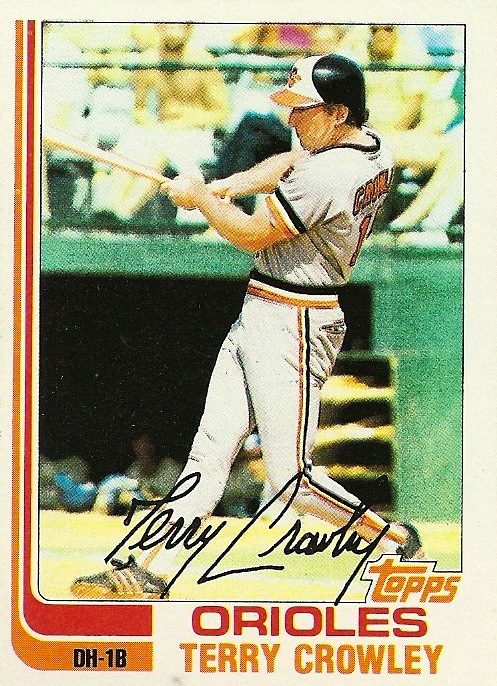
Terry Crowley, 1982 Topps #232

In news that comes as a relief to most Orioles fans (myself included), Terry Crowley's 12-year run as the team's hitting coach has come to an end. The surprising thing is that it was reportedly his decision. Buck Showalter offered him a spot on his staff for the 2011 season, and the Crow initially agreed before reconsidering. He has accepted a new role as "organization-wide offensive evaluator", whatever that means.

It's hard to believe that Crowley maintained his post through a dozen years of losing, outlasting five managers and one interim skipper. Pro sports are known for the impermanence of coaching jobs, especially when on-field results are poor. In this case, the O's ranked in the bottom half of the American League in OPS in 8 of the last 12 seasons, and were in the bottom half in runs scored 11 times. The sole exception was 2004, when they were an underwhelming sixth-best with 842 runs. Even that little bit of mediocrity took career years from Miguel Tejada and Melvin Mora and a strong effort from Javy Lopez...it was an expensive sixth-place finish.

It's hard to figure out just how much of the blame Crow deserves for the Birds' anemic offense through the years. Some of the best hitters he's coached, including Nick Markakis, rave about his tutelage. But isn't it possible that Markakis is a star because he's talented, and not because of the coaching he's received? Besides, his career hasn't progressed the way most expected; his home runs and OPS have dropped since peaking at .897 in 2008. Besides, Nick himself publicly questioned the offensive approach of his teammates last June, saying that it looked like they had no plan. Shouldn't Crowley be held responsible?

Some might say that you couldn't expect a hitting coach to make chicken salad out of chicken crap, and the Geronimo Gils and Deivi Cruzes of the world are more the latter. But the best coaches coax lesser players to perform above their talent level, don't they?

I'm asking questions, and I don't have many answers. I'm sure Terry Crowley is a great guy, and he certainly has his fans in the game of baseball. But I'm perfectly happy to give someone else a chance to go to work with Baltimore's batters.

Tuesday, October 26, 2010

Aubrey Huff, 2007 Fleer Ultra #19

Tomorrow night. World Series Game One. Rangers-Giants. Who ya got? I think I'll be pulling for the Giants (with all apologies to vociferous Giant hater Night Owl), and not just because I'm still bearing scars from 26-7 and 30-3. I'd be happy for Aubrey Huff, who had a bounce-back year in San Francisco after hitting the skids in Baltimore and Detroit in 2009. The guy has paid his dues after a decade of cellar dwelling as a Devil Ray and Oriole. Ex-O's Chris Ray and Eli Whiteside are also with the Giants, so bully for them. I've also taken a liking to obese third baseman Pablo Sandoval (a.k.a. "Kung Fu Panda"), goofy closer Brian Wilson and his thick black beard, and undersized, emo-looking ace Tim Lincecum, who might be my favorite non-Oriole. I also dig the look of AT&T Park, with its big brick wall looming in right field and inviting lefty hitters to take aim at the San Francisco Bay.

I'm also rooting for the Giants because it's been a long time coming. While the Rangers have never won a World Series, the Giants have actually had the longer drought: Texas (nee the Washington Senators) has been around since 1961, but the last championship for the guys in orange and black came in 1954, when they were known as the New York Giants. Since then, they've had their share of heartbreak. In 1962, they took Mantle's Yankees to Game Seven and lost 1-0 when Willie McCovey's line drive was snared with two out and two on in the bottom of the ninth. They waited 27 years to get back, and were swept by their Bay Area counterparts in Oakland in a Series that was interrupted and muted by a devastating earthquake that hit right before Game Three. In 2002, the Giants seemed poised to clinch in Game Six, but blew a 5-0 lead in the seventh and eighth innings. The Angels scored four early runs in Game Seven and made it hold up. As someone who's been a fan for 18 of the Orioles' 27 straight years without a World Series, I can't imagine the frustration of longtime Giants fans.

Above all, I just hope it's an exciting, competitive series. These are the last four-to-seven baseball games that count for a while. They've got to carry us through the next five months.

Monday, October 25, 2010

Rodrigo Lopez, 2003 Upper Deck Sweet Spot #15

Did you know that Rodrigo Lopez is still in the major leagues? Well, he was in 2010 anyhow. He might not crack an MLB rotation again any time soon. The bottom-feeding Arizona Diamondbacks were stretched so thin that they gave the ex-Oriole 33 starts, leaving him out there to absorb 200 innings of punishment. In the previous three seasons combined, Rodrigo had totaled 21 games pitched in the majors, due largely to injuries and a dash of ineffectiveness.

Did I say ineffectiveness? That was the name of the game for Lopez in 2010. 7 wins, a National League-worst 16 losses, and a 5.00 ERA. He also took the booby prizes for most earned runs allowed (111) and most home runs surrendered (37). He allowed 227 hits and walked 56 for a WHIP of 1.42.

Do you know what the real kicker is? That wasn't even the worst season Rodrigo has ever had. That would be his 2006 swan song with the O's, when he won 9 and lost a league-worst 18. He gave the Birds a ghastly 5.90 ERA and served up more earned runs (124) than any other American Leaguer. He also allowed an unheard-of 234 hits and 59 walks in 189 innings - a 1.55 WHIP. Just imagine how much more damage he would have done if Sam Perlozzo hadn't banished him to the bullpen late in the season.

Sunday, October 24, 2010

Josh Towers, 2002 Playoff Absolute Memorabilia #20

It's a hit-and-run piece tonight because I spent the day at my good friend Mike's wedding. They had beautiful weather and a classy ceremony and reception, and I had a blast seeing all of my college friends again. At the same time, I am thrilled to know that there are no other weddings on my radar for the foreseeable future. This was the third set of nuptials that I've attended in the past five weeks, and I'm pretty sure there are laws against that kind of thing. I'm ready to put away my fancy clothes for a while.

Oh, why Josh Towers? He shares a birthday - February 26 - with Mike. Good for them.

Saturday, October 23, 2010

Scott McGregor, 1984 Fleer #646

Now that the world has been spared a 41st World Series appearance by the Yankees, I'll turn my attention to the National League Championship Series, where the Giants have a chance tonight to clinch their first World Series appearance since 2002. They're trying to deny the Phillies their third straight N.L. pennant, and are also trying to win their first world championship since moving west from New York in 1956, as hard as that seems to believe. San Francisco is in this position because they have an excellent collection of starting pitchers, including Matt Cain. Cain combined with two relievers to shut out the Phillies on three hits in Game Three on Tuesday night, no easy feat when you consider that Philly's lineup boasts stars such as Ryan Howard, Chase Utley, and Jayson Werth.

It had been a while since the Phils had been blanked in the postseason...27 years to be exact. The last pitcher to whitewash them was none other than Scott McGregor on October 16, 1983. He performed the feat in the Orioles' Game Five World Series clincher, holding the Phillies to five hits and striking out six. It was the final postseason game for McGregor, who had an excellent track record in October: three wins, three very tough losses, and a 1.63 ERA. He also totaled 45 base runners in 49.2 innings, a superb 0.91 WHIP. All three of his losses were quality starts: in Game Seven of the 1979 World Series he allowed only two runs in eight innings, but the O's went on to lose 4-1. In 1983's ALCS opener, he permitted just two runs (one earned) in six and two-thirds innings, but Cy Young winner LaMarr Hoyt blanked the Birds until the ninth and prevailed 2-1. In that year's Fall Classic opener, he allowed a pair of runs in eight innings but again dropped a 2-1 final, this time to John Denny. On the flip side, all three of Scott's postseason wins were complete games: a six-hit shutout of the Angels in Game Four of the 1979 ALCS, an 8-4 win over the Pirates in Game Three of the 1979 World Series, and his aforementioned victory over Mike Schmidt, Joe Morgan, Pete Rose and the rest of the '83 Phillies. Eat your heart out, Jack Morris.

Friday, October 22, 2010

Vintage Fridays: Hoyt Wilhelm, 1960 Topps #115

With a win in tonight's ALCS Game Six, the Rangers would send the Yankees home for the winter and advance to the World Series for the first time in the franchise's 50-year history. If the Orioles aren't in the postseason, I'm all about giving someone new a chance...especially if it comes at the expense of those guys in pinstripes. So we're going to double up on the Yankee Killer mojo with this magnificent combo card from bygone days.

In May 2009, I told you about ageless knuckleballer Hoyt Wilhelm's run of dominance against New York. I'll elaborate now by giving you his career numbers vs. the Yanks, which are almost as impressive. Hoyt faced the Bronx Bombers 75 times in all, including 13 starts. He won only 9 of 20 decisions, but totaled six complete games and three shutouts. He racked up 209.1 innings, his most against any opponent, yet his 1.98 ERA and 1.01 WHIP against the Yankees were lower than his marks against almost any other club. In 67 career meetings with Mickey Mantle, he frustrated the slugger to the tune of a .192 average and .327 slugging percentage. Other New Yorkers that Wilhelm handled easily include Bobby Richardson (.403 OPS), Elston Howard (.371 OPS), Tony Kubek (.446 OPS), Tom Tresh (.250 SLG), and Roger Maris (.154 AVG). So it's safe to say that the old knuckler wasn't easily intimidated.

Roy Face never actually faced the Yankees in the regular season, as all but two of his career games were as a National Leaguer. However, he played a prominent role in one of New York's most memorable postseason series defeats. In the 1960 World Series, Face's Pirates squeaked by the Yanks in seven games despite being outscored 55-27 overall. As you may have guessed, they prevailed in some tight games, and leaned heavily on their relief ace to do it:

-In Game One, he relieved Vern Law in the eighth inning with Pittsburgh ahead 6-2. He stranded two inherited runners, but surrendered a two-run homer to Elston Howard in the ninth. Tony Kubek followed with a single to bring the tying run to the plate in the form of Hector Lopez. Face coaxed a game-ending double play ball to earn the save. The Yankees blew out the Pirates in the next two games, but the Bucs clung to a lead in the seventh inning of Game Four. Law ran into trouble again, and Roy got the call with one out and the go-ahead runs on base. He set down the final eight batters for another save. The next day was nearly the same situation. 4-2 Pirates in the seventh, Harvey Haddix puts two runners on with one out, Face is summoned, allows only a walk in 2.2 scoreless, save number three. New York romped again in Game Six to set up a winner-take-all Game Seven. For the third time, Face was called upon to preserve a Vern Law lead. This time it was the sixth, and Pitt led 4-1 with two on and none out. This time he was not sharp, surrendering the lead via a Mickey Mantle single and a three-run Yogi Berra homer. He got through the seventh unscathed, but was touched up for two more runs in the eighth and left his team in a 7-4 hole. You probably know what happened next. Five-run Pirates rally, Yanks fight back to tie it, Bill Mazeroski walks 'em off in the bottom of the ninth. The Bucco bats really let Face off the hook, so all is well that ends well.

Up-to-the-moment status: 5-1 Rangers after six. Cautiously optimistic.

Thursday, October 21, 2010

Chito Martinez, 1992 Stadium Club #438

I recently received a thoughtful comment from a reader named Chris, who said that he'd been enjoying my blog for a year or so and wondered if I could post a card of Chito Martinez. I'm always happy to comply with such requests, especially since it means that I don't have to wrack my brain for one night to decide which card to feature. It also gave me an excuse to post this excellent card. Of course that's Mark McGwire playing first base for the Oakland A's as Chito breaks for second, casting his shadow on the Memorial Stadium infield dirt. This photo would have been taken either on July 26 or July 28, 1991. Those were the only two Oakland at Baltimore games that Martinez played in that year in which he reached base. He did not attempt a steal in either game, so that doesn't help us pinpoint it. Both games were Oriole losses, by the way, as was their style in 1991.

Wednesday, October 20, 2010

Lou Montanez, 2009 Topps 206 #105

Yesterday afternoon I returned from my too-brief getaway to Ocean City to see a telltale yellow bubble envelope sticking out of my mailbox. It was from Ryan of "'O' No!!! Another Orioles Blog". He had answered my plea and knocked four cards off of my inaugural "Coveted Cluster" list: the Lou Montanez card you see above, as well as Dennis Sarfate's 2008 Topps Heritage High Numbers, Chris Waters' 2009 Upper Deck, and Robert Andino's 2010 Topps Heritage. That's four more players represented in my Orioles collection, and I've dug around the Internet and tabbed four worthy cards to replace them in the Coveted Cluster. But wait...there's more!

Ryan mentioned that he'd be sending along some other Orioles that might be of interest. Well, he was on the mark with that assessment, as the additional cards filled a few dozen empty slots in my collection. There were a ton of newer cards from sets I hadn't bought into (2009 Upper Deck Goodwin Champions, 2010 Bowman, etc.), as well as a few vintage O's that I'd needed. So big thanks to Ryan, who now gets to play the waiting game while I root through my house with his want list in hand.

After I made such a big deal out of adding Lou Montanez to my collection, I'd be remiss if I didn't tell you a bit about his tumultuous career. Andy MacPhail drafted him with the Cubs' first-round pick (third overall) in 2000 out of Miami Coral Park High School in...you guessed it, Miami, FL. Other notable first rounders that year were Adrian Gonzalez (#1), Rocco Baldelli (#6), Chase Utley (#15), and Adam Wainwright (#29). With the 14th pick, the Orioles took Beau Hale, who has been out of baseball for three years now. Moving on...

Lou (then known as Luis) spent seven years in the Cubs organization and didn't reach AAA until his final season in the system. He hit only .224 in 82 games at Iowa, with a .281 on-base percentage and .371 slugging percentage, and was eligible for minor league free agency following the 2006 season. He split 2007 between Bowie and Norfolk, and hit .288 overall with a bit of power (but only .259 at AAA). The O's assigned him to the Baysox for 2008 and he stayed there for the majority of the season; it was the fourth straight year he'd put in time at AA. The 26-year-old had figured out enough about the mid-minors to win the Eastern League Triple Crown, hitting .335 with 26 home runs and 97 RBI. He slugged .601, and the Birds finally gave him the call he'd been waiting for in early August as an injury replacement. He made his debut on my 26th birthday, and received his first start the next day. Though the Orioles lost that game, he made history by becoming the first O's position player to hit a home run in his first at-bat. Lou stuck around until the end of the season, hitting .295 in 38 games.

With Felix Pie's arrival in 2009, Montanez lost out in the numbers game and was sent back to the minors to start the year. But Pie was awful early on and Lou was back by late April. Unfortunately, he couldn't catch lightning in a bottle twice. He hit .204, broke his wrist in late May, and fell behind both a resurgent Pie and an emerging Nolan Reimold. Lou returned in September, playing just enough to drag his average down to .183. This season was more of the same. An afterthought in spring training (he memorably referred to himself as "the third monkey on Noah's gangplank"), he again found himself in Baltimore due to injuries (Pie) and ineffectiveness (Reimold). But 2010 was even worse than 2009 had been for Montanez: a .140 average in 26 games and more injuries. He's once again eligible for free agency, and it sounds like he's searching for a new baseball home and some better luck.

Tuesday, October 19, 2010

Jeffrey Hammonds, 1998 Leaf #86

This is one of Jeffrey Hammonds' final cards as an Oriole. At just 27 years of age, it seemed as though he had already peaked as an athlete. But he had a couple of good years left in him. After hitting .302 with the Reds after a late-season trade in 1998, he put up an .870 OPS the following year in a part-time role, hitting 17 home runs in 262 at-bats. He was traded to the Rockies for the 2000 season and the combination of increased playing time (he remained healthy enough to amass a career-high 511 plate appearances) and the high altitude of Coors Field agreed with him. Hammonds had a lofty .335 average, .395 on-base percentage, and .529 slugging percentage. He scored 94 runs, homered 20 times, and drove in 106 and made the All-Star Team. As luck would have it, he was also a free agent at the end of the year.

Perhaps ignoring his home/road splits (.399/.465/.651 at home, .275/.325/.415 on the road), the Brewers backed up the Brinks truck in Jeffrey's driveway: three years, $21 million. Unsurprisingly, injuries limited him to 49 games in 2001 and 46 games in 2003. In between those two seasons, he did make it through 2002 with 128 games played, but hit .257 and slugged only .397 while driving in a paltry 41 runs. Jeffrey's career wound down with short and injury-marred stints in San Francisco and Washington, highlighted by an NLDS appearance with the 2003 Giants in which he reached base five times in seven trips to the plate. When the Nationals wanted to option him back to AAA New Orleans in mid-2005, the 34-year-old outfielder chose to retire instead. He stuck around for parts of 13 big league seasons, hitting .272 with 110 home runs and 423 RBI.

When the Baltimore Sun caught up with Hammonds at the end of his career, he offered the following assessment of his time in baseball: "I am not downtrodden. I made millions. I played in the biggest ballyards. I played in some of the biggest games. That would be selfish [to be bitter]. I'm not the norm. And I can say that and say that with pride."

Monday, October 18, 2010

Jeffrey Hammonds, 1994 Triple Play #284

As I said yesterday, Jeffrey Hammonds wasn't a total bust. Of the six seasons in which he played for the Orioles, four were productive. But look a bit closer.

1993: Hits .412 in spring training, but a strained hamstring necessitates a season-opening stint at AA Bowie. Makes his major league debut on June 25 at age 22. Has two hits in each of his first three games and at least one hit in each of the first six. Hits .323 and slugs .500 in the first 29 games of his career, but a herniated disk  in his neck puts him out for most of August. Plays only four games in September (two starts) before being shut down for good.

1994: Hits .296 with an .819 OPS, but misses more than six weeks in May and June with a right knee injury. Ultimately has reconstructive surgery on the knee joint in October.

1995: A disaster. He spends 47 days on the disabled list and doesn't play all that well when he is able, hitting .242 with a .650 OPS. Hits four home runs in 178 at-bats.

1996: Another lost season. He hit .226 overall in 71 games and wound up being demoted to AAA Rochester in midseason. He was even worse after being promoted at the end of July, hitting .182 in fifteen games before getting shut down again in mid-August.

1997: Rebounded to contribute to a Baltimore club that led the American League East from wire to wire.  He played in 118 games (his high-water mark with the Birds), hitting .264 with an .809 OPS and a career-high 21 home runs. His home run total was second on the team to Rafael Palmeiro, and he achieved another personal best with a 15-of-16 mark in stolen bases. But like many of his teammates he struggled in the postseason, scraping out a single hit in 13 at-bats.

1998: Stop me if you've heard this before: missed 35 games in June and July. He was a solid player when he was able to play (.826 OPS), but the O's finally washed their hands of him in August and traded him to the Reds for the similarly-disappointing Willie Greene. Jeffrey's final career stats with the Orioles: .264 AVG, .767 OPS, 51 HR, 183 RBI, 38 SB in 410 games.

Sunday, October 17, 2010

Jeffrey Hammonds, 1992 Classic Draft Picks #4

Whelp, the Weekend Warrior is ducking out on his readership once again. This afternoon my girlfriend and I are headed to Ocean City for a two-night getaway. I've never been to O.C. in the offseason, and I'm really looking forward to seeing what it's like in cooler weather and without a crush of people turning the boardwalk into a hazard.

While I'm away, I'm leaving you with a trio of Jeffrey Hammonds cards. Why? Well...why not? Today we begin at the beginning, when Jeffrey was a five-tool prospect from Stanford University upon whom Orioles fans could pin all of their hopes and dreams. The O's chose him with the fourth overall pick in June 1992, wedged between Montreal's pick of Mississippi State pitcher B.J. Wallace and Cincinnati;s choice of UCF outfielder Chad Mottola. When you consider that Wallace never made it past AA and Mottola hit only .200 in 59 career major league games (including six with the Orioles in 2004), Hammonds wasn't a total miss. Even playing the hindsight game, the first round of the 1992 draft was pretty underwhelming: look at this list and tell me who you'd rather have - Derek Jeter, Shannon Stewart, Johnny Damon, Charles Johnson, maybe Preston Wilson.

Of course the back of the card reminds you of what could have been. The stats show a .354 batting average over his sophomore and junior seasons for an elite NCAA program, with 20 homers, 90 RBI and 54 steals. Further research uncovered a PAC-10 Conference record 48 steals as a freshman and a 37-game hit streak. He also hit .414 in the 1992 Olympics. The gushing write-up mentions him in the same breath as Rickey Henderson and mentions the predominant opinion of baseball scouts that Jeffrey  was "the best player in the nation". Back then, he probably was.

Saturday, October 16, 2010

Eddie Murray, 1987 Donruss Opening Day #136

For several years I've labored under the delusion that the first Orioles game I ever attended was a 1987 day game against the Brewers. But there was another game that year that apparently escaped my memory. I've been holding on to ticket stubs for practically every game I've attended in the last 18 years, and in going through those tickets, I found the following:
A phone call to my father was inconclusive, but he assumes that we went to both games. What he knows for sure is that any games we attended just shy of my fifth birthday resulted in an early exit. I had no interest in baseball as a tyke, and once I'd gotten my fill of yummy stadium wares, I was ready to go.

Considering the way this game played out, my dad was more amenable to leaving than he might have been otherwise. Mike Flanagan got the start for the O's, and he just didn't have it. Carlton Fisk doubled in two runs in the first, and a Ron Karkovice RBI grounder and a Gary Redus homer an inning later put the home team in a 4-0 hole. Things got exciting for a minute in the third, as Larry Sheets and Rene Gonzales hit back-to-back solo home runs off of Chicago starter Jose DeLeon. Flanny seemed to settle down until the White Sox chased him with a walk and a double to lead off the sixth. Reliever Mark Williamson allowed the fifth Sox run to score on an Ozzie Guillen single but escaped the inning without further damage.

An Eddie Murray home run in the bottom of the inning (the 277th of his career, if you're keeping count) brought the Birds within 5-3, but that's as close as they would get. Chicago tacked on insurance runs via an Ivan Calderon homer in the eighth and a Williamson wild pitch in the ninth. 7-3 White Sox, drive safely folks. Aside from their three solo home runs, the Orioles scraped up only three other hits - a pair of singles by DH Alan Wiggins and a single by John Shelby. The O's failed to capitalize on six walks by Pale Hose pitchers. I guess it's no wonder that I haven't retained any impressions from that game, though it would be cool to be able to say that my first baseball memory was an Eddie Murray homer.

Friday, October 15, 2010

Vintage Fridays: Jim Palmer, 1966 Topps #126

I've been waiting for a special occasion to post Jim Palmer's rookie card, and his 65th birthday is as special as it gets. How am I so fortunate as to have this iconic card in my collection? Thanks goes to longtime reader and commenter Bob (a.k.a. Commish), an Orioles fan since the glory days who was kind enough to share many of his vintage O's doubles with me. To celebrate #22's big 6-5, here are ten facts about the man they call "Cakes":

-He stole one base in his career: August, 16, 1971 against the Brewers. In the ninth inning, the O's were up 3-2 and Mark Belanger singled with one out. While Palmer batted, "the Blade" was gunned down at second base by catcher Ellie Rodriguez. Ken Sanders proceeded to walk Palmer, who swiped second with Don Buford at the plate. It was for naught, as Buford flied out to end the inning. The O's won 3-2, with Palmer still possessing enough energy to complete his start.

-Although Jim pitched 17 times in the postseason, he never got the ball on his birthday. Oddly enough, he started three World Series games on October 14 and pitched twice more on October 16. He was winless in his five starts spanning those two dates, but won in his final Fall Classic appearance on October 16, 1983, when he tossed two scoreless innings in relief of Mike Flanagan in Game Three vs. the Phillies.

-One of the clubs that competed with the Orioles to sign Palmer as an amateur free agent in 1963 was the nascent Houston franchise. Houston GM (and ex-O's GM and manager) Paul Richards apparently made such a bad impression on Jim and his family that they crossed his team off of their list. So "The Wizard of Waxahachie" continued to help the Orioles even after he left the club!

-Though his earned run average was more than a half-run lower at Memorial Stadium (2.59) than on the road (3.13), he had the exact same number of wins at home as he did on the road: 134 each.

-Talk about consistency: his career ERAs by month ranged from 2.62 to 2.99. August was his best month by ERA and by win total (54-25).

-The team he beat most often was the Yankees: 30-16 with a 2.84 ERA and seven shutouts (his most against any team). I like the sound of that.

-In his major league career, Jim threw to 21 catchers. The top five in terms of innings: Rick Dempsey (1158), Elrod Hendricks (773.1), Andy Etchebarren (752.1), Dave Duncan (331), and Earl Williams (216.2).

-In addition to his 1969 no-hitter against Oakland, Palmer tossed five one-hit complete games in his career. On May 12, 1967, he retired the first 18 Yankees he faced before Horace Clarke led off the seventh inning with a single. He was immediately wiped out on a double play, and Jim was flawless for the rest of the game. He faced the minimum 27 batters and the O's trounced New York 14-0.

-According to Bill James' Game Score tool, Jim's best game was a gem from September 27, 1974. He shut out the Brewers for 12 innings on four hits and six walks (two intentional) for a Game Score of 93, but received no decision thanks to 13 equally masterful frames by Milwaukee's Jim Colborn! The O's pulled it out in the 17th on a walkoff fielder's choice grounder by Bob Oliver.

-Among others, Palmer shares his birthday with Roman poet Virgil (70 BC), German philosopher Friedrich Nietzsche (1844), British novelist P.G. Wodehouse (1881), "Godfather" author Mario Puzo (1920), automotive tycoon Lee Iacocca (1924), and actor and star of "The Wire" Dominic West (1969).

Thursday, October 14, 2010

Gregg Olson, 1991 Cracker Jack #22

I own a variety of "miniature" cards, which is to say that they measure less than the standard 2.5"x3.5'. But this card is the smallest of them all, clocking in at one-quarter the size of a regular card. Holding it (very carefully) in my hand makes me feel like a giant, the same way I felt last weekend while handling the tiny appetizer fork and spoon that were handed out with the hors d'oeuvres at a wedding reception. On another note, I'm more than ready to go into hibernation from weddings. There's one more on my calendar later this month, and it will be the sixth I've attended in the past sixth months. With the exception of yours truly, is there anybody else out there who could possibly still be unmarried?

Anyway, just to give you a better idea of the relative size of this bitty Gregg Olson card, I've scanned it along with the regular 1991 Topps card that it was based upon.

If only there were a jumbo version of this card, we could have an infinite regression effect.

Wednesday, October 13, 2010

Ron Washington, 1991 Crown/Coca-Cola All-Time Orioles #475

Congratulations to Rangers manager and former Orioles utility player Ron Washington*, whose Texas Rangers outlasted the Tampa Bay Rays in Game Five of the ALDS last night. In return for winning the first postseason series in the forty-year history of the team, Washington and his charges get to advance to the ALCS and attempt to vanquish the Taco Bell-lovin' Yankees. Best of luck to them.

* = What, you don't remember Wash's lofty 26-game stint with the O's in 1987? He was 35 and hit .203 with six RBI in 81 plate appearances. The most notable thing about Ron Washington's time with the Birds?  On September 14, 1987, he replaced Cal Ripken, Jr. at shortstop in the eighth inning. Toronto was up 17-3, and manager Cal Ripken, Sr. decided that it was time to end his son's record of 8,243 consecutive innings played. Trivialicious.

Tuesday, October 12, 2010

Melvin Rosario, 1998 Fleer Sports Illustrated #160

As you can see, this psychedelic card has tabbed 25 year-old catcher Melvin Rosario as "One to Watch" in 1998. No doubt he was chosen because he had made his major league debut the previous September, when he appeared in four games for the O's but went hitless in three at-bats. The native of the Dominican Republic had come off of a solid season at AA Bowie, hitting .263 with 26 doubles and 12 homers, but a .729 OPS from a guy in his sixth minor league season isn't exactly something worth getting into a lather. He was promoted in September because the rosters had expanded to 40 and the O's wanted another warm body that could catch for a few innings when necessary.

Melvin never made it back to the bigs after being featured on this card. He remained in organized ball for  four more seasons, holding down a AAA roster spot for the Orioles, Rangers, Pirates, Royals, Dodgers, and Diamondbacks in short order. He then moved on to independent leagues, spending two years with the Northern League East's Brockton Rox and three years with the Atlantic League's Atlantic City Surf. In 2006, the final year of his career, Melvin hit .306 for the Surf. So he's got that going for him, which is nice.