2015 Topps Heritage is in stores now. As it borrows its design from the unfathomably dull 1966 Topps set, I don't have any burning desire to collect it. I mean, just look at the card above: even Wally Bunker is bored to be a part of it. Block letters, straight lines, sickly lime green...pass. Still, I like to put my money where my mouth is, so I picked up a 20-card pack from Target tonight. For my money, Heritage is still the nicest-looking set Topps puts out on a yearly basis, but yeah, I'm sitting this one out. It's just as well, since I haven't completed last year's Heritage set...or 2008's, for that matter. Whoops.
Oh, and I'm still 0-for-2015 on Orioles cards. It's like Topps is trolling me at this point.
Showing posts with label 1966 topps. Show all posts
Friday, March 6, 2015
Friday, December 12, 2014
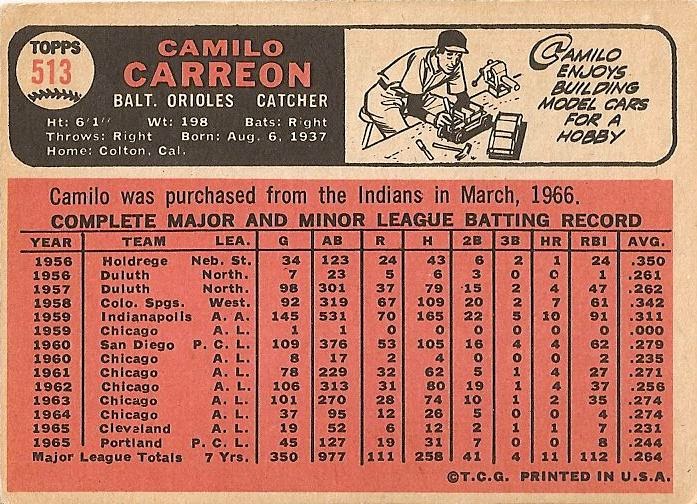
Vintage Fridays: Camilo Carreon, 1966 Topps #513
That's some good hustle by Topps to get Cam Carreon on a card in an Orioles uniform, considering that the O's didn't acquire him from Cleveland until March 10, 1966. The player they gave up? A young outfielder named Lou Piniella. This card is also something of an oddity because Carreon went on to play just four games for Baltimore, going 2-for-9 with three walks and spending most of the year at AAA Rochester. When he returned to the minors for the duration of 1967 as well, he decided to retire to spend more time at home with his family in Tucson. Though the minor league Toros coaxed him back for one season as a player and a few more as a coach, the team was based out of Tuscon, so he was still around for much of the year. One of his sons, Mark, went on to enjoy a ten-year career as an outfielder with the Mets, Tigers, Giants, and Indians. On one last note, here's a scan of the card back, featuring a great cartoon about Cam's favorite hobby.
Friday, September 26, 2014
Vintage Fridays: Dave McNally, 1966 Topps #193
On this date in 1962, Dave McNally took the mound as a major leaguer for the first time, making a late-season start in the opener of a doubleheader for the seventh-place Orioles against the visiting ninth-place Athletics. In other words, the few fans in attendance at Memorial Stadium had no reason to expect that they were witnessing something special. The O's scratched out a pair of second-inning runs off of Kansas City starter Bill Fischer, but couldn't muster anything else against him in seven innings. Luckily, the rookie Baltimore pitcher didn't need much support from his offense. After a few bumps in the early innings, McNally found his groove. A fourth-inning single by Ed Charles gave the A's runners on first and second with one out. From that point onward, Dave retired the last 17 batters he faced. Jerry Adair tacked on a solo home run off of Johnny Wyatt in the eighth inning to provide the final margin. 3-0 Orioles, as Dave McNally announced his presence with a two-hit, three-walk shutout. It was the first of 181 wins and 33 shutouts that the Montana native collected in orange and black. He's still the winningest lefty in team history, and also ranks first among O's southpaws in strikeouts and shutouts.
Friday, September 6, 2013
Vintage Fridays: Boog Powell, 1966 Topps #167
Last night, Adam Jones collected his 30th home run and 100th RBI in the 2013 season. Since Chris Davis is already sitting at 48 home runs and 123 RBI, the Orioles have at least two 100-RBI guys on the same team for the tenth time in team history. The first such occasion was the first O's World Championship team in 1966. That club actually had a trio of hitters reach the century mark, with Triple Crown winner Frank Robinson (122 RBI), future league MVP Boog Powell (109), and 1964 MVP Brooks Robinson (100) all doing the honors.
Speaking of Davis, I had the occasion to witness "Crush" 's 48th home run live and in the flesh tonight. It was part of a three-homer effort by the Baltimore offense, as Danny Valencia and Matt Wieters also went deep to support a great pitching performance by Scott Feldman. The righthander held the White Sox to five hits to notch his first career complete-game shutout, and the first one-man whitewash by an Oriole pitcher since Jason Hammel blanked the Braves last June. I believe it's the first time I've ever seen a complete-game shutout by an Oriole in person; it really was a special night.
Friday, August 16, 2013
Vintage Fridays: Steve Barber, 1966 Topps #477
On this date in 1969, former Oriole Steve Barber had the dubious distinction of allowing the only inside-the-park home run that Boog Powell hit in his entire career, as the Orioles pounded the Seattle Pilots 15-3 at Sick's Stadium. Indeed it wasn't a good day to be a Seattle pitcher, as Diego Segui, Marty Pattin, Jim Bouton, and Barber each allowed multiple runs, with none lasting longer than starting pitcher Segui's 3.1 innings of work. Only John Gelnar was unscored upon, and he faced just three batters. The mighty O's got production from some unlikely sources, as Paul Blair socked a home run and drove in three and Andy Etchebarren and Chico Salmon each went 4-for-4 in the seventh and eighth slots in the batting order. Salmon, acquired from the Pilots during Spring Training in exchange for Gene Brabender and Gordy Lund, had a pair of homers and six RBI. Meanwhile, Dave McNally was scored upon only twice in seven innings despite allowing six hits, six walks, and a hit batter.
But it was Boog's daring dash around the bases that put the exclamation mark on this rout. Facing ex-teammate Barber with one out and Dave May on first base in the top of the ninth inning, the humongous slugger walloped a ball that somehow eluded center fielder Wayne Comer and right fielder Billy Williams (no, not the Cubs' Hall of Famer). The 250-plus-pound Powell chugged all of the way around the bases for the only one of his 339 career round-trippers to not clear the fence. Oh, that video existed of this play.
Speaking of memorable trips around the bases by slow-footed Orioles, today is the tenth anniversary of Jack Cust's infamous belly flop. Of course, there's video for that one.
But it was Boog's daring dash around the bases that put the exclamation mark on this rout. Facing ex-teammate Barber with one out and Dave May on first base in the top of the ninth inning, the humongous slugger walloped a ball that somehow eluded center fielder Wayne Comer and right fielder Billy Williams (no, not the Cubs' Hall of Famer). The 250-plus-pound Powell chugged all of the way around the bases for the only one of his 339 career round-trippers to not clear the fence. Oh, that video existed of this play.
Speaking of memorable trips around the bases by slow-footed Orioles, today is the tenth anniversary of Jack Cust's infamous belly flop. Of course, there's video for that one.
Friday, December 21, 2012
Vintage Fridays: Hank Bauer, 1966 Topps #229
I feel as exuberant as craggy ol' Hank Bauer looks in this uncharacteristic photo. As of 3:30 this afternoon, I am officially on Christmas vacation. I won't have to go back to the office until January 2. That's 11, count 'em, 11 days to do as I please. This is the first time I've been able to take off for the entire week of Christmas since at least 2008. I'll be filling my time with holiday parties with friends, a Christmas Eve and Day with my family, and then a few days in Charlotte with my girlfriend and her loved ones. Naturally, I'll still be checking in with you fine folks each day. Happy holidays!
Friday, January 13, 2012
Vintage Fridays: Frank Robinson, 1966 Topps #310
Thirty years ago today, Hank Aaron and Frank Robinson were both elected to the Baseball Hall of Fame in their first year of eligibility. Talk about your no-brainers. At the time, they were #1 (Aaron) and #4 (Robinson) all-time in career home runs, which is to say nothing about their barrier-breaking roles as black superstars in the 1950s and on through into the 1970s. Robby was even the first black manager, and had unrealized dreams of being a general manager as well.
But look at the voting results from that 1982 ballot. Hammerin' Hank, despite being the all-time home run king and owning all of the sorts of big numbers that have long made baseball writers ooh and aah (3,771 hits, .305 AVG, 2,297 RBI), was left off of NINE ballots, settling for 97.8% approval. That's bad enough, but you can chalk it up to the tiny, moronic cabal that insists that "Babe Ruth didn't get 100%, so no one else should". If we were all bound to the poor decisions of our ancestors, Hank and Frank would never have even gotten the chance to play in the major leagues, so...way to miss the point, fellas.
Look at the next line of results. Frank Robinson got 89.2% of the vote. 370 out of 415. There were 45 clowns that didn't think that big, mean, driven Frank Robinson, with more career homers than anyone not named Hank, Babe, or Willie, with a Rookie of the Year, two MVP awards (one from each league, which had never been done before), a dozen All-Star seasons, the 1966 A.L. Triple Crown, a pair of World Series rings, a .926 career OPS, etc. etc. etc., was either a) worthy of Cooperstown or b) a "first-ballot player" (a fallacy almost as stupefying as the 100% rule). It makes my temples throb just to think about it.
Further down-ballot, we see a full dozen eventual enshrinees who failed to collect the 75% necessary to join Messrs. Aaron and Robinson in the Class of '82. Some are on the outer fringes of Hall-worthiness (Don Drysdale, Red Schoendienst), and surely there were tough choices to be made in filling no more than ten slots on one's ballot, but the notion that it took Juan Marichal three years and Harmon Killebrew (59.3% in 1982!) four years to pass the test is still galling to me. The lesson here is that the BBWAA at large may be creating its biggest mess ever with all of the steroid posturing, but their membership has always acted curiously. It just seems to be snowballing now.
But look at the voting results from that 1982 ballot. Hammerin' Hank, despite being the all-time home run king and owning all of the sorts of big numbers that have long made baseball writers ooh and aah (3,771 hits, .305 AVG, 2,297 RBI), was left off of NINE ballots, settling for 97.8% approval. That's bad enough, but you can chalk it up to the tiny, moronic cabal that insists that "Babe Ruth didn't get 100%, so no one else should". If we were all bound to the poor decisions of our ancestors, Hank and Frank would never have even gotten the chance to play in the major leagues, so...way to miss the point, fellas.
Look at the next line of results. Frank Robinson got 89.2% of the vote. 370 out of 415. There were 45 clowns that didn't think that big, mean, driven Frank Robinson, with more career homers than anyone not named Hank, Babe, or Willie, with a Rookie of the Year, two MVP awards (one from each league, which had never been done before), a dozen All-Star seasons, the 1966 A.L. Triple Crown, a pair of World Series rings, a .926 career OPS, etc. etc. etc., was either a) worthy of Cooperstown or b) a "first-ballot player" (a fallacy almost as stupefying as the 100% rule). It makes my temples throb just to think about it.
Further down-ballot, we see a full dozen eventual enshrinees who failed to collect the 75% necessary to join Messrs. Aaron and Robinson in the Class of '82. Some are on the outer fringes of Hall-worthiness (Don Drysdale, Red Schoendienst), and surely there were tough choices to be made in filling no more than ten slots on one's ballot, but the notion that it took Juan Marichal three years and Harmon Killebrew (59.3% in 1982!) four years to pass the test is still galling to me. The lesson here is that the BBWAA at large may be creating its biggest mess ever with all of the steroid posturing, but their membership has always acted curiously. It just seems to be snowballing now.
Friday, November 4, 2011
Vintage Fridays: Carl Warwick, 1966 Topps #247
Carl Warwick was an Oriole just long enough to get his face on this card. The six-year major league veteran made his mark with a 3-for-4 pinch hitting performance for the Cardinals in the 1964 World Series, and also hit 17 home runs in 1962 for St. Louis and Houston. In July 1965, the O's acquired him from the Cards but got little production. In 9 games, he was 0-for-14 with 3 walks. The following spring he was traded to the Cubs for backup catcher Vic Roznovsky. Carl spent most of the year in the minors, hitting .227 in 16 games in Chicago. Those were the final big league games of the 29-year-old's career. Considering the context, it's kind of impressive that Topps captured Warwick's fleeting time in orange and black instead of using one of those lame close-up portraits with no hat. It's the small stuff that makes me happy.
Friday, July 8, 2011
Vintage Fridays: Curt Blefary, 1966 Topps #460
Wow, this is the second straight Vintage Friday that I've posted on a Saturday. I must really be slipping. In my defense, I didn't arrive home from the Capital Fringe Festival until nearly 1:00 AM this morning. I had load-in for my play at 2:30, followed by our performance at 6:00 (it went very well, thanks for asking), followed by a couple other friends' shows at 8:15 (Sisters of Ellery Hollow) and 10:15 (The Road to Nowhere). I heartily recommend both, if you're so inclined. But I'm rambling.
Today's tardy vintage card was helpfully improved upon by a previous owner. He or she realized that Topps was selling Curt Blefary's defensive prowess and versatility short by designating him as "just an outfielder". He wasn't any old outfielder, he was a left fielder, by god. His talents didn't end there, either. He could play first base in a pinch as well! Isn't that something?
Of course, that's not the half of it. Over the course of his career, Curt also logged time in right field, at catcher (however reluctantly), second base, and third base. But as our unknown editor has rightly noted, he got most of his playing time at first and in left. It's worth noting that there were two separate seasons in Blefary's career in which he played exclusively at those two positions: his sophomore year of 1966, and 1969 (his first year in Houston).
Today's tardy vintage card was helpfully improved upon by a previous owner. He or she realized that Topps was selling Curt Blefary's defensive prowess and versatility short by designating him as "just an outfielder". He wasn't any old outfielder, he was a left fielder, by god. His talents didn't end there, either. He could play first base in a pinch as well! Isn't that something?
Of course, that's not the half of it. Over the course of his career, Curt also logged time in right field, at catcher (however reluctantly), second base, and third base. But as our unknown editor has rightly noted, he got most of his playing time at first and in left. It's worth noting that there were two separate seasons in Blefary's career in which he played exclusively at those two positions: his sophomore year of 1966, and 1969 (his first year in Houston).
Friday, April 29, 2011
Vintage Fridays: Luis Aparicio, 1966 Topps #90
Feliz cumpleanos a Luis Aparicio, who turns 77 today. "Little Looie" spent five years (1963-1967) in Baltimore after the White Sox traded him for a trio of young hitters and Hoyt Wilhelm. Already the reigning American League steals leader in each of his first seven years in the majors, the shortstop extended his streak to nine while wearing an Orioles uniform. In 1963, he swiped 40 bags in 46 attempts for an 87% success rate. The following year he stole a career-high 57 bases, and even swatted a personal-best 10 home runs. He added a pair of Gold Gloves and a couple of All-Star selections to his already-impressive resume. Luis even had three separate five-hit games in the 1966 season, including a 5-for-6 effort with three runs scored on June 2 as the O's erased a 5-2 deficit in topping the Angels 9-6. He was later a member of the Hall of Fame Class of 1984, along with Harmon Killebrew and Don Drysdale. Ex-White Sox double play partner Nellie Fox joined him posthumously in 1997.
Incidentally, the Orioles and White Sox start a four-game series tonight. May the best team* win!
*that wears orange
Incidentally, the Orioles and White Sox start a four-game series tonight. May the best team* win!
*that wears orange
Friday, October 15, 2010
Vintage Fridays: Jim Palmer, 1966 Topps #126
I've been waiting for a special occasion to post Jim Palmer's rookie card, and his 65th birthday is as special as it gets. How am I so fortunate as to have this iconic card in my collection? Thanks goes to longtime reader and commenter Bob (a.k.a. Commish), an Orioles fan since the glory days who was kind enough to share many of his vintage O's doubles with me. To celebrate #22's big 6-5, here are ten facts about the man they call "Cakes":
-He stole one base in his career: August, 16, 1971 against the Brewers. In the ninth inning, the O's were up 3-2 and Mark Belanger singled with one out. While Palmer batted, "the Blade" was gunned down at second base by catcher Ellie Rodriguez. Ken Sanders proceeded to walk Palmer, who swiped second with Don Buford at the plate. It was for naught, as Buford flied out to end the inning. The O's won 3-2, with Palmer still possessing enough energy to complete his start.
-Although Jim pitched 17 times in the postseason, he never got the ball on his birthday. Oddly enough, he started three World Series games on October 14 and pitched twice more on October 16. He was winless in his five starts spanning those two dates, but won in his final Fall Classic appearance on October 16, 1983, when he tossed two scoreless innings in relief of Mike Flanagan in Game Three vs. the Phillies.
-One of the clubs that competed with the Orioles to sign Palmer as an amateur free agent in 1963 was the nascent Houston franchise. Houston GM (and ex-O's GM and manager) Paul Richards apparently made such a bad impression on Jim and his family that they crossed his team off of their list. So "The Wizard of Waxahachie" continued to help the Orioles even after he left the club!
-Though his earned run average was more than a half-run lower at Memorial Stadium (2.59) than on the road (3.13), he had the exact same number of wins at home as he did on the road: 134 each.
-Talk about consistency: his career ERAs by month ranged from 2.62 to 2.99. August was his best month by ERA and by win total (54-25).
-The team he beat most often was the Yankees: 30-16 with a 2.84 ERA and seven shutouts (his most against any team). I like the sound of that.
-In his major league career, Jim threw to 21 catchers. The top five in terms of innings: Rick Dempsey (1158), Elrod Hendricks (773.1), Andy Etchebarren (752.1), Dave Duncan (331), and Earl Williams (216.2).
-In addition to his 1969 no-hitter against Oakland, Palmer tossed five one-hit complete games in his career. On May 12, 1967, he retired the first 18 Yankees he faced before Horace Clarke led off the seventh inning with a single. He was immediately wiped out on a double play, and Jim was flawless for the rest of the game. He faced the minimum 27 batters and the O's trounced New York 14-0.
-According to Bill James' Game Score tool, Jim's best game was a gem from September 27, 1974. He shut out the Brewers for 12 innings on four hits and six walks (two intentional) for a Game Score of 93, but received no decision thanks to 13 equally masterful frames by Milwaukee's Jim Colborn! The O's pulled it out in the 17th on a walkoff fielder's choice grounder by Bob Oliver.
-Among others, Palmer shares his birthday with Roman poet Virgil (70 BC), German philosopher Friedrich Nietzsche (1844), British novelist P.G. Wodehouse (1881), "Godfather" author Mario Puzo (1920), automotive tycoon Lee Iacocca (1924), and actor and star of "The Wire" Dominic West (1969).
-He stole one base in his career: August, 16, 1971 against the Brewers. In the ninth inning, the O's were up 3-2 and Mark Belanger singled with one out. While Palmer batted, "the Blade" was gunned down at second base by catcher Ellie Rodriguez. Ken Sanders proceeded to walk Palmer, who swiped second with Don Buford at the plate. It was for naught, as Buford flied out to end the inning. The O's won 3-2, with Palmer still possessing enough energy to complete his start.
-Although Jim pitched 17 times in the postseason, he never got the ball on his birthday. Oddly enough, he started three World Series games on October 14 and pitched twice more on October 16. He was winless in his five starts spanning those two dates, but won in his final Fall Classic appearance on October 16, 1983, when he tossed two scoreless innings in relief of Mike Flanagan in Game Three vs. the Phillies.
-One of the clubs that competed with the Orioles to sign Palmer as an amateur free agent in 1963 was the nascent Houston franchise. Houston GM (and ex-O's GM and manager) Paul Richards apparently made such a bad impression on Jim and his family that they crossed his team off of their list. So "The Wizard of Waxahachie" continued to help the Orioles even after he left the club!
-Though his earned run average was more than a half-run lower at Memorial Stadium (2.59) than on the road (3.13), he had the exact same number of wins at home as he did on the road: 134 each.
-Talk about consistency: his career ERAs by month ranged from 2.62 to 2.99. August was his best month by ERA and by win total (54-25).
-The team he beat most often was the Yankees: 30-16 with a 2.84 ERA and seven shutouts (his most against any team). I like the sound of that.
-In his major league career, Jim threw to 21 catchers. The top five in terms of innings: Rick Dempsey (1158), Elrod Hendricks (773.1), Andy Etchebarren (752.1), Dave Duncan (331), and Earl Williams (216.2).
-In addition to his 1969 no-hitter against Oakland, Palmer tossed five one-hit complete games in his career. On May 12, 1967, he retired the first 18 Yankees he faced before Horace Clarke led off the seventh inning with a single. He was immediately wiped out on a double play, and Jim was flawless for the rest of the game. He faced the minimum 27 batters and the O's trounced New York 14-0.
-According to Bill James' Game Score tool, Jim's best game was a gem from September 27, 1974. He shut out the Brewers for 12 innings on four hits and six walks (two intentional) for a Game Score of 93, but received no decision thanks to 13 equally masterful frames by Milwaukee's Jim Colborn! The O's pulled it out in the 17th on a walkoff fielder's choice grounder by Bob Oliver.
-Among others, Palmer shares his birthday with Roman poet Virgil (70 BC), German philosopher Friedrich Nietzsche (1844), British novelist P.G. Wodehouse (1881), "Godfather" author Mario Puzo (1920), automotive tycoon Lee Iacocca (1924), and actor and star of "The Wire" Dominic West (1969).
Friday, January 8, 2010
Vintage Fridays: Sam Bowens, 1966 Topps #412
A week ago, reader Jim asked when I would be getting around to Sam Bowens. Because my motto is "the customer is always right"*, I took him up on his request right away. It turns out that I've already dug up a lot of great facts about Sam for my 1965 Topps blog, as you can see here (I have no idea why Photobucket displays some of my images as black and white). But should that not slake your thirst for all things Bowens, feel free to peruse the following links:-Sam's obituary from The Wilmington Star-News, April 1, 2003.
-A photo of his gravesite at Greenlawn Memorial Park Cemetery in Wilmington, NC.
-A list of the other major leaguers that share his March 23 birthday, most notably Lee May and George Scott.
Friday, August 28, 2009
Vintage Fridays: Moe Drabowsky, 1966 Topps #291
Speaking of notable Orioles from yesteryear that I have yet to feature on this blog, we have one of the favorites of the gals over at Dinged Corners. Undoubtedly you've heard some of the choicest stories about reliever Moe Drabowsky's legendary pranks, but there may be a few you've missed. There are some amusing recollections in John Eisenberg's team history From 33rd Street to Camden Yards, but I want to keep this somewhat brief, so I'll share some of them now and save the rest for later. It also goes without saying that you absolutely should track down a copy of this book; you won't be sorry. Without further ado:DICK HALL (on the topic of the hot foot): "...After a while we said, 'Hey, no more players'. The poor sportswriters really paid for that. Guys would set 'em up, giving real serious, earnest answers while Moe was creeping up behind them with a match. By the time you felt it, it was too late."
BILLY HUNTER: "Moe would do things that other people would get punched in the nose for, and he'd get away with them."
BOOG POWELL: "Obviously, Moe's parents never let him have toys when he was little, so he had a lot of catching up to do. He sat around and dreamed up things. He'd tie string to dollar bills and leave them on the floor in the airport, then yank them away when people reached down to pick the bill up. He was basically insane."
STEVE BARBER: "Moe was fine when he was sober. When he started drinking, he did some crazy stuff. We had an off-day in spring training and Charlie Lau and I were going out on this big boat out in the water. Took a runabout out there. We were just getting on, and another runabout comes pulling up, and there's Moe standing bare-assed on the thing shooting at us with a target pistol. Once we got to land we spent an hour trying to get the gun away from him. I have no idea what that was about."
Friday, July 25, 2008
Vintage Fridays: Stu Miller, 1966 Topps #265
Stu Miller might be one of the most underrated pitchers in Orioles history, an exceptional relief ace whose career ended just as his role started to become more crucial and publicized. He was selected as Camden Chat's 19th-Greatest Oriole of All Time, and for good reason. The fact that he was 35 years old when he arrived in Baltimore in 1963, and yet made such a mark on the franchise, is telling of his sustained level of excellence. Using a deliberate windup and an array of offspeed and breaking pitches, Miller racked up 100 saves in five seasons in Charm City, not to mention 38 wins, all in relief. 14 of those wins came in 1965, almost certainly his finest season: 14-7 with career-highs of 24 saves (second in the A.L.), and a 1.89 ERA. His 0.997 WHIP was pretty nifty, too. His efforts were rewarded with a seventh-place finish in MVP voting that year.Forty years after his retirement, Stu is still all over the team's career leader board (minimum 500 innings pitched). He ranks first in ERA (2.37), fourth in WHIP (1.12), first in hits per nine innings pitched (6.9), third in strikeouts per nine innings pitched (7.75 - behind Erik Bedard and Arthur Rhodes, incidentally), third in saves (100 - behind Gregg Olson and Tippy Martinez), sixth in strikeout-to-walk ratio (2.44), and second in adjusted ERA+ (145, where 100 is league average). Not bad work for an old man, eh?
Friday, February 1, 2008
Vintage Fridays: Brooks Robinson, 1966 Topps #390
I've been saving this card for a special occasion, and today is pretty special. First of all, it marks one month since I started this blog. I've managed to post one card each day, which for me is pretty impressive. Maybe I can finally take the question mark off of my blog description at the top of the page.But I also launched my website today: NumerOlogy. For the better part of a year, I've been researching uniform numbers. I wanted to figure out just who wore which numbers for the Orioles, and when they wore them. I'm sure I've missed some here or there, but overall I'm pretty pleased with what I have. I spent most of today fighting with WordPress (I am not terribly tech-savvy), and I'll probably revisit it later. For now, I just wanted to get the site up. Feel free to check it out and offer me your thoughts.
In the meantime, let's talk about this card. I bought it at a card show at a local mall in 1994 or 1995, and for years it was the oldest card in my collection and my only card of Brooks. I kept it prominently displayed in my room. About four years ago, I was a senior in college when I found out that Brooks Robinson was coming to my school.
The baseball team was holding a fundraiser: there would be an "fireside chat" with Brooks and Tony Bruno, and then #5 would answer a few questions from the crowd. Afterward, there was a luncheon and silent auction, and Brooks made himself available for autographs. It was a no-brainer for me; how many chances do you get to meet one of the greatest Orioles players of all time? So I paid my $15 (I signed up too late to get a lunch ticket) and pocketed my baseball card.
During the chat, Brooks was as warm and folksy as you'd probably imagine. He talked about a wide variety of topics, from his two-hit debut against the Senators in 1955 ("I called my parents and told them, 'this is easy!' " Of course, those would be Brooks' only two hits that season.) to his love of fishing to the sad state of the contemporary O's (he said that Peter Angelos' biggest mistake was letting Mike Mussina and Rafael Palmeiro leave town). He talked for at least an hour, and I probably could have listened to him for much longer.
Upon arriving at the lounge for the second portion of the event, I put my jacket down and headed straight for the autograph line. After all, I couldn't afford to bid on anything and I couldn't have lunch. When I finally got to the head of the line, Brooks greeted me with a smile as I handed him the card. He asked me my name, and told me I was looking good. It seemed like an odd thing to say, but I wasn't about to turn down a compliment from a man with 16 Gold Gloves. He took a look at the card and immediately identified the venue as Yankee Stadium. After signing the card, he shook my hand and wished me well, and I left feeling like a million bucks.
I met one of my heroes, and I didn't even have to leave campus.
Subscribe to:
Posts (Atom)