Orioles Card "O" the Day

An intersection of two of my passions: baseball cards and the Baltimore Orioles. Updated daily?

Friday, July 23, 2010

Vintage Fridays: Tom Phoebus, 1968 Topps #97

On April 27, 1968, Baltimore native Tom Phoebus no-hit the Red Sox, picking up a 6-0 win in front of just 3,147 hometown fans. Since very few O's fans saw this historical game as it unfolded, it would be a nice treat if it were to show up on MASN's Orioles Classics series. Unfortunately, that doesn't seem likely.

The local sports cable channel has the potential for something both simple and great with Orioles Classics: just take tapes of memorable O's games of yesteryear and rebroadcast them, complete with a little pre-and-post-game exposition from Tom Davis and a former player. Nostalgia is always in fashion, especially with bedraggled Birds fans who don't have much to enjoy in the present. These games should pull higher ratings than the ESPNews simulcasts that eat up chunks of MASN airtime each day. Now that there are two MASN stations to account for simultaneously occurring O's and Nationals games, there's plenty of room for a little trip down memory lane.

But I feel like I've seen all of the games that Orioles Classics has to offer. If you watch much MASN, you can recite them along with me: various games from the 1966, 1970, and 1983 World Series and the 1996 and 1997 ALDS, the first home win in 1988, the 1991 farewell to Memorial Stadium, the 1992 opener at Camden Yards, Eddie Murray's 500th home run game in 1996, and Cal Ripken, Jr.'s 2,130 and 2,131 games and his 2001 farewell. I also seem to recall spotting the 1998 game that ended his streak, and a wild walkoff win against the Angels in 1989. So that's probably a dozen to sixteen games to represent more than 56 years of baseball history. What gives?

It doesn't seem likely that there would be a broadcast rights issue, since the Orioles have an ownership stake in MASN...that's a pretty big trump card. Besides, they still partner with WJZ-13 to televise a handful of games each year, so they should have access to several years worth of game footage in that case. I guess you never know.

Anyway, as long as I'm spitballing, here a few other games I would like to see on Orioles Classics: the birth of "Oriole Magic", featuring Doug DeCinces' walkoff homer against Detroit; the Tippy Martinez three-pickoff inning against Toronto in 1983; Chris Hoiles' Ultimate Grand Slam in 1998; the "Birdland Day" ten-run comeback against Boston last year...I could go on for quite a while. What's your wish list for Orioles Classics?

Thursday, July 22, 2010

Cal Ripken, Jr. and Billy Ripken, 1992 Upper Deck #82

Cal and Billy Ripken each made their major league debuts in Baltimore's Memorial Stadium, out on 33rd Street. Both were on the field for the final MLB game ever played there. A few weeks ago, Charm City's most famous brothers broke ground on the site where that stadium once stood. They were on hand to announce that a new park was being built there - a miniature replica of Memorial Stadium intended to be the first of several nationwide Youth Development Parks for underprivileged children. It's part of the Cal Ripken, Sr. Foundation's Swing for the Future initiative. There were several other local dignitaries on hand, including Brooks Robinson and Artie Donovan. I'm thrilled to hear that Memorial Stadium is coming back in some capacity. It was always bittersweet to drive past that spot in the years since the ballpark was demolished. There will be baseball on 33rd Street once again.

Wednesday, July 21, 2010

Jeff Manto, 1996 Fleer Ultra #8

I wanted to talk about that incredible roller coaster of a game that the Orioles won last night, but of course they had to cock it all up by dropping a one-run game this afternoon on the strength of another crummy starting pitching performance, a bases-loaded walk by their best reliever, and more buffoonish baserunning. On the other hand, they probably won't win 60 games all year, so I'd better take what I can get.

I had to be at the theater last night at 7:30 for an 8:30 performance, so I followed the game through text notifications from ESPN's ScoreCenter iPhone app...when I wasn't onstage, of course! I also read backstage via Deadspin about the bizarre pickoff play in which Jake Arrieta's throw struck Carl Crawford flush in the groin, causing him to crumple to the ground and be tagged out by Ty Wigginton. It was an omen for an unusual night of baseball. After the early thrill of back-to-back-to-back home runs by Luke Scott, Wiggy, and Adam Jones, I felt a familiar sense of disappointment and resignation when the Rays scored seven unanswered runs in the middle innings to take an 8-4 lead. By the time the play had ended and we moved down the street for a beer, Luke's RBI single and Miguel Tejada's two-run double had brought the O's back to within a run in the seventh. Still, I confidently told my friend and costar Mikey that my team was just tantalizing me, and that the overtaxed bullpen would cough up a few insurance runs to make it moot. As if on cue, an alert soon popped up on my phone telling of Reid Brignac's solo homer to make it 9-7 Tampa Bay. Still, I was in for a surprise.

As I enjoyed a Great Lakes Edmund Fitzgerald Porter (yes, I chose this draught primarily based its overblown name, but it was tasty), I got another message: Miggi had doubled in a couple more runs in the ninth, and we were all tied up. Twitter informed me that the Orioles had the winning run on second base with no outs, and left him stranded. Extra innings for the bedraggled remnants of the Baltimore crowd. I was starting to get a sneaking sense that the O's might win the bloody game. One of the weirdest things about this season has been their penchant for improbable comebacks. They might barely win at all, but when they do, they make the most of it.

I was driving the monotonous path of the Baltimore-Washington Parkway when I heard the six-note chime of the SportsCenter tone yet again. My hopes sank; in his third inning of work, de-facto closer Alfredo Simon had given up a 12th-inning run on a walk, throwing error, and single. 10-9 Rays. I didn't get any more texts for a while, so I finally tuned in to 105.7 to find out if the game was still going on. It was, but Koji Uehara was in with a runner on first. For some reason I assumed that Tampa Bay was still batting in the 12th, and that the pitching change had been the reason that things were still going without any further scoring. I switched back to my Arcade Fire CD and waited for the final score to pop up on my phone.

Several more minutes passed with no news, so I turned the game back on in time to hear former Oriole Lance Cormier surrender a four-pitch walk to Cesar Izturis...which is NOT easy to do, as he's topped 30 free passes once in his career and sports a .299 lifetime on-base percentage. Play-by-play man Fred Manfra insisted that the winning run was now on base, and I assumed he was making one of his standard gaffes. Surely Cesar was merely the tying run. But Manfra insisted upon it, and finally mentioned that it was the 13th. Somehow I'd missed the notification of Scott Moore's game-tying sacrifice fly in the bottom of the 12th. Now Felix Pie was up, and he quickly bunted Izturis to second. Given the team's usual futility in hitting with runners on base, as well as my Earl Weaveresque loathing of giving away outs, my hopes were dimming. The fact that Julio Lugo (who had pinch run for Tejada in the ninth) was the next batter wasn't encouraging, either. But in the next breath, the game was over! Lugo served Cormier's first pitch into right field for a walkoff single. After 4:38 of baseball, it took six pitches total to end it all. Orioles 11, Rays 10. Hallelujah.

But this game wasn't just a rarity because the O's actually won (it was their 30th victory of the year; by comparison, the Rays picked up their 30th W two months ago). The back-to-back-to-back homers in the second inning were really something special. The last time the Birds hit three consecutive home runs in an inning was fifteen years ago: September 5, 1995. If the date sounds familiar, it's because that was also the night that Cal Ripken, Jr. played in his 2,130th consecutive game. The victim was Angels starter Brian Anderson, who must have been having flashbacks as he called the game from the visitor's broadcast booth last night. The sluggers that night were Brady Anderson, Mark Smith, and Mr. Jeff "Super" Manto. Takes you back, doesn't it?

Tuesday, July 20, 2010

Armando Benitez, 1996 Fleer Ultra Gold Medallion #302


Since I've already posted three 1990s cards in a row, I might as well keep the trend going. This one is a gilded doozy of an insert card, as was the M.O. for Fleer in those days. When I was a fresh-faced youth, inserts were special because you were lucky to pull even one of them out of several packs of cards. They were the best (or at least the hottest) players, and the designs were unlike anything you'd see in another set, or at least in the base set into which they were inserted. An insert was almost certainly going to be much more valuable than a base card, a near-guarantee of dollars rather than cents. Now you can even find one-per-box autographs and relics in dollar bins. Inserts are a bloated mess.

I don't know about you, but I could absolutely do without inserts and I kind of wish that they'd never reared their ugly heads. Occasionally, there's a nifty concept or an eye-catching design that tickles my fancy, but most are just noise. I've started looking down on inserts as a nuisance. As the dwindling number of dedicated set collectors will tell you, every insert that clogs a pack of Topps is one less base card that you're getting for your money. I bought a hobby box of 2010 Series 1 and figured I had a decent shot at completing the 330-card series. 36 packs x 10 cards per pack = 360 cards, right? Ha. Each pack contained multiple ho-hum inserts. Turkey Red? Been there. Toppstown? Who cares? History of the Game AND Tales of the Game? Was it necessary to do both? By the time I put my partially-completed set in binder pages, I was about 60 cards short of completion and was left staring in frustration at a stack of worthless inserts. Bah.
I'm absolutely not buying any more packs of Series 1. I suppose that I'd better put together a want list and start seeking out trades...and maybe next year I'll be smart enough to remind myself that trying to complete sets - at least through pack-and-box-consumerism - is a sucker's game.

Monday, July 19, 2010

Randy Myers, 1996 Skybox Emotion XL #7

Before I was undone by my own poor sense of time management last night, I was going to talk about the Cincinnati Reds. No, I haven’t suffered a concussion…at least not that I can remember. I’ve spent most of my precious free time over the past week taking advantage of a free cable preview of MLB Extra Innings, which affords me a look at teams other than the Orioles, Nationals, Yankees and Red Sox. One of the weekend matchups that intrigued me was the Rockies-Reds series at the Great American Ballpark in Cincinnati. Both are teams with a lower national profile who are in the thick of the pennant race. As of today, the Reds are a half-game out of first in the National League Central, and the Rockies are four games back of the surprising Padres in the West. But as I watched Friday’s game I was struck by the number of cameos by one-time Orioles.

The Reds were inducting the newest members of the team’s Hall of Fame, and one of the honorees was third baseman Chris Sabo. The begoggled, crew-cut Sabo had been Rookie of the Year in 1988 and was a vital cog in Cincy’s last World Series champ to date, the 1990 squad that swept the defending champion Athletics. The Orioles signed him prior to the 1994 season, expecting him to replace the disappointing Leo Gomez at the hot corner. But “Spuds” struggled with injuries and balked at being shuffled into the corner outfield and designated hitter positions when Gomez had a bounce-back year. He played 68 forgettable games in Baltimore, posting a career-low (at the time) 96 OPS+ and signing with the White Sox the following year. Anyhow, one of the Fox Sports Reds’ reporters interviewed Sabo during the game. He seemed like a pleasant enough, humble guy, insisting that he didn’t think he’d accomplished enough in his career to deserve the honor, but that he was appreciative of the fan support.

TV announcers Thom Brennaman and Jeff Brantley were joined in the booth for a few innings by former bullpen-mates Randy Myers and Norm Charlton, who narrowly missed one another in Charm City (Myers was the closer for the last two O’s playoff teams in 1996-1997, and Charlton spent a miserable half-season in orange and black in 1998). In a former life, they partnered with current Nationals “analyst” and full-time buffoon Rob Dibble to form the three-headed monster known as the “Nasty Boys” . The trio shut down many a lineup in the late innings during the Reds’ march to and through the postseason in 1990, and they were there to throw out the first pitch(es) on Friday as part of the club’s 20th anniversary celebration. Myers, true to form, was decked out in camouflage whereas Charlton went with more of a casual look. Both seemed comfortable on the mic, reminiscing about their glory days and talking about their current involvement in charities and other pursuits. Footage was shown of their pregame ceremonial pitches; whereas Charlton went with the customary lob, Myers fired a point-blank fastball to his catcher, looking for all the world like he could still close games at age 47. Hey, if Moyer is still pitching, you never know. It’s not like Matt Albers and Alfredo Simon couldn’t use the competition…

Speaking of ageless lefties, conversation in the booth turned to Arthur Rhodes, who was one of four current Reds presented with plaques before the game to commemorate their selections to the All-Star Game. At age 40, it was the reliever’s first trip to the Midsummer Classic in his 19th season. Myers recalled the two years he spent in Baltimore as Rhodes’ teammate, when Davey Johnson boosted the (then) young southpaw’s career by recasting him as a tough middle reliever. Myers noted that on most nights, the combination of Rhodes, Jesse Orosco, Armando Benitez (yeah, I know), and Myers could stifle the opponent beyond the fifth inning. Later on, Rhodes protected a one-run lead in the eighth inning by escaping from a bases-loaded, nobody-out jam, striking out the final two hitters of the inning. Meanwhile, something called Frank Mata pitched in 15 games for the Birds this year before being demoted today. Look upon these works and despair.

Yesterday afternoon, my girlfriend was doing chores around her apartment, so I busied myself by channel surfing through a slate of Sunday baseball games. Since the Rockies were leading the Reds by a slim 1-0 margin, I spent a great deal of time on their contest. At one point, a young boy of maybe eight or nine years apparently made a great snag on a ball that Cincinnati’s Laynce Nix fouled off into the seats to the third-base side of home plate. Another former 1990 Red and mid-90s Oriole, outfielder Eric Davis, was sitting in a box above the kid and gave him a standing ovation. One of the network’s cameras found the boy as an usher escorted him over to Davis’ box, where the ex-player chatted briefly to the young fan, high-fived him, and signed the ball that he had caught. It was a great moment that I would have missed out on if I hadn’t sought out a couple of teams beyond the usual suspects.

…But I’m still not ordering Extra Innings. Comcast gets enough of my paycheck as it is.

Sunday, July 18, 2010

Chris Sabo, 1994 Score Rookies/Traded Gold Rush #RT17

I assure you that there is a story behind this card choice, but right now it is past my bedtime. Consider this a teaser, with more to follow tomorrow...

Saturday, July 17, 2010

Brady Anderson, 1998 Pinnacle Inside #82

Brady Anderson has always been a California kind of guy, and it's not surprising that he tried his hand at acting with a guest appearance in 1997 on the goofy tween/teen sitcom version of Sabrina the Teenage Witch. As you can see if you click that link, #9 was wise not to give up his day job.

Similarly, acting is something that I do for fun in my downtime. I'm currently taking to the stage for the first time in two years for Zero Hour Theatre, a community troupe that I had a hand in founding back in 2007 with some of my college friends. For the third straight year, we're taking part in the annual Capital Fringe Festival in Washington, D.C. The festival is a showcase of sorts for independent artists, and this July over 150 different shows are out there for the viewing. Our play is "7 Lessons on Suicide", a world premiere by our good friend (and award-winning playwright!) Steve Spotswood. Last night was our first of seven performances over the next week-plus, and things went pretty smoothly. At 4:30 today it's show #2, and if any of you are in the Baltimore or D.C. area and you're in the mood for some dark comedy (not to mention the sight of yours truly playing a short-tempered postal worker), we'd love to have you in the audience. All of the pertinent details are on our website, but I will tell you that tickets are $15 plus a one-time purchase of a $5 button that is good for discounts at local businesses and restaurants. The venue is the Goethe Institut, which is right down the street from the Gallery Place-Chinatown Metro station (on the red/green/yellow lines). Be there, or I just might be tempted to post more TGIF videos!

Friday, July 16, 2010

Vintage Fridays: Foster Castleman, 1958 Topps #416

Since the order of the week is obscure Fosters, here's the sublimely named Foster Ephraim Castleman. Sounds like he should be a member of British high society, or at the very least a Yale grad with a summer home in the Hamptons. The back of the card refers to him lovingly as "Foss", which is a bit adorable. But in reality, he was a humble Tennessee boy who served in the Navy and then had his major league career stunted by knee injuries. He was the Giants' starting third baseman for one year exactly, that being 1956. He tied for third on the team with 14 homers but hit just .226. He would've killed for that mark by 1958, his first season with the O's and his last as a big leaguer. In 98 games his average was a bone-chilling .170 and he mustered three homers and 14 RBI in 200 at-bats. By comparison, pitcher Jack Harshman hit .195 with six homers and 14 RBI in 86 trips to the plate!

But I don't want to bag on ol' Foss. Baseball-Reference allows me to look for the good in every situation. I can tell you that on August 30, 1958 he started at shortstop in Fenway Park, batting eighth for the Birds. His two-out, three-run home run in the top of the second gave the Orioles an early lead in a game they won 7-2. He also singled in the seventh and scored the sixth Baltimore run. It was one of just five multi-hit games for Castleman in an O's uniform, the most notable of which was a 4-for-7 outburst in a 15-inning win over those same Red Sox on July 3! He was a regular Sawx killer, hitting .286 (14-for-49) against them on the year with eight RBI in 17 games...that's over half of his run production. If only he could've been in some kind of Boston-and-Detroit (.273 in 12 games)-only platoon.

Thursday, July 15, 2010

Brooks Robinson, 1988 Pacific Legends #3

July 15 is a pretty eventful day in Orioles history. In 1993, Cal Ripken, Jr. homered off of Scott Erickson to break Ernie Banks' record for home runs by a shortstop. (Harold Reynolds also hit the first of his four homers as an Oriole, but who's counting?) Three years later, manager Davey Johnson moved Cal to third base after 2,216 straight games at short; it was a six-game trial balloon, and Junior wouldn't move to third for good until the following season. Five years ago today, Rafael Palmeiro doubled in Seattle for his 3,000th career hit. I don't really want to get into that.
Most notable of all, it's the fiftieth anniversary of Brooks Robinson hitting for the cycle. Facing White Sox star Billy Pierce, the young third baseman singled in the first, homered in the third to give the O's a 2-1 lead, singled again in the fifth, and doubled in the seventh. A solo homer by Chicago's Roy Sievers brought the Pale Hose within 3-2 in the eighth, but Brooks came to the plate in the ninth with Milt Pappas and Gene Woodling on base and two outs. Turk Lown had replaced Pierce, but it made no difference. Brooks served the ball into center field and motored all the way to third base with a triple, giving Pappas a three-run cushion and capping off his own 5-for-5 day with the first cycle by an Oriole. Pappas sealed the complete-game victory with a perfect bottom of the ninth. As for Brooksie, he had just one other five-hit game in his 23-year career, and it came ten years after this one. To date, only three other O's have hit for the cycle: the unlikely trio of Cal, Aubrey Huff, and Felix Pie.

Wednesday, July 14, 2010

Kris Foster, 2003 Donruss Team Heroes #53

Did somebody say Kris Foster? Here's an Oriole so short-lived and obscure, even he probably doesn't know who he is. If you must know, this 6'1" righthander was drafted by the Expos out of Florida's Lehigh Acres High School in 1992. Over the next decade, he climbed through the minor leagues at a glacial pace in the Montreal and Los Angeles organizations. At the 2001 non-waiver trading deadline, the Dodgers sent him to the O's along with catcher Geronimo Gil for reliever Mike Trombley (blockbuster alert!). The Birds summoned the 26-year-old pitcher to the majors, and he debuted on August 3 with a scoreless inning of mopup relief in a 10-1 pasting from the Blue Jays. He pitched in seven games that season between trips to AAA Rochester, and managed to give up only three earned runs in ten innings in the majors despite a hefty 17 baserunners allowed. That was the sum total of his MLB experience.

I love coming across cards of barely-there ex-Orioles. When your collection reaches a certain size, you get burned out by the stacks of Cals and Bradys and Mooses and you find yourself hoping against hope for a hidden surprise, a guy that you don't even remember wearing the orange and black. It's like found money when I discover a Foster (in a set a full season after his first and last MLB games!), or skim over an online checklist to see that Matt Nokes snuck into the 1995 Pinnacle set in an O's uniform...still gotta get that one.

Tuesday, July 13, 2010

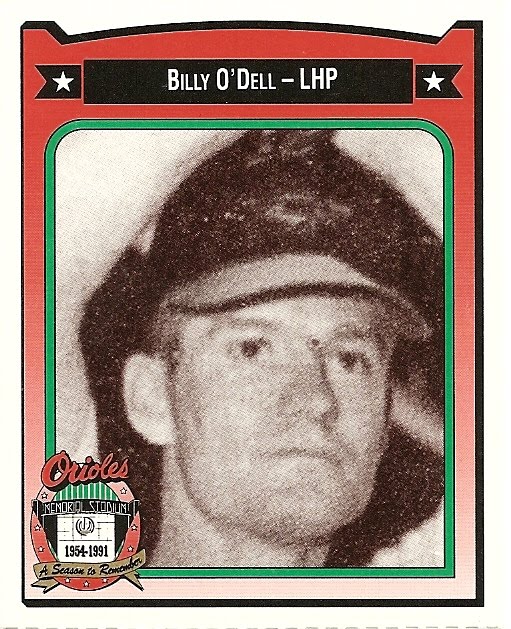
Billy O'Dell, 1991 Crown/Coca-Cola All-Time Orioles #337

It's not likely that rotund Oriole infielder Ty Wigginton, who could make his All-Star debut tonight in his ninth major league season, will have a big impact on the outcome of the Midsummer Classic. Of course, you never know who will shine in this July showcase. Just ask Billy O'Dell.

Back on July 8, 1958, Baltimore had the honor of hosting the All-Star Game for the first time. It was the 25th annual game; no game was played in 1945 due to World War II. The O's were in their fifth season in the league but were still battling to get out of the second division (they would finish sixth out of eight American League clubs in 1958 at 74-79). But there was cause for optimism, as manager Paul Richards was working to rebuild the club with his shrewd eye for talent. Catcher Gus Triandos, acquired in a blockbuster trade with the Yankees, had been selected to start behind the plate. He had already hit 16 homers en route to a career-high 30 (still a record for Oriole catchers). It was the second of three straight All-Star years for Triandos, and the first of two starting nods. Making the roster as a reserve pitcher was a 25-year-old southpaw from South Carolina named Billy O'Dell.

O'Dell had been signed by the Birds in the early going, back in June of their inaugural 1954 season. They gave him a $12,500 signing bonus, making him their first "bonus baby". He debuted with the O's two weeks later and never played a game in the minor leagues. Military service halted his development early on, but 1958 would be his breakout year. Shuttling between the rotation and the bullpen, he was only 8-9 at the break, but had strong peripheral stats (3.00 ERA, 1.06 WHIP, 2.68 K/BB). His luck turned around in the second half, allowing him to finish the year with a 14-11 record and eight saves.

A capacity crowd of 48,949 packed Memorial Stadium, and scores of fans watched at home on NBC. Vice-president Richard Nixon threw out the first pitch, and then it was time to play ball! It was a tight, brisk game from beginning to end. American League starter Bob Turley of the Yankees (a former Oriole) was shaky in the first inning, giving up two runs on singles by Willie Mays and Stan Musial, a hit-by-pitch to Ernie Banks, and a walk to Frank Thomas. A Hank Aaron sacrifice fly and a wild pitch accounted for the runs. Three of the first four A.L. batters reached in the bottom half of the inning against Warren Spahn, but a Jackie Jensen double play ball brought in the only run. The clubs traded runs in the second inning on singles by Bob Skinner for the Nationals and Nellie Fox for the Americans, and the score would stay put at 3-2 N.L. until the bottom of the fifth.

The A.L. loaded the bases with no outs in the fifth, but a Jensen RBI grounder was all they got out of it. So the game was tied for the moment. Boston's Frank Malzone led off the next inning with a single, and Triandos (1-for-2 with a single) was due up. American League skipper Casey Stengel pinch hit for the hometown hero with his own player, Yankee catcher Yogi Berra. The partisan crowd booed the Ol' Perfesser lustily. (Sound familiar?) An error by third baseman Frank Thomas (the fourth overall in the game) proved critical, as Gil McDougald singled home the go-ahead run. 4-3, A.L.

McDougald had pinch-hit for pitcher Early Wynn, so Stengel had to go to his bullpen. Perhaps trying to appease the Charm City fans, he called upon O'Dell. It may have been the smartest move he made all day, as Billy was flawless. He pitched three perfect innings, nine up and nine down, to earn the save with no margin for error. Five of the nine Nats that he retired were future Hall of Famers; he even struck out Bill Mazeroski and Ernie Banks. The American League won by a 4-3 score in two hours, 13 minutes. O'Dell was praised by Stengel, even though the Yankees didn't clinch home-field advantage in the World Series with the win or anything like that. Go figure.

Monday, July 12, 2010

Miguel Tejada, 2006 Upper Deck Player Highlights #PH-15

Tonight, Major League Baseball's All-Star Festivities get underway in earnest out in Anaheim with the 26th annual Home Run Derby. In its current state, this exhibition has become nightmarishly long and pretty grating on the senses, thanks in large part to ESPN's resident windbag Chris Berman. But occasionally a player heats up and puts on a real show - like Texas' Josh Hamilton in 2008 - and makes it all a little more worthwhile. I still remember watching 1993's Derby, back when it was only one round and ESPN still presented it on tape delay. It was a thrill watching Juan Gonzalez and Ken Griffey, Jr. battle it out, especially when Junior became the first (and still only) player to hit the B & O Warehouse at Camden Yards on the fly. So I'll be tuning in tonight for better or worse.
Of course, there are no Orioles in this year's longball contest; Adam Jones and Ty Wigginton are tied for the team lead with a ho-hum 14 homers apiece. But the O's do have a memorable history in past derbies:

-Cal Ripken, Jr. and Eddie Murray both participated in the inaugural contest back in 1985 in Minnesota's Metrodome. Cal finished last with a single clout, but Eddie tied with three other players for second place with a total of four. Cincinnati's Dave Parker took the crown with six.

-After a five-year absence from the Derby, Ripken redeemed himself in 1991 in Toronto's Skydome. He blew away the competition with 12 moon shots, leaving the Reds' Paul O'Neill in a distant second with five. Cal also took the All-Star Game MVP honors the next night with a 2-for-3 performance with a home run and three RBI. He became the first player to win the Home Run Derby and the Midsummer Classic MVP, and went on to become the first American Leaguer to be MVP on a cellar-dwelling club.

-Out in San Diego the following year, Cal failed to defend his crown. His four home runs left him in a four-way tie for third, far behind Mark McGwire's winning total of 12.

-Despite breaking the Yankees' 1961 team record for home runs in a season, the 1996 Birds sent just one representative to the Derby in Philly. Brady Anderson's 30 HR at the Break were a stunning surprise, but he ran out of gas in this contest after advancing past the first round with five taters. He actually topped himself with six in round two, but was outpaced by McGwire's nine and eventual champion Barry Bonds' ten (17 total). Brady's total of 11 placed him third overall.

-Back for more in 1997, Anderson placed fifth with four homers and failed to advance to the second round in Cleveland. Yankee Tino Martinez went deep 16 times in three rounds to win.

-In the final season of his first stint in orange and black, Rafael Palmeiro finally gained entry to the Derby in 1998 in Denver. He was one of four players to crank out seven longballs in the first round. As Ken Griffey, Jr. led with eight, the last three second-round slots came down to tiebreakers and Raffy advanced. He hit only three more and placed fourth. Griffey won with 19 overall.

-In 1999 at Fenway Park, the O's were represented for a fourth straight year, this time by...B. J. Surhoff? I clearly had forgotten this, but the stats tell me that he had 20 homers at the time, which was only two less than his previous best for an entire season. But Surhoff wasn't a natural power hitter and it showed, as his two four-baggers tied him with three others for fifth. On the plus side, one of the two contestants to finish worse than Beej was Sammy Sosa, who hit a single homer. Griffey made it back-to-back-wins with another 16-spot.

-After a four-year drought, the Birds came back with a vengeance in 2004. Two of the team's offseason acquisitions, Miguel Tejada and Rafael Palmeiro, were entered in the Derby in Houston. Both advanced past the first round; Miggi tied hometown hero Lance Berkman for third place with seven jacks, and Raffy led the way with nine. Palmeiro slumped to third in the next round with a five-spot, but Tejada put on a show with a single-round record of 15 to advance to the finals against Berkman (who was no slouch himself with 10 second-rounders). Not only did Miggi emerge victorious by clearing the fence five more times to Berkman's four, he had the highest total to that point with 27 homers. He even hit the longest shot of the day, a 497-footer.

-Pittsburgh wasn't as hospitable to Tejada as Houston had been. In a return trip to the Derby in 2006, the shortstop tied with his old sparring partner Berkman for sixth place with three home runs and did not clear the first round. Ryan Howard's total of 23 won the day.

-Aaand that's all she wrote for now. Next year, when Matt Wieters gets tired of lulling the rest of baseball into a false sense of security, I'm sure he'll drop some jaws in Phoenix with the first ever 50-homer Derby performance.

Sunday, July 11, 2010

Jim Dwyer, 1985 Fleer #176

When you're hot, you're hot. Take the Orioles, who head into the All-Star Break having won their first road series of any kind since last September. By sweeping the AL West-leading Texas Rangers, they've also got their first four-game road sweep since 1995 and their first four-game sweep at Texas since 1976. Maybe July will be kinder to the O's than April, May, and June were.

July was a good month for Jim Dwyer - July 1983, to be specific. The veteran outfielder made his mark with the Orioles as a pinch hit specialist, but he actually started a dozen of the 15 games he played for the club that month. Manager Joe Altobelli was wise to use him more frequently, because he was scorching. In 48 trips to the plate, Jim had nine walks, 18 hits, eight doubles, a triple, four home runs, and 17 RBI. He scored 14 times and batted .474 with a .574 on-base percentage and a 1.053 slugging percentage! The Birds, who would go on to win the World Series that year, went 11-4 with Dwyer making appearances in July. At the time, he set a record for the best batting average in a single month in major league history. A few players have passed him since, but his otherworldly performance is still fifth-best all-time.

Today you can still see Jim in a professional baseball capacity down in Fort Myers, FL, where he has been the hitting coach for Minnesota's Class A affiliate (the Miracle) since 2006.

Saturday, July 10, 2010

Cesar Devarez, 1997 Fleer #5


Now nobody can say that I've never posted a card of Cesar Devarez. That's a load off.

Friday, July 9, 2010

Vintage Fridays: Jim Palmer, 1973 Topps #341


I thought this card, featuring a young Jim Palmer taking a dip, was perfect for a leisurely summer day.

Thursday, July 8, 2010

Jerry Hairston, Jr., 2002 Topps Reserve #18


Wow, I'm pretty lousy at this whole blogging-on-vacation thing. I guess that's why I usually schedule posts during my absences.

When I was in San Diego last month, I saw both Jerry Hairston, Jr. and his younger brother Scott play for the Padres. I attended the game on Fathers' Day, and between innings various players appeared on the video board with pre-recorded messages for their dads. Jerry thanked his father for his support and for liking Jerry more than Scott. It was worth a laugh.

Wednesday, July 7, 2010

Melvin Mora, 2000 Upper Deck SP Authentic #172


Though I've always had an appreciation for the 19th-Century style and florid quirkiness of Topps' Allen and Ginter cards, I never have mustered up the nerve and the cash to jump headlong into an attempt at collecting the set. Instead, I buy a pack or a blaster now and again and wait for the Orioles to trickle in through trades. So I have a bunch of Melvin Mora A&Gs but little else.

However, I'm always on the hunt for freebies. I just entered a contest at Coolio Cards for a chance to win a hobby box of 2010 Allen and Ginter. Will I win? Probably not. But it's worth a shot.

Tuesday, July 6, 2010

Kevin Brown, 1995 Score Select #228


Nothing beats a dynamic action photo on a baseball card. Unfortunately, I'm not all that enthralled by Kevin Brown's turn at pitchers' fielding practice in spring training. Back to the drawing board, Score.

Monday, July 5, 2010

Rene Gonzales, 1989 Donruss #377


Could the more seasoned Orioles fans out there help me
? I didn't get on the O's bus until 1993, so I wasn't around for the Rene Gonzales days. His first couple Donruss cards refer to him as "R.C." Did he ever actually go by that nickname? Or was Donruss going into business for themselves, a la Topps and "Bob" Clemente? Inquiring minds want to know.

Sunday, July 4, 2010

Sam Horn, 1992 Pinnacle #221


Whoops! Somehow in all the July 4 hub-bub, I forgot to post a card. It probably had something to do with the fact that my girlfriend and I left my house at 2:30 AM to drive to the beach...something about beating the holiday traffic. We spent the morning and afternoon homeless in Ocean City, and then passed out cold after finally checking in at the hotel. We woke up in time for fireworks, and that about did it for the day.

As a belated Independence Day post, here's (Uncle) Sam Horn. It was really just a happy accident that one of the cards I pre-scanned for the week was this one. This morning I read about Night Owl's all-Sam team and decided to piggyback on his idea. So there you have it!

Saturday, July 3, 2010

Ramon Hernandez, 2007 Bowman Chrome X-Fractor #91

It may seem a little soon, but I'm leaving you all again. I'm leaving for Ocean City, MD in a few hours and I'll be there until next Sunday. In the ensuing eight days, I will post cards that were chosen with very little forethought. For instance, this X-Fractor of Ramon Hernandez. I don't really know what an X-Fractor is, I don't think I have any others like it, but it was in the middle of a stack on my desk and it sure does have a shiny checkerboard pattern. So soak up the X-Fractrosity, whilst I prepare to soak up some rays.

Friday, July 2, 2010

Vintage Fridays: Howie Fox, 1954 Topps #246


Howie Fox pitched for nine years in the major leagues and sported a gruesome 43-72 won-lost record that included a league-leading 19 losses with the Reds in 1949. He did rebound the following year with an 11-8 mark, but that kind of thing doesn't grab headlines. At the end of his career, Howie had the rare distinction of playing for the AAA International League Baltimore Orioles in 1953 and the MLB's American League Baltimore Orioles the following season. He had won 15 games for the minor-league club, but posted just a single victory in 38 games (mostly in relief) with the big league Birds in 1954. His 3.67 ERA was the lowest among the few regularly-used relievers on the club, but it was not enough to guarantee the veteran a spot on the club a year later. Instead he was dispatched to AA San Antonio, the place where his life would end shortly after the end of that 1955 season.

Fox, weighing the career prospects of a 34-year-old pitcher who's been farmed out to the Texas League, opened a tavern in San Antonio. On October 9, 1955, three men entered his bar and began harassing the bartender. Howie intervened and was stabbed by one of the aggressors. The knife wound was fatal. I was sorry to learn about the tragic and premature ending to his life, but I am relieved that no other ex-Oriole has been murdered to date. Howie Fox is buried at Laurel Grove Cemetery in Springfield, Oregon. For information about his burial site and some photos (including a full-length portrait of him in his Orioles uniform), visit this site.

I recently found Howie's 1951 Bowman card in the two-dollar bin at my local hobby shop. Knowing only that he was an ex-Oriole who was killed in a bar fight (as Wikipedia so unfortunately phrased it), I was intrigued enough to make it one of three cards from the set that I bought that day. It didn't hurt that he was pictured in a Reds uniform, allowing me to add another player/team combo to one of my sub-collections. Now that I've gotten a clearer picture of just how he died, I'm very glad to have this card in my possession and to have the chance to share a bit of his story with you.

Thursday, July 1, 2010

Bob Alexander, 1991 Crown/Coca-Cola All-Time Orioles #7

On the extremely off chance that I have any readers in the Great White North, I would just like to wish you a Happy and Prosperous Canada Day. I haven't been across the border since I spent my Spring Break in Toronto during my sophomore year of college, way back in the heady days of March 2002. But I found the sights beautiful, the streets clean, the exchange rate favorable, the beer cold, and the hobos entertaining. I have no quarrel with you, Maple Leafers.

Bob Alexander was not the best Canadian-born player to suit up for the Orioles, but he was the first, way back in the team's second year in Baltimore. Though he made his big league debut that year, he was already a wizened professional vet in his 13th season. The Yankees originally signed the Vancouver native way back in 1942, when he was 19 years old. His minor league travels had taken him to 11 different locales, from Hagerstown to Montreal. The second-division Birds (they finished seventh out of eight American League clubs with 97 losses) carried Bob on their Opening Day roster, but only used him four times in relief before sending him back to the bus leagues in May. His first three appearances were mop-up jobs in which he allowed six runs in three and two-thirds innings, but he did go out on a high note.

On May 1, 1955 the O's and White Sox were in the first game of a doubleheader and went to extra innings tied at seven apiece. When Don Ferrarese, their fifth pitcher of the game, walked Nellie Fox to load the bases, manager Paul Richards called on Alexander to retire Minnie Minoso to send the game to the 11th frame. The 32-year-old rookie did his job, getting Minoso to foul out to first base, and was rewarded with his only major league win when Jim Pyburn pinch-hit for him and delivered a two-run single in the top of the following inning. Harry Byrd nailed down the save despite allowing a run-scoring double to Clint Courtney.

Bob made it back to the bigs two years later for one more cup of coffee with the Indians. He was hit hard again, giving up seven runs in as many innings and failing to retire a batter in what proved to be his MLB swan song. He continued to pitch in the minors through the 1960 season, finally hanging up his spikes after 18 seasons and 148 professional wins...one of which came in a Baltimore Orioles uniform. O Bob Alexander, we stand on guard for thee!

Wednesday, June 30, 2010

Chris Hoiles, 1997 Stadium Club #330

Well, it was nice while it lasted. From Thursday through Sunday, the Orioles crafted their longest winning streak yet this season, a whopping four games. It was especially encouraging to see the offensively-challenged O's rally from deficits of 3-0, 6-0, 5-0, and 3-0 again to put those contests in the win column. But during last night’s back-to-reality, 4-2 loss against Oakland, MLB.com beat reporter Britt Ghiroli quoted a disturbing statistic. So far in 2010, the Orioles are 0-46 when trailing after eight innings. No matter what the margin, they’ve been unable to overcome it. Among the many things that O’s fans have been denied this season, they’ve yet to be treated to the exquisite relief and euphoria of a probable defeat turned on its head into a sudden victory.

Few ninth-inning comebacks in recent Birds history have been as dramatic as the one delivered by Chris Hoiles on May 17, 1996. It was a Friday night game vs. the Mariners at Oriole Park at Camden Yards, and it had been a back-and-forth, high-scoring affair, as was the M.O. for the '96 O's. The home team bombarded Seattle starter Bob Wolcott, with 11 of 18 batters reaching base against him. Young Orioles starter Jimmy Haynes survived five shaky innings of his own (8 H, 3 BB), but left with a 7-2 lead. The first man in from the 'pen was Arthur Rhodes, who did not retire any of the four batters he faced. All of them came around to score, with a little help by way of throwing errors by Roberto Alomar and B. J. Surhoff. Roger McDowell stopped the bleeding, but it was a whole new game at 7-6.

The Birds got some breathing room via a Rafael Palmeiro two-run home run in the home half of the seventh, making it 9-6. When Seattle threatened again in the eighth, Davey Johnson started playing bullpen roulette and busted. McDowell left with a run in, two on, and one out. Jesse Orosco retired the only batter he faced (Luis Sojo), leaving one more out to be collected by Alan Mills. Mills got that out, but first he walked pinch hitter Brian Hunter to load the bases and allowed an Alex Rodriguez grand slam to un-load them. 11-9 Mariners.

Cal Ripken, Jr. halved the deficit with a solo homer off of Mike Jackson, but Mills continued his Gasoline Man act in the ninth, with a two-run shot by Jay Buhner giving the M's and closer Norm Charlton a 13-10 cushion heading into the bottom of the ninth. That's when things really got wild.

Alomar led off with a walk, but Charlton got Palmeiro to strike out. A Bobby Bonilla double brought the tying run to the plate, but pinch hitter Billy Ripken (stop laughing) fouled out to first base and the Orioles were down to their last out. Cal picked up his little brother by coaxing a walk to load the bases, which placed the burden squarely on the shoulders of Chris Hoiles. The tension built as the veteran catcher worked the count full. Now the Birds were down to their last strike...the pitch was delivered by Charlton...

GRAND SLAM! ORIOLES WIN, 14-13!

What Hoiles did on that night is one of the rarest of baseball feats, the "ultimate grand slam": a walkoff bases-loaded homer that allows the home team to win by a single run. Only 22 other players in major league history have done it, but Chris was the only one to pull it off with two outs and a full count, causing some to dub his clout the "Ultimate Ultimate Grand Slam". Not a bad feather to put in your cap.

Tuesday, June 29, 2010

Eddie Murray, 1985 Fleer Limited Edition #23

If Eddie Murray looks a bit disgruntled on this card, it's probably because he can't get any respect. "Steady Eddie" may have been the best player to never win a Most Valuable Player award, which isn't to say that he didn't come agonizingly close. The slugging first baseman had six top-five finishes in MVP balloting, including a string of five straight from 1981-1985. In back-to-back years he was the runner-up, first to Milwaukee's Robin Yount in 1982 and then to his Orioles teammate Cal Ripken, Jr. in 1983. In the latter case, the total points favored Cal 322-290.

This actually pertains to my latest Sporcle quiz, which I hope will have a little more wide-ranging appeal than the Maryland-born home run hitter quiz. This time, I'm asking you to name the second bananas on baseball's annual MVP ballot from 1980-2009. Enjoy it, offer any suggestions you may have, and tell your friends!

Monday, June 28, 2010

Jamie Moyer, 1994 Donruss #547

We're all about baseball history here at Orioles Card "O" the Day, especially as it pertains to the delightfully elderly Jamie Moyer. Last night, the only active major leaguer born during the Kennedy administration won his ninth game of the season and the 267th of his endless career. He's 36th all-time in total victories, and his next 'W' will tie him with Jim Palmer. After that, he's only two wins away from former O's teammate Mike Mussina. But in Sunday night's game, Jamie unseated another pitching great with Birdland ties for a dubious honor. He surrendered a two-run homer to Vernon Wells - the 506th home run allowed in his career. Of course, when you hang around for 24 years and pitch to contact, you're bound to get hammered a few times. I wandered over to Jamie's Home Run Log on Baseball-Reference and dug up some real great trivia on Moyer's roundtrippers:

-He allowed his first two home runs on June 23, 1986...24 years and five days ago. The first was hit by Juan Samuel, currently the interim manager of the Orioles. The second was hit by Mike Schmidt, who was inducted into the Hall of Fame in 1994.

-322 different batters have victimized Jamie, including six current Hall of Famers (Schmidt, Tony Gwynn, Andre Dawson, Wade Boggs, Paul Molitor, and Cal Ripken, Jr.). At a glance, as many as 15 others could be enshrined in Cooperstown when the smoke from the Steroid Era clears.

-Manny Ramirez is Moyer's most frequent flier with 10 home runs. Rounding out the Top Five are Carlos Delgado (8), Bernie Williams (7), and Eric Chavez, Alex Rodriguez, and Frank Thomas (6 each).

-Batters have knocked the ball out of 42 different ballparks against Jamie. Contrary to popular belief, he never pitched at Shibe Park or Forbes Field.

-Once he got to 400 homers allowed, he apparently couldn't wait to give up #500. David Ortiz hit the big 4-0-0 off of Moyer in a Red Sox-Mariners tilt in 2006; it was the first of five home runs Boston hit against the lefty that day. Alex Gonzalez, Jason Varitek, Kevin Youkilis, and Manny Ramirez rounded out the quintet.

-He's given up only one inside-the-park home run. It was hit by Kansas City's Kevin Seitzer on May 13, 1989.

-Likewise, Jamie has surrendered just one walk-off home run. It came on June 24, 2004. The Mariners and Rangers had been tied at seven when Moyer was called upon to make an emergency relief appearance in the 15th inning. He held Texas scoreless for three innings before Hank Blalock singled to open the bottom of the 18th. Two pitches later, Alfonso Soriano ended the game with a round-tripper.

-He has given up home runs to the father-son combos of Cecil and Prince Fielder and Tony Pena Sr. and Jr.

-Last year, Jamie was taken deep by Dan Murphy of the Mets. Murphy was born on April 1, 1985. Moyer was drafted by the Cubs in June 1984, ten months earlier.

Sunday, June 27, 2010

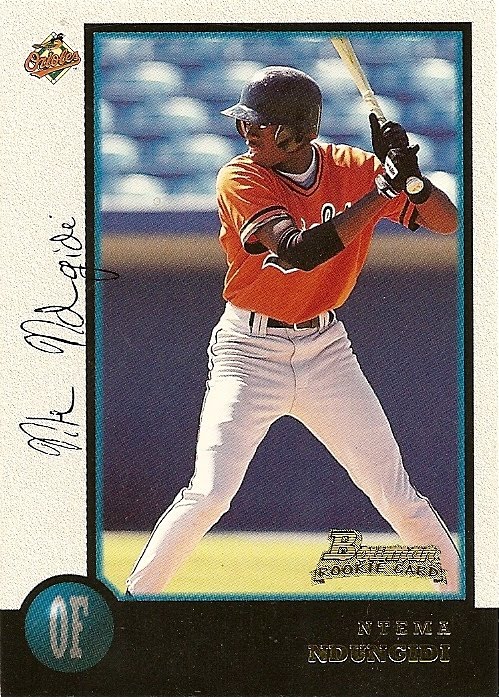
Ntema Ndungidi, 1998 Bowman #151

Your wish is my command, dear readers. So when a longtime follower like William requests a card of Ntema Ndungidi, I jump at the chance to actually show off this card. Sure, there's a chance that William was just being a smartass. Or maybe he saw this card in his own collection and thought he had a funny name; seriously, how many of those letters are silent? Perhaps he knew that Ntema was the first African-born player in professional baseball, having been born in the former Zaire (now the Congo), and thought it would be a neat tie-in to the World Cup. There's even a chance that William knew that the O's actually used a first-round "sandwich pick" (36th overall) to draft a guy who hadn't even played high school baseball and wouldn't end up making it beyond AA Bowie in six seasons in the organization. When you look at a decision like that, you can't help but feel a little more optimistic about more recent personnel choices in Birdland.

Any way you slice it, Ntema Ndungidi is a conversation starter.

Saturday, June 26, 2010

Nick Markakis, 2008 Topps Co-Signers #11

With a team as young as the Orioles, one of the (many) problems has been the lack of a player to serve as a leader both on and off the field. The O's need someone to lead by example and to make others accountable when they're not giving an honest effort. If recent events have been any indicator, it looks like Nick Markakis is ready to step into that role.

Last week, the club's star right fielder allowed his frustration to boil over in an interview with the Baltimore Sun's Jeff Zrebiec. He openly questioned the offensive approach of the team without calling attention to specific players, noting that the swing-away philosophy wasn't working and that the successful teams in the division like the Yankees and Red Sox have patient, lengthy at-bats that wear down pitchers and allow them to wait for the right pitch to hit. For a player with a public image of being quiet and unassuming to speak out like that, he has to be frustrated with the status quo. I'm sure it got the attention of his peers.

Then two days ago, Nick requested a one-on-one meeting with owner Peter Angelos to discuss the direction of the Orioles. They ended up talking for three hours over lunch, with Markakis expressing the need for the young players on the team to have the support of a handful of productive, proven veterans. He also explicitly stated his desire to assume a leadership role on the team. However, actions speak louder than words. For all of the gripes about Angelos' meddlesome reputation as an owner, he has been notably hands-off with the players themselves. It's believed that the summit with Markakis was his first one-on-one meeting with a player since he and Melvin Mora discussed a contract extension four years ago. For a player to take the initiative to ask for such a forum with Peter is no small feat.

Not for nothing, but the Birds are 2-0 since the Markakis-Angelos pow-wow. They've come back from a three-run deficit and a six-run deficit, and scored 18 total runs after struggling most nights to push across three or four. I'm just saying.

Friday, June 25, 2010

Vintage Fridays: Baltimore Orioles, 1971 Topps #1

Tomorrow, many of the men pictured on this card will reunite at Oriole Park at Camden Yards to celebrate the 40th anniversary of their 1970 World Championship season. Gates open at 2:30 PM for an alumni press conference featuring Brooks and Frank Robinson, Jim Palmer, Paul Blair, Boog Powell, Davey Johnson, and Earl Weaver. Concurrent with the press conference will be autograph sessions on the lower concourse. Scheduled to sign are Fred Beene, Don Buford, Andy Etchebarren, Bobby Floyd, Bobby Grich, Dick Hall, Dave Leonhard, Tom Phoebus, Merv Rettenmund, Pete Richert, and Eddie Watt. There will be a memorabilia sale before and during the game and a pregame ceremony on the field at 3:30. The current O’s will wear 1970 throwback uniforms, as will their opponents, the Nationals (they’ll be dressing up as the old Senators, not the Expos). By my count, that’s 16 former players and the manager, and that doesn’t even include current hitting coach Terry Crowley. Unfortunately, 11 of the 32 men who suited up for the Birds that year have passed away. The organization has done well to gather the bulk of those who remain, though.

I fear that we may never see a team like this one again. To put it another way, those of us born in the 1970s and later just plain may not see it. Not to belabor the point, but at the 72-game mark the 1970 O’s were 46-26. The current team has twice as many losses and would be trailing them by a full 26 games. From 1969 through 1971, the Birds put together the most dominant three-year regular season run by any baseball team, winning 318 games and losing only 164 (a winning percentage of 67%). They never trailed in the standings after June 4 in any of those three seasons, and finished each year with at least a 12-game cushion on the runner-up. They swept all three American League Championship Series. Of course, the black mark on their record is the fact that they won “only” one World Series in that stretch, getting shocked by the Mets in 1969 and being outlasted by Roberto Clemente, Steve Blass, and the Pirates in 1971.

But that makes the 1970 club all the more memorable. There were seven All-Stars (Frank, Brooks, Palmer, Boog, Cuellar, Davey Johnson, and McNally). Boog Powell (.297/.412/.549, 35 HR, 114 RBI) was the AL MVP, finally nabbing the award after two previous top-three finishes in balloting. In a sign of things to come, Jim Palmer, Dave McNally, and Mike Cuellar were all 20-game winners, with the latter pair tying Minnesota’s Jim Perry with a league-leading 24. Brooks, Paul Blair, and Davey were Gold Glove winners. And of course the World Series became the Brooks Robinson Show, as #5 robbed the Cincinnati Reds time and time again with jaw-dropping plays at third base and hit .429 (9-for-21) with two doubles, two homers, and six RBI in the five-game set.

So if you’re in the neighborhood this weekend, drop on in at Eutaw Street and toast one of the greatest teams in the history of our fine city.

Thursday, June 24, 2010

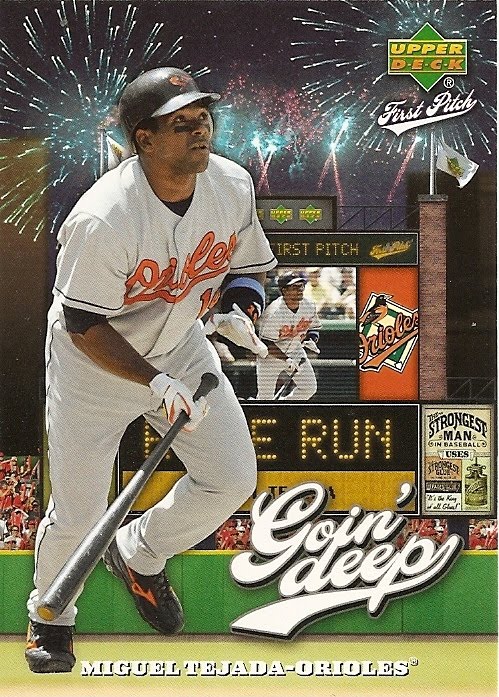
Miguel Tejada, 2006 Upper Deck First Pitch Goin' Deep #GD-25

So here's the deal. There's not a whole hell of a lot to celebrate about this wretched season. If Miguel Tejada has four hits in one night, thereby quadrupling his RBI total from the first 23 days of June, and also breaks a 201-at-bat homerless drought, you'd better believe I'm going to commemorate it.

The Orioles have 20 wins. It only took them 72 games, and it came three weeks after the Indians became the second-to-last team to win their 20th. Hip...hip...hooray.

Wednesday, June 23, 2010

Arthur Rhodes, 1997 Topps #53

The last time Baltimore had a winner on the diamond, Arthur Rhodes was a 27-year-old reliever having a career year. It was 1997, and the lefty was already in his seventh season with the Orioles. The first five had been marked mostly by setbacks and disappointment, as he failed to take hold of a spot in the starting rotation despite multiple opportunities and a world of talent. But Davey Johnson took over in 1996 and shifted Arthur to the bullpen, a move that worked like a charm. After a solid season in which he “vultured” nine wins with a 4.08 ERA, he followed up with a 10-3 record and a 3.02 ERA in ’97. He did it all in a career-high 95.1 innings, striking out 102 batters and posting a 1.06 WHIP.

Now it’s 2010. The O’s have been skidding for nearly a decade and a half, but Rhodes is still pitching. Moreover, he’s pitching some of the best baseball of his life at age 40. Now a late-inning lefty specialist for the Cincinnati Reds, his seventh team, Arthur has appeared in 34 games for a total of 31 innings. He has struck out 29 batters, walked only 10, and given up 15 hits – that’s a 0.81 WHIP. Do you know how many earned runs he’s allowed?

One.

That’s a 0.29 ERA, folks. The crazy thing is that that single earnie was an eighth-inning pinch-hit home run by Colorado’s Jeff Baker, and it was enough to break a 3-3 tie and saddle Rhodes with a loss.

Anyway, it’s been 11 years since Arthur Rhodes left Charm City, and he doesn’t seem ready to stop. I would say that we could still use him, but he’s a one-inning guy at most. That leaves another eight innings to worry about.

Tuesday, June 22, 2010

Randy Milligan, 1991 Studio #7

It's a big day for animalistic baseball transactions, as the Orioles traded a (Ross) Wolf to the Athletics for a (Jake) Fox. At first blush, it's a swap of 27-year-old minor league vets, but I appreciate the fact that corner infielder/outfielder/emergency catcher Fox joined the major league club right away, ostensibly putting one more nail in the coffin of punchless Garrett Atkins.

"Moose" Milligan could not be reached for comment. Neither could Walt "Moose" Dropo, Mike Mussina, Howie Fox, Chico Salmon, Bob "Rabbit" Saverine, Marlin Stuart, Dizzy Trout, Gregg "Otter" Olson, Mike Parrott, John "Horse" Orsino, Terry "the Crow" Crowley...well, you get the idea.

Monday, June 21, 2010

Cal Ripken, Jr., 2007 Upper Deck Road to the Hall #CRTG17

I'm sure you were worried when I didn't post yesterday, but I did in fact have a safe and uneventful flight home from San Diego. It's just that I didn't get my Internet set up at the new house until today (being Tuesday), and I had miscalculated the number of cards I needed to scan last week. So this is your Monday post! Tuesday is forthcoming.

It was a pleasant and restful long weekend in Coronado with my good friends Jill and Tristan and their menagerie (two cats and a dog). No difficulties on the flight in or the flight back, so it seems like a nonstop flight is the way to go. My first experience with Southwest Airlines was a positive one. There was copious good food and drink, including a cookout with J and T's local friends. I took a few lengthy walks, taking advantage of the fantastic weather (70s and sunny and not a bit of humidity - I miss it already!) and the proximity to the beach. I think that about covers it all...

Oh, right, there was a baseball game.

Tristan was able to get some unbelievable seats for Sunday's Orioles-Padres tilt at Petco Park. Like second row behind the home dugout unbelievable. I couldn't resist the urge to root on my team all the way across the continent, so I dressed as conspicuously as possible with my Angry Bird cap and construction-vest-orange Matt Wieters tee. I did not hear a single taunt or jeer from the home fans. Maybe that was because there's no natural rivalry there, or maybe the people of Southern California are just more genteel. Or maybe they took pity on the fan of a team that has as many road wins in 2010 as Rockies pitcher Ubaldo Jimenez. Who's to say?

We took our seats just as the ceremonial first pitches were being thrown. As it was Father's Day, several dads of current San Diego players did the honors. This included Tony Gwynn, whose son and namesake is now the center fielder. It was a nice moment.

Also nice was the top of the first inning, as the O's loaded the bases against opposing starter Jon Garland. Knowing the team's penchant for stranding runners, I cheered extra-loud when Adam Jones beat out a two-out grounder to plate a single run. I only half-jokingly told my friends that it would be the only run they'd score all game. But Matt Wieters proved me wrong and did me proud by clearing the bases with a double to break his 0-for-16 skid and give rookie Jake Arrieta an early jump on the third win of his career.

I'd like to tell you more about the game, but I can't seem to recall what happened after that. I vaguely remember Arrieta getting bashed around for six runs and being pulled after only three innings, but I'm sure that was just a waking nightmare. I could have sworn that the Orioles had only two baserunners in the last seven innings, but that just can't be right.

The good thing about being on vacation is that I didn't need any excuse to drown my sorrows in some fine microbrews at the Yard House after the game. It's probably just as well that my next trip to San Diego probably won't coincide with a visit from the Birds.

Sunday, June 20, 2010

Steve Finley, 1989 Upper Deck #742


In their ongoing efforts to break new ground in baseball card photography and presentation, I'm sure that Upper Deck thought they were capturing Steve Finley in a moment of intense contemplation as he prepared to bat. Instead, a half-deflated chewing gum bubble makes him look like nothing so much as a slack-jawed goon. Swing and a miss.

Saturday, June 19, 2010

Ken Singleton, 1984 Donruss #610

I think that Ken Singleton is one of the most underrated players of his era. He played for 15 seasons, and posted an OPS+ of less than 100 only twice: his rookie year (when he was right on the cusp with a 99 in 76 games), and his final season. Overall, his OPS+ was a very good 130. Ken had that valuable combination of on-base skills and power that made him a highly productive player: he had five seasons of 20-plus homers and another seven in double digits, as well as an impressive .388 on-base percentage. He routinely carried an on-base percentage that was more than 100 points above his batting average, walking 90-120 times with regularity. For his career, he walked slightly more than he struck out. But you don't often hear Singleton discussed as one of the best hitters of his day.

I recently pulled out one of his cards and looked at the stats on the back. I knew that Ken must have been underestimated even when active, since the Mets and the Expos both let him get away in the early years. But I was still amazed to see that in 1973, as a 26-year-old fourth-year player, the outfielder hit .302 with 23 homers, 103 RBI, and 123 walks (that's a .425 OBP!) for Montreal. Sure, his power dipped the following year (20 2B, 9 HR), but he still got on base at a .385 clip in a "down year". How could the Expos turn around and trade him entering his prime? And how could they also give up on a solid 27-year-old starter like Mike Torrez? What could be worth that? Surely not a past-his-prime Dave McNally and a struggling Rich Coggins. Our gain, I guess.

Friday, June 18, 2010

Vintage Fridays: Lee May, 1980 Topps #490

During the 1965 season, Lee May was a 22-year-old first baseman at AAA San Diego, the Pacific Coast League affiliate of the Reds. He did everything he could to get noticed by the big league club, swatting 34 home runs and driving in 103 while batting .321. He also had 32 doubles, amassing a lofty .586 slugging percentage. These feats did earn him a five-game cup of coffee at the end of the year, but he received only seven at-bats (all as a pinch hitter) in the first month of the following season. He failed to get a hit in his limited opportunities and was sent back to the minors, this time to the less exotic locale of Buffalo. Lee was brought back in September and caught fire, hitting safely 25 times in 68 at-bats for the remainder of the season (.368). With that he was in the big leagues for good, hanging around until 1982 - long enough to hit 354 home runs. He topped 20 longballs in all 11 of the seasons in which he received at least 500 at-bats.

The story of Lee May seems like the kind of cautionary tale that Orioles fans should keep in mind during this flaming hellscape of a season. Many of us are panicking because the young players who were supposed to improve and flourish this season took a step backwards instead. Brian Matusz has been winless for two months now (not entirely his own fault), Brad Bergesen and Chris Tillman have been dropped from the rotation for the time being, Matt Wieters is short on power and average, and Nolan Reimold is struggling to hit his weight at AAA Norfolk. Sure it's distressing that all of this has happened at once, and it underscores the point that there are many more Alex Ochoas in baseball's history than there are Lee Mays, but it's still early in the careers of these young men. It's getting later all the time, but there's nothing you or I can do. Let the chips fall where they will.

Thursday, June 17, 2010

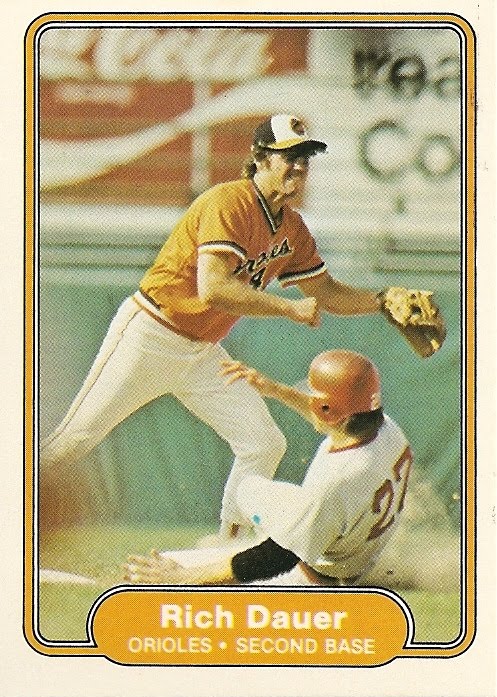
Rich Dauer, 1982 Fleer #161


All things considered, this isn't a bad photo by 1982 Fleer standards. It's a fairly dynamic shot of Rich Dauer trying to turn the double play as Carlton Fisk barrels into him at second base, kicking up a plume of dirt. There's also some product placement for Coca-Cola, which I'm sure they didn't mind.

By the way, now that I'm officially on Pacific time for the weekend, this still qualifies as a Thursday blog entry - it's 10:40 here.

Wednesday, June 16, 2010

Aurelio Rodriguez, 1983 Topps Traded #97T

While researching an upcoming 1965 Topps Project post about ex-Athletics pitcher Aurelio Monteagudo, I was reminded of a chilling bit of trivia (previously mentioned on some of my favorite card blogs). There have been three players with the first name "Aurelio" in major league history, and all three have been killed in car accidents between the ages of 44 and 52.

Monteagudo was a second-generation big leaguer from Cuba who gained Venezuelan citizenship after Castro rose to power. He relied on a screwball and pitched mostly in relief in parts of seven seasons (1963-1967, 1970, 1973), but played practically year-round in various countries for two decades. He compiled a 3.37 ERA in the Venezuelan Professional Baseball League. In the Mexican League, he was tops in strikeouts in 1978 and tossed a no-hitter in 1979. In 1990, he was killed in a car accident in Mexico at age 46.

Aurelio Lopez was a hard-throwing reliever from Mexico who became known as "Senor Smoke" while with the Tigers. He won ten or more games thrice during his years in Motown, saved 85 games, was selected to one All-Star Game, and pitched to a 3.41 ERA. He was a major leaguer for 11 years (1974 and 1978-1987). In 1992, he was in a fatal accident in his native country in which his car overturned and he was ejected from the vehicle. It was September 22 - one day after his 44th birthday.

Aurelio Rodriguez, like Lopez, was a Mexican native who enjoyed his greatest success with the Tigers (both are also in the Salon de Fama, the Mexican Baseball Hall of Fame). His major league career spanned three decades (1967-1983). He became renowned for his strong throwing arm, winning a Gold Glove at third base in 1976 to break Brooks Robinson's 16-year stranglehold on the award. Aurelio also had a dubious honor among card collectors: his 1969 Topps rookie card does not feature his photo, but rather a portrait of Angels batboy Leonard Garcia. The third baseman came to Baltimore in the final season of his MLB career, largely as a bench player. He managed only eight hits in 67 at-bats and was released in August, at which point he finished his career with the White Sox. On September 23, 2000 (one day after the eighth anniversary of Lopez's death), Rodriguez was visiting Detroit. At 2:00 PM, he and an unidentified woman were walking on the city's Southwest side when a car jumped the curb and ran over him. The driver had already been ordered not to drive and had her license suspended due to a previous brain anuerysm. Aurelio had to be pulled out from underneath the car and was pronounced dead at Henry Ford Hospital. He was 52 years old. The motorist was charged with felony manslaughter but received probation.

Sorry to be such a downer, but it's a gloomy overcast day and this piqued a morbid part of my brain.

Tuesday, June 15, 2010

Benny Ayala, 1981 Topps #101

Suddenly, Benny Ayala had the sneaking suspicion that he was being watched.

Monday, June 14, 2010

Tim Stoddard, 1981 Donruss #475

Although I'm settled into my new house and it even looks like a domesticated human lives there, I still have some kinks to iron out. I didn't get the cable/Internet situation ironed out until today, and the install won't actually take place until next Tuesday. So I've been Macgyvering it for the last week or so, scanning a few cards at a time and saving them on a thumb drive until I can mooch off a loved one and upload to the 'net. This process is further deemed necessary by my travel itinerary this week, as I am flying out to San Diego on Thursday to spend a weekend with some friends. I will fly back in to BWI late next Monday evening. Do you know what that means?

Theme week!

I hereby dub the next eight days Eighties Week, featuring eight choice cards from the decade of my birth. We'll kick it off with a card that's quintessentially 1980s. Donruss and Fleer broke the baseball card monopoly previously held by Topps in 1981, but they still had some catching up to do. Their cards were riddled with typographical errors, the card stock was cheap, and many of the photos were blurry, off-center, bizarrely composed. I've heard the massive Tim Stoddard referred to as "Bigfoot", and the quality of this picture certainly is reminiscent of the grainy, dark shots that are often offered up as proof of the existence of his namesake. All you can see is his ample backside and the profile of his face, as though the photographer was eavesdropping on the pitcher. He seemed to be cloaked in late-afternoon shadows. Based on the dirt and the chalk line, he's probably warming up on a bullpen mound in foul territory. Unusual, but not pretty.