Quiz time! Why does Don Buford look so cheesed off?
a) He just got traded from the White Sox to the Orioles, and he knows that he looks ridiculous with his bare head and pinstriped jersey on a card that says "Orioles".
b) He spent the bulk of his time in Chicago playing second base and third base, positions that are well spoken for in Baltimore at the hands of Messrs. Johnson and Robinson. So he's just trying to figure out where he fits in with the Birds. (Hint: left field.)
c) Some fortune teller just told him that he'll make history as the first player to ever lead off a postseason series with a home run, doing so against Mets ace Tom Seaver in the opener of the 1969 World Series...but that some day he would have to share that distinction with a rodent-faced little dirtball named Dustin Pedroia.
d) Not only is this card woefully miscut, but whoever owned it for the first four decades of its existence allowed it to be creased, dinged, and scratched. Is that any way to treat an All-Star and the leadoff hitter for the 1970 World Champs?
Showing posts with label 1968 topps. Show all posts
Friday, December 4, 2015
Friday, January 10, 2014
Vintage Fridays: Hank Bauer, 1968 Topps #513
My wife may be the only person who enjoys early mornings less than I do. I routinely wake up at 6:00 AM on work days, and she often refers to it as "the middle of the night". I consider my early rising to be a necessary evil. I work on flex time, so the earlier I get to the office, the earlier I get out. I can clock in as early as six, or as late as half past nine. While it's certainly nice to be home before 5:00 PM most days, it's also important for me to avoid the worst of the Beltway traffic. Nobody likes sitting bumper-to-bumper on the highway, and I know from experience that congestion on 695 can turn a 25-minute commute into an hour-plus slog. If anything, the near four and one-half years that I spent trekking deep into Washington DC for work on a daily basis (by car, train, subway, bus, and foot) have made me even less tolerant of the slightest delays. When I put it all in perspective, even an hour spent traversing 17 miles is a relief compared to the best case scenario of my Columbia-to-Georgetown days, when I'd leave my apartment at 6:45 AM and sit down at my desk around 8:30. But honestly, I feel like I have to make up for the time lost while enduring all of those mass transit delays and breakdowns. Every additional minute spent in my car is a minute not spent watching one of my favorite shows, or playing a video game, or organizing cards, or reading a new book.
I cope with the tedium of my daily drive by keeping my mind stimulated in various ways. Usually I listen to an audiobook or the occasional podcast. I finished The Hunger Games recently and now I'm pushing through Wilkie Collins' 1859 mystery novel The Woman in White, which checks in at a whopping 25 hours of air time. Only 18 hours left to go! If I'm not in the mood for placidly listening along and trying to absorb a narrative, I'll put on some music and play a solo version of the road games that my family has always used for time-wasters on long trips. I often keep track of all of the various out-of-state license plates that I find on the other vehicles. I might watch road signs, billboards, and other such scenery and try to pick out names or words that double as the surnames of past and present baseball players. Sometimes I just let my mind wander and see where it goes...all while keeping my primary focus on the road, of course.
This morning I was out of the house even earlier (and darker) than usual. Our dog, an affectionate 35-pound mutt named Val, has been yanking us out of our slumber around 5:00 AM for the past few days, and I'd already resolved that I would just get up and get moving if it happened again today. If I was already awake, with less than a full hour left before I'd be getting up anyway, might as well see if I can finagle an early exit from the office. So when Val started whining loud enough for me to hear her on the top floor at 5:15, I kept my word and thereby made it to my car by 6:00...just in time for the icy rain that was just bothersome enough to make driving a bigger chore while still allowing my agency to operate on a regular schedule. It didn't look good when I merged onto the Beltway and found three lanes of traffic at a near-standstill. As I craned my neck to search for a path out of the "slow" lane, a tractor trailer bearing the trademarks of Yoo-hoo lurched past in the middle lane. This got me thinking about the number of late-1960s Topps Orioles cards bearing photos taken in the team's spring training facility in Miami. On several of these cards, you can plainly make out the Yoo-hoo sign on the outfield fence. (The clearest view is on the 1967 Andy Etchebarren card that I posted two years back.) That brings me to today's card, with the "Y" of Yoo-hoo peeking out from behind Hank Bauer's right shoulder, and now you know how Friday's sausage was made.
I cope with the tedium of my daily drive by keeping my mind stimulated in various ways. Usually I listen to an audiobook or the occasional podcast. I finished The Hunger Games recently and now I'm pushing through Wilkie Collins' 1859 mystery novel The Woman in White, which checks in at a whopping 25 hours of air time. Only 18 hours left to go! If I'm not in the mood for placidly listening along and trying to absorb a narrative, I'll put on some music and play a solo version of the road games that my family has always used for time-wasters on long trips. I often keep track of all of the various out-of-state license plates that I find on the other vehicles. I might watch road signs, billboards, and other such scenery and try to pick out names or words that double as the surnames of past and present baseball players. Sometimes I just let my mind wander and see where it goes...all while keeping my primary focus on the road, of course.
This morning I was out of the house even earlier (and darker) than usual. Our dog, an affectionate 35-pound mutt named Val, has been yanking us out of our slumber around 5:00 AM for the past few days, and I'd already resolved that I would just get up and get moving if it happened again today. If I was already awake, with less than a full hour left before I'd be getting up anyway, might as well see if I can finagle an early exit from the office. So when Val started whining loud enough for me to hear her on the top floor at 5:15, I kept my word and thereby made it to my car by 6:00...just in time for the icy rain that was just bothersome enough to make driving a bigger chore while still allowing my agency to operate on a regular schedule. It didn't look good when I merged onto the Beltway and found three lanes of traffic at a near-standstill. As I craned my neck to search for a path out of the "slow" lane, a tractor trailer bearing the trademarks of Yoo-hoo lurched past in the middle lane. This got me thinking about the number of late-1960s Topps Orioles cards bearing photos taken in the team's spring training facility in Miami. On several of these cards, you can plainly make out the Yoo-hoo sign on the outfield fence. (The clearest view is on the 1967 Andy Etchebarren card that I posted two years back.) That brings me to today's card, with the "Y" of Yoo-hoo peeking out from behind Hank Bauer's right shoulder, and now you know how Friday's sausage was made.
Friday, February 8, 2013
Vintage Fridays: Moe Drabowsky, 1968 Topps #242
Earlier this week, the Orioles became the fourth team to acquire Russ Canzler this offseason. The 26-year-old first baseman/corner outfielder has only 29 games of big-league experience, all coming with the Rays and Indians over the past two seasons. Though he's too old for prospect status, Russ is an attractive option for AAA depth. In 2011, he batted .314/.401/.530 with Tampa Bay's top farm club in Durham. But that "AAA depth" label seems to have cursed Canzler to become the ultimate fungible roster piece, a journeyman's journeyman.
On December 18, 2012, the Indians designated him for assignment to clear a 40-man roster spot for our old pal Mark Reynolds. Three days later, the Blue Jays claimed Russ on waivers with the intention of stashing him in the minors. However, he needed to clear waivers first; Cleveland grabbed him back on January 2 of this year. Just two days later, the Tribe tried to pass Canzler through waivers when they signed Brett Myers, and this time the Yankees snatched him. He lasted nearly a full month on New York's 40-man before his ex-Indians teammate Travis Hafner signed with the Yanks, so Russ hit the waiver wire again last Friday. That brought him to the O's 40-man roster...for the time being. I'll be pulling for Russ Canzler, wherever he lands.
Like Russ Canzler, Moe Drabowsky got his start in the Cubs organization. Unlike Russ, Moe was a major leaguer from age 20 onward. But he did his share of moving in his own right, pitching for eight different teams in a 17-year career. After an initial five-year stint in Wrigley, the Polish native stopped briefly in Milwaukee and Cincinnati before a three-plus year engagement with the Kansas City Athletics. Then there was a greatly successful three-season tenure in Baltimore's bullpen (1966-1968), after which Moe was claimed in the expansion draft by the Royals. That gave him the rare and dubious distinction of pitching for both of K.C.'s big league teams. The Birds reacquired the righty in the summer of 1970, but before the champagne had been sopped up from the team's second World Series title, he was dealt once more, this time to St. Louis. Finally, in 1972, Moe finished his career in a White Sox uniform following an early August release from his Cardinals contract. I'm always fascinated by the various twists and turns a player's career can take, even when he's one of the very best at what he does.
On December 18, 2012, the Indians designated him for assignment to clear a 40-man roster spot for our old pal Mark Reynolds. Three days later, the Blue Jays claimed Russ on waivers with the intention of stashing him in the minors. However, he needed to clear waivers first; Cleveland grabbed him back on January 2 of this year. Just two days later, the Tribe tried to pass Canzler through waivers when they signed Brett Myers, and this time the Yankees snatched him. He lasted nearly a full month on New York's 40-man before his ex-Indians teammate Travis Hafner signed with the Yanks, so Russ hit the waiver wire again last Friday. That brought him to the O's 40-man roster...for the time being. I'll be pulling for Russ Canzler, wherever he lands.
Like Russ Canzler, Moe Drabowsky got his start in the Cubs organization. Unlike Russ, Moe was a major leaguer from age 20 onward. But he did his share of moving in his own right, pitching for eight different teams in a 17-year career. After an initial five-year stint in Wrigley, the Polish native stopped briefly in Milwaukee and Cincinnati before a three-plus year engagement with the Kansas City Athletics. Then there was a greatly successful three-season tenure in Baltimore's bullpen (1966-1968), after which Moe was claimed in the expansion draft by the Royals. That gave him the rare and dubious distinction of pitching for both of K.C.'s big league teams. The Birds reacquired the righty in the summer of 1970, but before the champagne had been sopped up from the team's second World Series title, he was dealt once more, this time to St. Louis. Finally, in 1972, Moe finished his career in a White Sox uniform following an early August release from his Cardinals contract. I'm always fascinated by the various twists and turns a player's career can take, even when he's one of the very best at what he does.
Friday, September 7, 2012
Vintage Fridays: Pete Richert, 1968 Topps #354
I owe you a first-hand account of the dizzying highs and lows of last night's raucous 10-6 win over the Yankees. However, I am tired and grouchy tonight, so I leave you to stare in puzzlement at the misshapen clump of brown that passes for Pete Richert's hair. Somehow he seems to have a textbook flattop with wild, wayward locks sticking out from the sides. It's like he has hat hair, but only at the temples. What is this? Couldn't the photographer have said something? Maybe Pete just didn't give a flying fig. Good night, all.
Friday, July 27, 2012
Vintage Fridays: Jim Hardin, 1968 Topps #222
On this date in 1969, the Orioles continued flattening every American League team in their path, sealing a four-game home sweep of the White Sox with a 17-0 blowout victory. Jim Hardin, less than two weeks shy of his 26th birthday, pitched one of the finest games of his career. He blanked Chicago and permitted just two hits, both singles by second baseman Bobby Knoop. The righthander struck out five and issued no walks, and even chipped in on offense with a three-run homer off of Gary Bell to give himself a 10-0 in the fourth inning. Home runs were the order of the day for the O's, as Boog Powell had a two-run shot and Frank Robinson added a pair and finished with five RBI. The Birds racked up 20 total hits on that early Sunday evening. Four players had three hits apiece: Don Buford, Paul Blair, Boog, and Davey Johnson. Perhaps the biggest surprise was light-hitting shortstop Mark Belanger's 4-for-5 performance. By brooming the Pale Hose out of Baltimore, the Orioles boosted their season record to 69-31 (a .690 winning percentage!) and increased their prohibitive American League East lead to 12.5 games. More than four decades later, this game still represents the greatest margin of victory by an O's team in a shutout win.
Friday, March 30, 2012
Vintage Fridays: Frank Peters and Ron Stone, 1968 Topps #409
This is a profoundly weird card. Not only do Frank Peters and Ron Stone look eerily alike, with the same facial expression and all, but Stone is clumsily airbrushed to obscure his Athletics cap. The bill is still green, as are his sleeves, and the vest is still gold. But the cap is black! Job well done. These are also two players that I know nothing about. But that's why I have this blog!
Frank Peters is not to be confused with Hank Peters, the Orioles' general manager from 1975 to 1987. Don't feel bad if you've never heard of Frank; he never made it to the major leagues. The O's signed the Oregon native in 1964, when he was 20 years old. He was a career .269 hitter in a ten-year minor league career, with a total of 65 home runs. He was never a threat to supplant the likes of Davey Johnson, Mark Belanger, or Brooks Robinson, and he spent the last few years of his playing career close to home in Portland.
Despite the green-and-old duds, Ron Stone was originally signed by Baltimore out of California State University Sacramento in 1963. He missed out on the 1964 season due to military service, and was a Rule 5 pick of the A's prior to the 1966 campaign. Kansas City used him in only 26 games, and he batted scarcely (6-for-22, .273 AVG). They finally threw in the towel and returned him to the Orioles in July. He spent the following two years at AAA Rochester, then was traded to the Phillies for backup catcher Clay Dalrymple. Ron was in the majors with Philly for parts of the 1969-1972 seasons, peaking with a .262 average, 3 homers, and 39 RBI in 123 games in 1970. He finished with a .241 average, 6 home runs, and 89 RBI in 388 career games.
Once again, hindsight tells us that Topps was a bit presumptuous in labeling these gentlemen as "Rookie Stars".
Frank Peters is not to be confused with Hank Peters, the Orioles' general manager from 1975 to 1987. Don't feel bad if you've never heard of Frank; he never made it to the major leagues. The O's signed the Oregon native in 1964, when he was 20 years old. He was a career .269 hitter in a ten-year minor league career, with a total of 65 home runs. He was never a threat to supplant the likes of Davey Johnson, Mark Belanger, or Brooks Robinson, and he spent the last few years of his playing career close to home in Portland.
Despite the green-and-old duds, Ron Stone was originally signed by Baltimore out of California State University Sacramento in 1963. He missed out on the 1964 season due to military service, and was a Rule 5 pick of the A's prior to the 1966 campaign. Kansas City used him in only 26 games, and he batted scarcely (6-for-22, .273 AVG). They finally threw in the towel and returned him to the Orioles in July. He spent the following two years at AAA Rochester, then was traded to the Phillies for backup catcher Clay Dalrymple. Ron was in the majors with Philly for parts of the 1969-1972 seasons, peaking with a .262 average, 3 homers, and 39 RBI in 123 games in 1970. He finished with a .241 average, 6 home runs, and 89 RBI in 388 career games.
Once again, hindsight tells us that Topps was a bit presumptuous in labeling these gentlemen as "Rookie Stars".
Friday, October 28, 2011
Vintage Fridays: Wally Bunker, 1968 Topps #489
Yes, I know that we're in the midst of one of the most closely contested, thrilling, unpredictable World Series of our lifetime, but there are more important matters to discuss. Namely, the cartoon bird is back! MASN's Roch Kubatko and the Baltimore Sun's Dan Connolly have confirmed that the O's caps next year will feature a smiling caricature of an Oriole bird for the first time in a quarter-century. Supposedly it will be "a combination" of the two distinct birds that have been used. The original bird lasted from 1966 through 1974, and the newer bird was worn from 1975 through 1988. Though full details aren't available, I would assume (and hope) that the caps will be black with orange bills instead of including the white front panel that came about in later years. There are a lot of people who preferred the various ornithologically-correct bird logos that the Orioles cycled through from 1989 through 2011, but that grinning fowl is the iconic image of the franchise, and baseball takes itself too seriously as it is. As long as the new bird doesn't end up looking like the lame "Fun Bird" of last decade, it's all good.
Friday, November 12, 2010
Vintage Fridays: Baltimore Orioles, 1968 Topps #334
Sitting front and center in this team photo is Jay Mazzone. Jay was the Orioles bat boy from 1966-1971, meaning that he got to experience four World Series (including two championships) in his six years as a young employee for the O's. He usually assisted the visiting team, and worked Sandy Koufax's final game in the 1966 Series. The Birds even gave him a partial World Series share in his final season. He also had the opportunity to meet three presidents. But that's not the only thing that makes Jay remarkable.
A few nights ago I was watching a replay Game One of the 1970 World Series on MASN. It was the infamous Bernie Carbo game, in which Elrod Hendricks fielded a ball with his bare hand and tagged Carbo with his empty glove, and the confused umpire (who had been entangled with the players) called the Reds player out. The Birds won 4-3.
In the middle of the game, the camera settled upon Jay Mazzone and the play-by-play announcer pointed out that the teenager had lost both of his hands in an unfortunate accident when he was just a toddler. At the age of two, his snowsuit caught fire and amputation was necessary due to the severity of the burns. He was outfitted with prosthetic hooks, which he had learned to use deftly to handle objects - including bats and balls. I was surprised that I had never heard about him before, beyond passing mentions of his name. I checked the team cards in my collection, and none give a really clear view of Jay's appendages. The closest was the 1971 card, but I'd already used it last summer.
I checked online to see if there was any more information about Mazzone, and found a few articles. The Baltimore Sun caught up with him in 2007, and found that he was living in Parkton (north of Baltimore) with his wife Bobbie. At age 54, he was working as a heavy equipment operator for R&F Construction Co. on Eutaw Street, within shouting distance of Oriole Park at Camden Yards.
The other article was a USA Today piece about kangaroo courts, and they had Jay share an amusing story about the O's brand of clubhouse justice. Frank Robinson presided over the team's mock court, and he got along well with the bat boy. However, Mazzone felt that many of the other players were overly sensitive to his disability and didn't know how to treat him. During one "trial", Robinson asked for a thumbs-up or thumbs-down vote to decide whether a fine should be levied on a teammate. Afterward, he announced that Jay would be fined for not voting. That broke the tension, and from then on the players treated him more inclusively. Jimmy Tyler even made Mazzone a big cardboard thumb so that he could participate in future votes!
(With this, my second blog entry about bat boys, I now believe that I hold an unofficial record in the baseball card blogosphere.)
A few nights ago I was watching a replay Game One of the 1970 World Series on MASN. It was the infamous Bernie Carbo game, in which Elrod Hendricks fielded a ball with his bare hand and tagged Carbo with his empty glove, and the confused umpire (who had been entangled with the players) called the Reds player out. The Birds won 4-3.
In the middle of the game, the camera settled upon Jay Mazzone and the play-by-play announcer pointed out that the teenager had lost both of his hands in an unfortunate accident when he was just a toddler. At the age of two, his snowsuit caught fire and amputation was necessary due to the severity of the burns. He was outfitted with prosthetic hooks, which he had learned to use deftly to handle objects - including bats and balls. I was surprised that I had never heard about him before, beyond passing mentions of his name. I checked the team cards in my collection, and none give a really clear view of Jay's appendages. The closest was the 1971 card, but I'd already used it last summer.
I checked online to see if there was any more information about Mazzone, and found a few articles. The Baltimore Sun caught up with him in 2007, and found that he was living in Parkton (north of Baltimore) with his wife Bobbie. At age 54, he was working as a heavy equipment operator for R&F Construction Co. on Eutaw Street, within shouting distance of Oriole Park at Camden Yards.
The other article was a USA Today piece about kangaroo courts, and they had Jay share an amusing story about the O's brand of clubhouse justice. Frank Robinson presided over the team's mock court, and he got along well with the bat boy. However, Mazzone felt that many of the other players were overly sensitive to his disability and didn't know how to treat him. During one "trial", Robinson asked for a thumbs-up or thumbs-down vote to decide whether a fine should be levied on a teammate. Afterward, he announced that Jay would be fined for not voting. That broke the tension, and from then on the players treated him more inclusively. Jimmy Tyler even made Mazzone a big cardboard thumb so that he could participate in future votes!
(With this, my second blog entry about bat boys, I now believe that I hold an unofficial record in the baseball card blogosphere.)
Friday, September 24, 2010
Vintage Fridays: Davey Johnson, 1968 Topps #273
Yesterday I spoke of fluke home run seasons in the context of Jose Bautista's 50-homer outburst in 2010. Well, good ol' Joe Posnanski compiled a list of the 32 Flukiest Home Run Seasons, and the man above (Davey Johnson, not God) took home the prize as #1. That's not too surprising; Davey averaged nine home runs per year as an Oriole, peaked at 18 in 1971, and then hit 43 in 1973 in his first season with Atlanta. I'd say that some of his newfound (and fleeting) power was due to hitting in a lineup with Hank Aaron and Darrell Evans (who also topped 40 HR each that year), but most of the time he batted behind them, and you would think that Frank Robinson and Boog Powell would have rubbed off on him previously if power could be transferred by osmosis. The hitter-friendly "Launching Pad" of Atlanta's Fulton County Stadium is the most frequent explanation given for his surge, but even if you take out his 26 HR at home, he still hit 17 on the road. Sometimes a fluke is just a fluke.
That brings me to #2 on JoePoz's list, Brady Anderson. I was a witness to his wild 50-homer barrage in 1996, the year that the O's broke the major league record for home runs in a season with 257 total and had seven different players swat 20. (Eddie Murray added 10 after arriving from Cleveland in July; if Jeffrey Hammonds had eked out one more lousy homer, the Birds would've had a whole lineup in double digits!) It was great fun watching a player from my favorite team chase Roger Maris' record, which Brady did for the first few months: 11 HR at the end of April, 20 at the end of May, 30 at the All-Star Break. On a team with sluggers like Rafael Palmeiro, Chris Hoiles, and Bobby Bonilla, it seemed strange that Brady (with a previous career high of 21 in 1992) was the one reaching the seats most often, especially from the leadoff spot. But at 14 years old, I certainly wasn't asking questions, and neither were most fans and media members. It's only through the lens of the so-called "steroid era" and its aftermath that people have thrown around Brady's name in a snide, presumptuous manner.
There are several logical fallacies at work when someone accuses Brady Anderson of steroid abuse, and he's mentioned some of them himself. He was always a gym rat, as opposed to one of those guys who suddenly added several pounds of muscle during one off-season (see Barry Bonds or Ivan Rodriguez). Throughout the past five years of testimonies, leaked documents, and investigations, hundreds of major leaguers have been implicated in PED abuse, and not once has Brady been fingered. So if he was juicing, any witnesses and/or suppliers must have been a tight-lipped bunch. Finally, his home run totals in the "steroid era" go like this, starting from 1993 and going through his last full season (2001): 13, 12, 16, 50, 18, 18, 24, 19, 8. What gives? Did he only take steroids in 1996, hit 50 homers, get picked for the All-Star team and Home Run Derby, go to the playoffs for the first time, and then decide, "nope, this success and attention just isn't for me"? Or did the stuff just not work as well in every other year?
Sometimes a fluke is just a fluke.
Friday, July 23, 2010
Vintage Fridays: Tom Phoebus, 1968 Topps #97
On April 27, 1968, Baltimore native Tom Phoebus no-hit the Red Sox, picking up a 6-0 win in front of just 3,147 hometown fans. Since very few O's fans saw this historical game as it unfolded, it would be a nice treat if it were to show up on MASN's Orioles Classics series. Unfortunately, that doesn't seem likely.The local sports cable channel has the potential for something both simple and great with Orioles Classics: just take tapes of memorable O's games of yesteryear and rebroadcast them, complete with a little pre-and-post-game exposition from Tom Davis and a former player. Nostalgia is always in fashion, especially with bedraggled Birds fans who don't have much to enjoy in the present. These games should pull higher ratings than the ESPNews simulcasts that eat up chunks of MASN airtime each day. Now that there are two MASN stations to account for simultaneously occurring O's and Nationals games, there's plenty of room for a little trip down memory lane.
But I feel like I've seen all of the games that Orioles Classics has to offer. If you watch much MASN, you can recite them along with me: various games from the 1966, 1970, and 1983 World Series and the 1996 and 1997 ALDS, the first home win in 1988, the 1991 farewell to Memorial Stadium, the 1992 opener at Camden Yards, Eddie Murray's 500th home run game in 1996, and Cal Ripken, Jr.'s 2,130 and 2,131 games and his 2001 farewell. I also seem to recall spotting the 1998 game that ended his streak, and a wild walkoff win against the Angels in 1989. So that's probably a dozen to sixteen games to represent more than 56 years of baseball history. What gives?
It doesn't seem likely that there would be a broadcast rights issue, since the Orioles have an ownership stake in MASN...that's a pretty big trump card. Besides, they still partner with WJZ-13 to televise a handful of games each year, so they should have access to several years worth of game footage in that case. I guess you never know.
Anyway, as long as I'm spitballing, here a few other games I would like to see on Orioles Classics: the birth of "Oriole Magic", featuring Doug DeCinces' walkoff homer against Detroit; the Tippy Martinez three-pickoff inning against Toronto in 1983; Chris Hoiles' Ultimate Grand Slam in 1998; the "Birdland Day" ten-run comeback against Boston last year...I could go on for quite a while. What's your wish list for Orioles Classics?
Friday, December 4, 2009
Vintage Fridays: Curt Blefary, 1968 Topps #312
There's always something that calls out to us, attracting us, pulling us back home again.Curt Blefary signed his first professional contract with the Yankees when he was still a teenager, back in 1962. Three years later, he was an Oriole and also the American League Rookie of the Year, a 22-home-run slugger with a .381 on-base percentage. The following year he and his Baltimore teammates were World Champions, the greatest thrill that a player can experience in his career. I suppose it was only natural that his career would seem like a letdown after such a fantastic start. After he slumped to .200 with a .301 OBP in 1968, the Birds traded him to Houston. He never recaptured the momentum of his early career, and was out of the league before age thirty.
But some part of Curt apparently remained back in Charm City. After his career ended, he continued what would be a lifelong struggle with alcoholism and developed pancreatitis, which claimed his life at age 57 in early 2001. Though he died in Florida, the ex-outfielder's final resting place is in Baltimore, on 33rd Street. Carrying out his final wish, his widow Lana scattered his ashes on home plate (provided by the Babe Ruth Birthplace and Museum) on the site of Memorial Stadium, which had already been demolished by that time.
Curt Blefary is home.
Friday, February 13, 2009
Vintage Fridays: Frank Robinson and Brooks Robinson, 1968 Topps #530
Talk about a loaded card. The Robinsons combined to lead the Orioles to four World Series in six years, and two World Championships. They each won an MVP award in Baltimore, and combined to hit 447 home runs for Baltimore. They are, of course, both in the Hall of Fame, both wearing a smiling bird cap on their bronze plaques. On this card, they appear poised to burst from the visitor's dugout and charge the field, striking fear in the hearts of their fleeing enemies. They are the mighty Robinsons of Charm City.
Friday, October 24, 2008
Vintage Fridays: Gene Brabender, 1968 Topps #163
As Halloween is but a week away, who better to help us count down than "Lurch"? Gene Brabender was an imposing dude, which you might not guess from a simple head shot. The righty from Wisconsin towered over most of his peers at 6'6", 225 pounds. Gene's notoriety comes from his status as a member of the 1969 Seattle Pilots, the legendarily inept team immortalized by Jim Bouton in his controversial book Ball Four. 'Bender won a team-high 13 games for the doomed expansion team after three years as an effective swingman for the O's. Of course that's not what most people remember about him. Per Bouton:"We were talking about what we ought to call Brabender when he gets here. He looks rather like Lurch of the 'Addams Family', so we thought we might call him that, or Monster, or Animal, which is what they called him in Baltimore last year. Then Larry Haney told us how Brabender used to take those thick metal spikes that are used to hold the bases down and bend them in his bare hands. 'In that case,' said Gary Bell, 'we better call him Sir.'
Elsewhere comes the following anecdote:
"Pagliaroni says that one of the great things about Gene Brabender as a pitcher is that he's big enough to intimidate hitters with his size. 'He looks like if you got a hit off him,' Pag said, 'he'd crush your spleen.'"
Quotes like this make me wonder if Gene, who passed away in 1996, ever had trick-or-treaters stop by his home in Madison. If he gave out candy, I wonder whether he dressed up in costume. Even if he didn't, I bet those kids thought twice about knocking on his door.
Friday, March 14, 2008
Vintage Fridays: Andy Etchebarren, 1968 Topps #204
I'm currently re-reading Jim Bouton's excellent book, Ball Four. I couldn't help but laugh out loud when the former pitcher described a favorite bullpen time-waster: choosing an all-ugly team. An excerpt:"Some famous all-uglies are Danny Napoleon ("He'd be ugly even if he was white," Curt Flood once said of him); Don Mossi, the big-eared relief ace on the all-ugly nine (he looked like a cab going down the street with its doors open); and Andy Etchebarren, who took over as catcher from Yogi Berra when the famed Yankee receiver was retired to the all-ugly hall of fame."
If you clicked the links above, I'm sure you'll agree that Don Mossi is a historical, legendary kind of ugly. He truly looks like something that sprung to life in Jim Henson's Creature Shop. It's worth noting that a young Andy Etchebarren nearly faced Mossi in the ninth inning of a late-season game in 1965, but manager Hank Bauer lifted him in favor of pinch-hitter Dick Brown. Mossi retired at the end of the season, leaving generations of fans to dream of the aborted showdown between the Godzilla and Mothra of Ugly.
You can't help but think that ol' Etch made things harder on himself by refusing to do something about that unibrow. Even if he didn't have the self-awareness to realize it was a problem, didn't he have a friend, a significant other, a sibling, or even a barber to say, "Hey, let's get that taken care of"? Then again, judging from the prodigous chest hair trying to escape from the neck of his jersey, as well as the dense thicket on his forearms, it may have been more trouble than it was worth.
As frightening as it is, I think Andy has actually gotten better-looking in his old age. That is to say, he's aged more gracefully than his all-ugly predecessor behind the plate, Yogi Berra. At least Etch doesn't resemble a shriveled old gnome...yet, anyway.
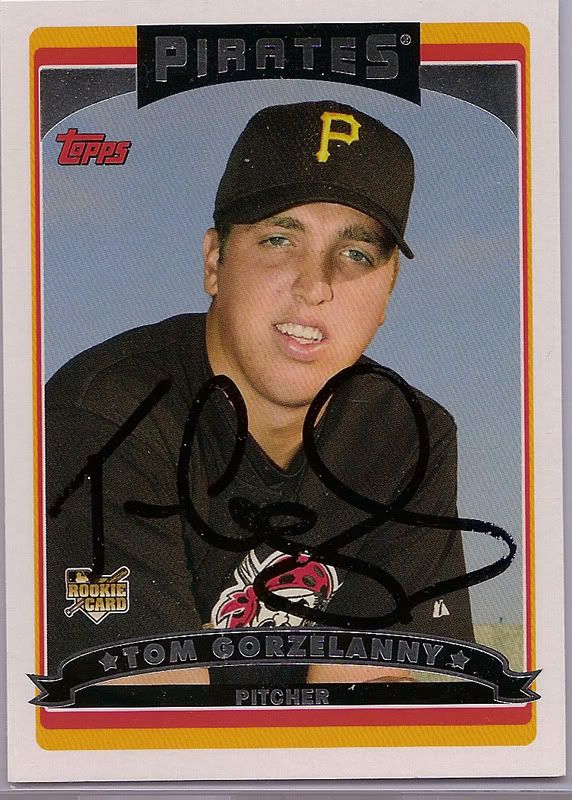
Who do you think is the ugliest player in the game today? Hometown hero Jay Gibbons certainly has a strong case, as does Cincinnati's own Thing That Goes Bump In the Night, Aaron Harang. But for my money, I'd have to go with Pirates pitcher Tom Gorzelanny, who must be a big fan of The Goonies.
Subscribe to:
Posts (Atom)