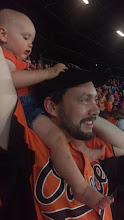
Sadly, the Orioles family lost another notable name over the weekend, as Sammy Stewart was found dead in Hendersonville, NC on Friday. He was 63 years old.
Stewart, a powerful 6'3" righthander, burst onto the scene on September 1, 1978. Tabbed to start against the White Sox in his big league debut, he set a rookie record that still stands by striking out seven consecutive batters from the second inning to the fourth. Though he was never able to gain a foothold in the deep Baltimore starting rotation, Sammy pitched effectively in a variety of roles during his seven full seasons with the team, posting a 51-45 record, 42 saves, and a 3.47 ERA (114 ERA+). Most notably, he led the American League with a 2.32 ERA during the strike-shortened 1981 season, when he logged 112.1 innings in 29 games despite making only three starts. In the 1979 and 1983 postseasons, he allowed no runs in 12 innings across six appearances. He even picked up a save in Game Three of the 1983 ALCS, yielding just one hit and one walk in four innings after relieving starter Mike Flanagan. Sammy was by all accounts a good and affable teammate, according to the memories that several prominent ex-Orioles shared in this obituary by the Baltimore Sun.
Sammy's career was short-lived after the O's traded him to Boston for the 1986 season. He spent one year with the Red Sox, followed by a partial season in Cleveland's bullpen. As I've mentioned on this blog before, his life away from the diamond was full of struggles. He lost two children to the effects of cystic fibrosis - son Colin passed away in 1991 at age 11, and daughter Alicia was 34 when she died in 2016. In between these two tragedies his life was derailed by drug addiction, leading to homelessness and an eventual six-year incarceration in his native North Carolina. Stewart was released in 2013, and seemed to have cleaned himself up and found peace. He remarried, and worked to build a better relationship with his daughter. And now, just a few years later, he's gone. I just hope he's truly found that peace that eluded him for so long.
Showing posts with label 1981 donruss. Show all posts
Monday, March 5, 2018
Monday, September 14, 2015
Dennis Martinez, 1981 Donruss #533
September 14 is a good day for an anniversary. On this date in 1976, Dennis Martinez earned the win in his major league debut with 5.2 shutout innings of four-hit, five-strikeout relief in a 9-7 victory over the Tigers. He bailed the Birds out after Ross Grimsley and Dave Pagan combined to cough up seven runs in three and one-third innings, stranding a pair of inherited runners. By the time he entered, the O's had already come most of the way back from an early 6-0 deficit, thanks in large part to a Doug DeCinces three-run homer, but he arrested Detroit's momentum and kept the score tight until the offense broke through with a four-run burst in the bottom of the seventh. Dennis sealed the win with a perfect ninth inning, inducing a trio of ground ball outs to make history as the first-ever Nicaraguan-born player in the major leagues. To this day, he's still one of just 14 players from his native country to play in the bigs, and is by far the most accomplished. (Take THAT, Everth Cabrera.)
September 14, 2015 is also the second anniversary of my wedding day. She's still putting up with me, and often doing so with a smile. I'm forever grateful.
Wednesday, February 11, 2015
Rich Dauer, 1981 Donruss #232
Occasionally I flip through my 1981 Donruss cards and I wonder how the company ever got off the ground. Who looked at this out-of-focus, washed-out picture of Rich Dauer at Comiskey Park and said, "Yeah, good enough...print it." It looks like something your nearsighted aunt snapped with a Polaroid on Photo Day. When I scanned this card, it came out crooked...that seemed to be in the spirit of the half-baked, blurry, shadowy, paper-thin 1981 Donruss set, so I left it like that.
Monday, September 22, 2014
John Lowenstein, 1981 Donruss #235
You never know when and where you're going to run into a fellow Orioles fan. I spent this past weekend in Easton, PA (outside of Allentown), taking in Chikara Pro Wrestling's King of Trios event. It was three days and nearly nine hours of independent, family-friendly wrestling, highlighted by a 16-team tournament to crown the best three-man tag team. I spent some time catching up with long-distance friends and meeting new folks. On Saturday afternoon, Chikara held a fan conclave, which gave fans a chance to meet their favorite wrestlers, shop for merchandise, play board games and video games, and participate in trivia contests. There was even a talent show.
As I was wandering around the gymnasium where the conclave was held, I noticed Chikara ring announcer Gavin Loudspeaker making the rounds. He's just as dynamic a personality as the wrestlers themselves; he pops up at the beginning of each show in tight leather pants and a vest, usually accented by a bright, colorful scarf. He runs laps around ringside, greeting fans and jumping up on the ringside seats to whip the crowd into a frenzy before the matches begin. Anyhow, Gavin was dressed more casually than usual on Saturday afternoon, and his black Orioles tee caught my attention. When he had a free moment, I approached him and struck up a conversation. I told him that I'd been able to attend the team's division-clinching win last Tuesday, and that I already had my playoff tickets reserved. He actually came out from behind his table and gave me a hug. It turns out that Mr. Loudspeaker (which is most probably not his real name) is a lifelong O's fan, and he was at Memorial Stadium to see the team's Game Two win over the Phillies in the 1983 World Series. He was about 10 years old at the time, and was thrilled to see his team succeed on the largest stage possible. He would've seen John Lowenstein go 3-for-4 with a double and a solo homer in support of Mike Boddicker, who limited the Phillies to three hits in a complete-game effort.
There's a photo of Gavin and yours truly. As a postscript, he also performed an original song as an opener for the fan talent show. It consisted largely of the ring announcer strumming his guitar and continually repeating a refrain that the Orioles were going to the World Series. I hope he's right, and I hope I see him there.
As I was wandering around the gymnasium where the conclave was held, I noticed Chikara ring announcer Gavin Loudspeaker making the rounds. He's just as dynamic a personality as the wrestlers themselves; he pops up at the beginning of each show in tight leather pants and a vest, usually accented by a bright, colorful scarf. He runs laps around ringside, greeting fans and jumping up on the ringside seats to whip the crowd into a frenzy before the matches begin. Anyhow, Gavin was dressed more casually than usual on Saturday afternoon, and his black Orioles tee caught my attention. When he had a free moment, I approached him and struck up a conversation. I told him that I'd been able to attend the team's division-clinching win last Tuesday, and that I already had my playoff tickets reserved. He actually came out from behind his table and gave me a hug. It turns out that Mr. Loudspeaker (which is most probably not his real name) is a lifelong O's fan, and he was at Memorial Stadium to see the team's Game Two win over the Phillies in the 1983 World Series. He was about 10 years old at the time, and was thrilled to see his team succeed on the largest stage possible. He would've seen John Lowenstein go 3-for-4 with a double and a solo homer in support of Mike Boddicker, who limited the Phillies to three hits in a complete-game effort.
There's a photo of Gavin and yours truly. As a postscript, he also performed an original song as an opener for the fan talent show. It consisted largely of the ring announcer strumming his guitar and continually repeating a refrain that the Orioles were going to the World Series. I hope he's right, and I hope I see him there.
Saturday, December 22, 2012
Benny Ayala, 1981 Donruss #236
If Donruss had only tried a little harder, I'm sure that they could have found a blurrier photo of Benny Ayala. The focus here is softer than on those Barbara Walters interview specials. The only part of Benny's face that comes through clearly is his thick black mustache. It's a fine mustache indeed, but I'd like to think that there was more to the veteran outfielder than a cookie-duster. If it were up to Donruss, we might never know.
Tuesday, October 4, 2011
Pat Kelly, 1981 Donruss #600
We have made some incredible technological and cultural advances as a society over the past three decades, but I think everyone can agree that few breakthroughs have been more beneficial than the newer styles of cold-weather sportswear. The collared-jacket-under-jersey thing just wasn't a flattering look for anyone.
Thursday, August 4, 2011
Doug DeCinces, 1981 Donruss #352
As much as I pride myself in playing detective and identifying in-game photos from context clues, I'm a bit in the dark when it comes to stadiums (stadia?). In particular, I haven't done much to familiarize myself with the characteristics of older stadiums. However, I know Chicago's Comiskey Park when I see it...or at least when I see its famed "exploding scoreboard", which is blurry yet visible over Doug DeCinces' right shoulder. There's something gratifying about being able to pin a thirty-year-old photo to a specific place.
Thursday, May 12, 2011
Earl Weaver, 1981 Donruss #356
I wrote a novel last night, but I'll be spending this evening in Oriole Park at Camden Yards, enjoying a few draughts of Heavy Seas (buy local!), collecting my free Vlad Guerrero t-shirt, and hopefully watching Zach Britton complete a three-game sweep of the Mariners. So I'll just pass along a link to Mike Klingaman's story about Earl Weaver auctioning off a number of mementoes from his Hall of Fame managing career. I was just relieved to learn that he wasn't selling his keepsakes because of a financial emergency. Instead, he's saving himself and his family some difficult decisions about how to divvy up his memorabilia after he shuffles off to the tomato garden in the sky. It might seem morbid, but as usual Earl is thinking ahead. Most of us probably wouldn't mind seeing our loved ones enjoy their inheritance while we're still around.
Thursday, April 14, 2011
Tippy Martinez, 1981 Donruss #354
It always seemed like it would be hard to take an unflattering picture of Tippy Martinez, but here we stand. When you take a look at the cards that Donruss churned out in their inaugural 1981 set, it's hard to believe that they ever had a second set. The drab borders and Local-Eyewitness-News fonts don't seem like the kinds of things that would grab the imaginations of young collectors. The photos are washed-out, blurry, and/or yellowed as if they were taken by your nearsighted Aunt Melba with her Polaroid.
The Orioles are clinging to a shortening lead against the Yankees in the late innings. I wish they could turn the ball over to Tippy Martinez, who had 9 wins, 17 saves, and 66 appearances against New York in his career, his highest totals against any team. His 3.13 ERA vs. the Bronx Bombers was lower than his overall mark of 3.45. Having debuted in the major leagues with the Yankees, Tippy certainly wasn't intimidated by the guys in pinstripes.
Monday, November 29, 2010
Mark Belanger, 1981 Donruss #472
Since I kvetched about the placement of the 1971 Orioles' starting rotation in a recent installment of MLB Network's "Prime 9" series, it would be unsporting if I failed to mention last week's countdown of the top nine double play combos in baseball history. In a list that featured such dazzling shortstop-second base duos as Alan Trammell and Lou Whitaker, Omar Vizquel and Roberto Alomar, and Dave Concepcion and Joe Morgan, the #1 pair was none other than Mark Belanger and Bobby Grich.
Although Grich did not take over for Davey Johnson at second base until 1973, and joined the Angels as a free agent after the 1976 season, he and Belanger made their four-year partnership count. They each won all four Gold Glove Awards given at their respective positions in that span, providing support up the middle for a club that won back-to-back American League East titles in 1973 and 1974 and averaged 91.5 wins from 1973-1976. With backup from Bobby and "the Blade", the O's pitching staffs finished first, second, first, and fourth in the A.L. in team ERA, and Jim Palmer won all three of his career Cy Young Awards. (He struggled with injuries in 1974; Mike Cuellar finished sixth in voting that year despite 22 wins as Catfish Hunter topped a competitive field.)
If you ever wonder how important a defensively skilled double play combination can be, look at the Brian Roberts-less Orioles from the first two-thirds of last year. How many innings were extended because the Birds couldn't turn two? The same problem occurred in 2008, when Roberts was healthy but Miguel Tejada was gone. Miggi's replacements were found wanting, to say the least. We might never have a Belanger-Grich combo again, but I'd settle for competence.
Although Grich did not take over for Davey Johnson at second base until 1973, and joined the Angels as a free agent after the 1976 season, he and Belanger made their four-year partnership count. They each won all four Gold Glove Awards given at their respective positions in that span, providing support up the middle for a club that won back-to-back American League East titles in 1973 and 1974 and averaged 91.5 wins from 1973-1976. With backup from Bobby and "the Blade", the O's pitching staffs finished first, second, first, and fourth in the A.L. in team ERA, and Jim Palmer won all three of his career Cy Young Awards. (He struggled with injuries in 1974; Mike Cuellar finished sixth in voting that year despite 22 wins as Catfish Hunter topped a competitive field.)
If you ever wonder how important a defensively skilled double play combination can be, look at the Brian Roberts-less Orioles from the first two-thirds of last year. How many innings were extended because the Birds couldn't turn two? The same problem occurred in 2008, when Roberts was healthy but Miguel Tejada was gone. Miggi's replacements were found wanting, to say the least. We might never have a Belanger-Grich combo again, but I'd settle for competence.
Monday, June 14, 2010
Tim Stoddard, 1981 Donruss #475
Although I'm settled into my new house and it even looks like a domesticated human lives there, I still have some kinks to iron out. I didn't get the cable/Internet situation ironed out until today, and the install won't actually take place until next Tuesday. So I've been Macgyvering it for the last week or so, scanning a few cards at a time and saving them on a thumb drive until I can mooch off a loved one and upload to the 'net. This process is further deemed necessary by my travel itinerary this week, as I am flying out to San Diego on Thursday to spend a weekend with some friends. I will fly back in to BWI late next Monday evening. Do you know what that means?Theme week!
I hereby dub the next eight days Eighties Week, featuring eight choice cards from the decade of my birth. We'll kick it off with a card that's quintessentially 1980s. Donruss and Fleer broke the baseball card monopoly previously held by Topps in 1981, but they still had some catching up to do. Their cards were riddled with typographical errors, the card stock was cheap, and many of the photos were blurry, off-center, bizarrely composed. I've heard the massive Tim Stoddard referred to as "Bigfoot", and the quality of this picture certainly is reminiscent of the grainy, dark shots that are often offered up as proof of the existence of his namesake. All you can see is his ample backside and the profile of his face, as though the photographer was eavesdropping on the pitcher. He seemed to be cloaked in late-afternoon shadows. Based on the dirt and the chalk line, he's probably warming up on a bullpen mound in foul territory. Unusual, but not pretty.
Sunday, June 21, 2009
Kiko Garcia, 1981 Donruss #514
In 1979, Kiko Garcia committed 27 errors at shortstop and second base for the Orioles. That's the most miscues in one season by an Oriole since 1961, when Ron Hansen booted 31 balls. The team's all-time record is 34, by shortstop Willy Miranda in 1955. I guess that's my way of saying that everyone makes mistakes. I made an error in judgment by waiting until late last night to write a blog post. When I finally got around to it, I discovered that my Internet connection was not functioning properly. Everything is up and running now (obviously), so this is the first of two entries today. I'd like to say that you live and learn, but as you can see, I'm at the keyboard pretty late again tonight. Whoops!
Wednesday, January 7, 2009
Lenn Sakata, 1981 Donruss #499
I'm spending a lot more time this winter on Hot Stove talk than I did in early 2008. But yesterday's news was a lot more exciting than a Ramon Hernandez salary dump or a Mark Hendrickson signing. The Orioles have just come to terms with 34-year-old Koji Uehara, who will be the first Japanese player in team history. By extension, he's also the first Oriole born in an Asian country (Lenn Sakata was Hawaiian, by the way). This is an encouraging developmentfor several reasons. First and foremost, he's a legitimate starting pitcher. The only sure thing about the Birds' 2009 rotation was Jeremy Guthrie; now we can pencil in a veteran who has twice won his league's equivalent of the Cy Young Award for the Yomiuri Giants, one of the most successful and storied franchises in Japan. He has a strikeout-to-walk ratio of approximately 5-to-1, and a 12-0 record in international competition. Even though he struggled by his standards in 2008, his 3.81 ERA would have looked pretty damn good on the O's staff. As for his demotion to the minors, it's been suggested that the team was punishing him for his decision to pitch in America. Baltimore also signed him to a reasonable contract: two years, $10 million with an additional $6 million in incentives. Compare that to the five-year, $20 million Kei Igawa contract that the Yankees are saddled with (not to mention the $26 million they posted just to negotiate with him!).
Of greater significance still might be the Orioles' standing as an international player. After years of sticking their heads in the sand while the Yankees, Red Sox, White Sox, Angels, and others got a head start in scouting and signing in Cuba, Japan, and elsewhere, Andy MacPhail is truly rebuilding a badly damaged organization from the ground up. It's exciting to imagine throngs of Japanese baseball fans watching and reading about the Orioles. Heck, maybe they'll even throw some All-Star Game votes to the guys in orange and black!
Welcome to Baltimore, Koji. I hope there's a Japanese word for "hon".
Wednesday, March 5, 2008
Jim Palmer, 1981 Donruss #353
Growing up in Baltimore in a family full of Orioles fans, I was exposed to the team on a consistent basis even before I became a fan. Those early years are a bit of a blur when it comes to the O's. A game I attended here, or a name I heard there, filter through sometimes. But I remember hearing about Jim Palmer's comeback attempt.Palmer was simply the best pitcher the Orioles ever had, possibly the best they ever will. Three Cy Young Awards. Four Gold Gloves. Six All-Star Games. Eight 20-win seasons in a span of nine years, and 268 wins overall. (All the more impressive when you consider that he missed large chunks of five different seasons with injuries.) A career ERA of 2.86. On top of it all, he was the only Oriole to participate in all three of the team's World Championships, winning one game in each World Series (1966, 1970, 1983).
But Jim Palmer didn't quite go out on top. After starting the 1984 season 0-3 and allowing more than a run per inning, the great pitcher was released on May 17 by the O's, 22 years after they'd signed him as an amateur. He was 38 at the time.
Palmer remained in the public eye, broadcasting television games for ABC and continuing to appear in the famous Jockey underwear ads. He was a shoo-in inductee to the Baseball Hall of Fame in his first year of eligibility in 1990. But the competitive fire still burned within him, and he announced his intention to rejoin the Oriole pitching staff in 1991, at the age of 45. The sports world was all abuzz when Jim reported to Spring Training wearing the #22 that the O's had retired six years earlier. It was unprecedented for a Hall of Famer to return to action. He made it as far as his first exhibition game, giving up five hits and two runs to the Red Sox in two innings of work and tearing his hamstring. This time, Palmer saw the writing on the wall and hung up his spikes for good.
Comeback attempts are always exciting, though. Even though the end result is usually a disappointment, we root for these men who were once at the top of their game and have become underdogs again through the passage of time and the cylical nature of things. We are forever hoping against hope that the extraordinary can happen - that a man past his physical prime can dominate a young man's game. Jim Palmer's amazing career doesn't leave a whole lot of room for What Could Have Been (save for this game), but you can't help but dream about the headlines if he could have won so much as one last game in Memorial Stadium, a last hurrah for both pitcher and stadium.
Heck, if Jim's up for a challenge, this year's team has a #5 slot in the rotation to fill.
Subscribe to:
Posts (Atom)