Orioles Card "O" the Day

An intersection of two of my passions: baseball cards and the Baltimore Orioles. Updated daily?

Saturday, December 31, 2011

Melvin Mora, 2005 Skybox Autographics #8

Thursday night, while I was indulging in some silliness about Leo Gomez's baseball equipment, news leaked out about Melvin Mora's retirement. Of course, as I wrote back in July when the Diamondbacks released him, the writing was already on the wall. Still, I've been glad to read some favorable remembrances of his career from both O's-centric blogs and national blogs in the past few days. Here in Baltimore, we had the unhappy task of witnessing Melvin's decline, as his power dried up and he began grousing about attempts to drop him lower in the batting order and/or give him days off. But that shouldn't lessen his significant contributions to the team in his nine and a half seasons in Charm City.

His truly is an incredible story, as he signed with the Astros as a teenager in 1991 and played all over the field without much distinction before finally reaching the majors with the Mets in 1999. After a few seasons as a utility player with a passable bat in New York and Baltimore, he suddenly had an All-Star season with the Birds at age 31 in 2003, when he had a triple slash (AVG/OBP/SLG) of .317/.418/.503. Some second-half injuries limited him to 96 games and kept his counting stats down, but his .921 OPS was the highest among regulars on the team by a full 100 points. (The runner-up was the great Larry Bigbie...yeesh.) He was healthy enough to see action in 140 games in 2004, and the result was a career year: personal bests of 111 runs scored, 187 hits, 41 doubles, 27 home runs, 104 RBI, and a batting line of .340/.419/.562. That on-base percentage led the American League, and although he missed out on the All-Star Game, he did win the Silver Slugger in his first season as a regular third baseman. Looking back, it's almost inconceivable to me that Mora reached base nearly 42% of the time in those two seasons, especially since his OBP settled back into the .340s immediately afterward. But even at that lesser level of performance, he remained a solid offensive player for the next four seasons and a true member of the community, settling in Fallston with his wife and six children.

He left after 2009 with the most career games at third base for any Oriole not named Brooks Robinson, and is still ranked eighth in team history in Offensive Wins Above Replacement (26.0), tenth in games played (1,256), ninth in runs scored (709), tenth in hits (1,323), eighth in total bases (2,073), seventh in doubles (252), ninth in home runs (158), eighth in RBI (662), tenth in walks (465), eleventh in steals, surprisingly (82), second in hit-by-pitches (107)...well, you get the idea. Melvin Mora is a big part of Orioles history, and he's earned a happy and peaceful retirement.

Friday, December 30, 2011

Vintage Fridays: Dave McNally, 1964 Topps #161

Here we are: the final Vintage Friday of 2011. I've provided this crooked scan of Dave McNally's first solo Topps card as a reminder that we're all imperfect but we have the power to improve...not tomorrow, but today. The Orioles learned their lesson quickly in the mid-1960s, dumping these so-so black caps with the orange block "B" a year after debuting them as their home caps in 1963. New Year's resolutions are all well and good, but we shouldn't have to resort to gimmicks to reach our goals.

Also, I was too lazy to rescan the card in perfectly centered form. Shh.

Thursday, December 29, 2011

Leo Gomez, 1993 Leaf #155

Today just d-r-a-g-g-e-d. It was 27 degrees when I sat my frozen tuchus behind the wheel of my car this morning, just so I could drive to work at my half-empty office. One of my contact lenses must have had some extra dirt or debris on it, because my right eye was bothering me all day, but I never did succeed in dislodging the offending particle. (Update: I was wearing the lens inside-out. That'll do it.) It wasn't a bad day, it wasn't a good day, it was just there, and it stayed there well past the sell-by date. I need something to snap me out of these winter doldrums...

...A Leo Gomez card should do the trick! Hey, stop laughing and look at Leo's ass. Whoops, I mean his back left pocket. It looks like he's got a glove tucked in there. However, he's wearing his batting gloves. So what's the extra glove for? Baserunning only? I mean, it takes the right kind of gear to go 4-for-14 on attempted steals for your career.

Jokes about Leo Gomez's rear end don't do it for you? I'm just trying to make something out of a dull situation.

Wednesday, December 28, 2011

Alex Ochoa, 1994 Upper Deck #538

Alright folks, get your Epsom salts and Life Alert bracelets handy, because I'm about to make you feel really old. Last week, Alex Ochoa was named first base coach for the Boston Red Sox. Yes, that Alex Ochoa. HardballTalk's Aaron Gleeman beat me to the punch, so I can only echo his sentiment. When my Oriole fandom was at its freshest and most fervent, Alex was the "it" guy in the O's farm system: a multi-tool prospect who was flashing power, speed, and a fair amount of plate discipline at AA at age 22. He peaked at #35 in the Baseball America prospect rankings in 1995, the year that the Birds sold high and made him the centerpiece of a deal that brought Bobby Bonilla over from the Mets. He was in the majors from 1995 through 2002, peaking with consecutive strong years as a reserve outfielder for the Brewers in 1999 and the Reds in 2000. Obviously I know that I'm getting older, though I'm still young enough to treat it with the right amount of detached bemusement. 29 is not a bad age to be, and from here, I'm willing to bet that 30 isn't much different. But after a while you just stop thinking about fresh-faced future star Alex Ochoa, and then BOOM, he's a 39-year-old coach for one of your hated divisional opponents. Craziness.

Tuesday, December 27, 2011

Kevin Hart, 2004 Upper Deck SP Prospects #275

In my ongoing quest to confound and annoy you, I present another fine gentleman who never suited up for the Orioles. Hart was expertly airbrushed out of a Maryland Terrapins uniform for this card, as he'd pitched and played first base for the Terps before the O's took him in the 11th round of the draft in June 2004. In the entire 58-year history of the Birds, pitcher Lou Sleater (who played high school ball at Mt. St. Joseph's in Baltimore) is the only UMD product to log time in Baltimore. He finished his career as an Oriole in 1958.

Hart could not snap the drought, as he was traded to the Cubs in December 2006 for not-so-useful utility player Freddie Bynum. The righty didn't do much to distinguish himself in two-plus seasons in the O's farm system, but made some hay in a September 2007 callup with Chicago after splitting the year between AA and AAA. In 8 relief appearances totaling 11 innings, Kevin allowed a single earned run and had a 13-to-4 strikeout-to-walk ratio. He was not nearly so masterful in longer looks as a reliever in 2008 and a starter in 2009 for the Cubs and Pirates, and he last pitched at AAA Indianapolis in 2010, where he put up a 6.75 ERA in only 5 games. If he's out of baseball, he'll leave with a 6-11 big league record and a 5.26 ERA. However, that's worth a little something; he's one of just 4 players chosen in his draft round to get the call to the majors. See? It's all relative.

Monday, December 26, 2011

B.J. Surhoff, 1996 Skybox Emotion XL#10

If you celebrate Christmas, I hope you got what you wanted. Santa and/or my lovely family provided generously, with a new iPhone 4S, a slow cooker with lid security (so that I might not spill chili in my new car...again), a few desired baseball books, and of course some nifty new O's merchandise: orange and black flannel pajama pants, some utility gloves with the now-retro "serious bird" logo, and a couple of wine bottle stoppers. My latest Christmas was indeed a good one.

If you were one of the folks responsible for the Emotion cards, I hope you got a dictionary bookmarked near the word "emotion". B. J. Surhoff is indeed tracking the flight of his ball in the above photo, but that's not so much an emotion.

Ray Knight, 1988 Donruss #108

Merry Christmas to all, and to all a good Knight!

Saturday, December 24, 2011

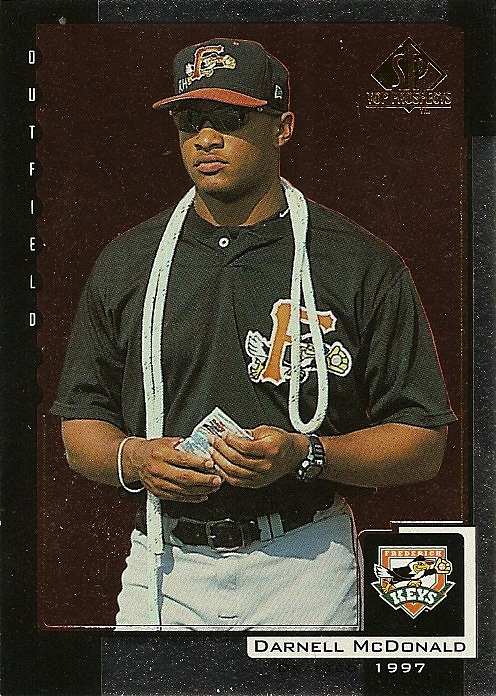
Darnell McDonald, 2000 Upper Deck SP Top Prospects #87

I grabbed up the Orioles cards in Thorzul's el cheapo December box break. He bought a whole mess of assorted cards off of one of his favorite eBay sellers and divvied up the cards by team for a small price. As fortune would have it, I received my haul in the mail yesterday, just in time for Christmas. While blindly buying into a lot of cards is always a delicate balance of risk and reward, I got a fair share of O's that were new to me, mostly from the mid-to-late 1990s. I also got 44 copies of the same Cal Ripken, Jr. card from 2006, which I'll have to keep separate from my 50 copies of Rob Dibble's 1989 Topps card.

One of my favorite cards in the bunch was this shiny-tastic card of former #1 draft pick and current Red Sox outfielder Darnell McDonald. Not only is he wearing the uniform of the Frederick Keys, but he appears to have a jump rope draped around his neck. How many players still incorporate jump roping into their training routines?

Friday, December 23, 2011

Vintage Fridays: Mike Blyzka, 1954 Topps #152

Today is as good a day as any to write about Mike Blyzka, one of the few Orioles with a December 25 birthday. I hope his special day didn't get lost in the shuffle, which seems to be a common complaint for those born this time of year. At this moment, I don't know a single other thing about Mike, so let's give him the Fun Facts treatment!

1. He was actually born Michael Bliska, according to Baseball Reference. I don't know why or when the name change came about. If his family joined the witness relocation program, they were probably too subtle about it.

2. His birthplace was Hamtramck, MI, an oddly-named locale five miles north of Detroit. Four other Hamtramckers (Hamtramckites?) have played in the major leagues, the most recent being 1970s-1980s journeyman catcher Bill Nahorodny.

3. Mike, like many players of his era, served in the U.S. military during the Korean War. This explains the gap in his playing career from 1951-1952.

4. He debuted with the Browns in 1953 at age 24, going 2-6 with a 6.39 ERA in 33 games (including 9 starts). His totals of 56 walks and just 23 strikeouts indicates that his record was well-earned.

5. Blyzka followed the team to Baltimore in 1954, and made 37 appearances out of the bullpen. He had a 1-5 record, a single save, and a 4.69 ERA. With 51 walks and 35 strikeouts, he still wasn't fooling many batters.

6. His lone win as an Oriole came on June 8, 1954, when he relieved Bob Chakales in the seventh inning of a 3-3 game at Fenway Park and allowed a run on 5 hits over the final 3 innings. The O's bats boosted him with a pair of runs in each of the final two innings. He also singled off of future Oriole Hal "Skinny" Brown in the ninth inning for one of his two career hits.

7. After the 1954 season was through, the Birds sent Blyzka to the Yankees as part of the massive 17-player trade that delivered Gus Triandos, Gene Woodling, and Willy Miranda to Baltimore and Bob Turley and Don Larsen to the Bronx. Mike spent the next two seasons in the Yankee organization without getting the call back to the majors, and finished his pro baseball career with the Giants' AAA Minneapolis club in 1957.

8. His minor league record was 63-60 with a 4.18 ERA.

9. He lived in Denver for some time, and spent the last 32 years of his life in Cheyenne, WY. For several years he was the manager and bartender of a VFW post in the area.

Thursday, December 22, 2011

Matt Riley, 2000 Upper Deck Pros and Prospects Future Forces #F9

I'll be honest with you: I have not exactly given this blog my undivided attention over the past few weeks. Oddly enough, the roundabout reason is fantasy football. I'd played for fun and bragging rights for several years, even though the condensed schedule and catastrophic injuries made it a maddening hobby. But this year was the first time I ever played for money, filling a slot in a 12-team NFL.com league with my uncle and his coworkers. I rode Michael Vick, Darren McFadden, Jahvid Best, Mike Wallace, Steve Smith, Dez Bryant, and the Ravens defense (as well as a good dose of luck) to an 8-0 start that included two head-to-head wins with the closest opponent in my four-team division. At the midway point of the season, it looked like the division title and the attendant share of the prize money was as good as mine.

Of course if you follow football, you can probably look at the names above and guess how the rest of the season went. My quarterback and my entire stable of running backs all suffered significant injuries, helping me sputter to four straight losses and a final winner-take-all head-to-head showdown with the second-place guy in Week 13. With a patchwork lineup that included Miami QB Matt Moore and rookie Redskins RB Roy Helu, I eked out the victory and the spoils by five points. Then I promptly got creamed the following week in our league's opening playoff round. Oh well, I'd already made back my entry fee 2.6 times over.

With that money burning a hole in my pocket, I bought an XBox 360 and a bundle of games off of somebody on Craig's List. Now, I've never been a hardcore gamer, but every once in a while I stumble across a game that's got an enjoyable premise and a low enough learning curve, and I dive in headfirst. Such has been the case with Fallout: New Vegas, a post-apocalyptic role-playing game that has grabbed me and won't let go. The first weekend I had it, I stayed up until 4:00 AM on consecutive nights wandering through the fantastic virtual wasteland, shooting mutants and warring rogues and salvaging found materials. It would be bad enough to be addicted to one game, but I also gave in to temptation and bought the newest wrestling game, WWE '12. As someone who's been playing WWF/WWE games since 1998 (WarZone for the original PlayStation), I am dumbstruck by the scope and customization options in this one. Thank goodness I've maintained enough sanity to avoid trying out the other couple of XBox 360 games I now own.

As the holidays approach, it's a slow enough time for baseball news that I've been able to scrape by with some news-light offerings. And now, here I am droning on about fantasy football and video games. At least I'm not talking about ponies...

Wednesday, December 21, 2011

Cesar Izturis, 2009 Upper Deck #991

Cesar Izturis is the newest former Oriole after signing a minor league contract with the Brewers. He'll likely back up Alex Gonzalez at shortstop, giving Milwaukee a tandem of defensively gifted infielders who happen to be historically inept with the bat.

Gonzalez at least has enough pop in his bat to keep him hovering around a league-average OPS+ in his best years. He's peaked at 23 home runs twice, most recently in 2010. But he doesn't hit for a high average (.247 career), and doesn't walk enough to bridge the gap. His on-base percentage has not cleared .300 since 2007, and is down to .291 for his career. At age 35, it's not likely to improve.

But Cesar's so-called offensive numbers make Gonzalez look like Honus Wagner. The 5'9" Venezuelan has a career OPS+ of 64, and his high-water mark was 88...in 2004. With a career average of .255 and OBP of .295, he's actually slightly ahead of Alex. But a complete lack of power is his ultimate undoing. In 1,185 games spanning 11 seasons, he's hit a total of 15 home runs. That would match the total that Gonzalez hit in 149 games for the Braves last season. Izturis, too, is no spring chicken, as he'll turn 32 before Opening Day. He's also something of a health risk, having missed 48 games in 2009 and well over 100 last year with injuries.

Of course, Cesar did bring some value to the O's in his two-plus seasons with the team. His glove skills at shortstop were a breath of fresh air following the range-challenged tenure of Miguel Tejada and the bumblings of Miggi's various would-be replacements in 2008. And I'll always remember witnessing his wall-scraping two-run homer that put the exclamation point on a 10-5 Opening Day win over the Yankees. It was an improbable way for Izzy to debut in Baltimore, especially considering that he would hit only 2 more home runs in 281 subsequent games with the O's. Speaking of which, the last of those longballs came against Cliff Lee in July 2010! As a popular blog often says, you can't predict baseball.

Tuesday, December 20, 2011

Cal Ripken, Jr., 1988 Sportflics #152

I've had this card for a few months, but I'm just now looking closely at it. If you peer into the field-level seats behind Cal Ripken, Jr., you'll be able to see the Toronto Blue Jays' mascot shift from side to side while Junior takes his hacks. I'm guessing that it was an unsporting attempt to distract the Orioles' shortstop. Judging from the strength of the swing that's captured in the photo sequence, I'm going to optimistically assume that this dirty bird failed in his task. Nasty creatures, those blue jays.

Monday, December 19, 2011

Glenn Gulliver, 1983 Donruss #131

Glenn Gulliver is more than just a funny name. His major league career consisted of 73 games with the Orioles in 1982 and 1983. In that time, he hit only one home run. It came on Sunday, October 3, 1982, in the final game of the season. Though the game at large was a disappointment, as Jim Palmer was thrashed and the O's failed to unseat visitor Milwaukee for the American League East crown, it was undoubtedly a thrill for the 27-year-old rookie Gulliver to hit a third-inning solo homer against the great Don Sutton. Glenn assured himself a spot in the record books. According to Raphy at High Heat Stats, Gulliver is one of only 65 players in the entire history of MLB to hit his only career home run off of a Hall of Fame pitcher. Though Sutton pitched for an incredible 23 seasons and generously allowed 472 longballs to opposing hitters, the only other man to victimize Sutton for his lone career homer was a journeyman catcher by the name of Rick Stelmaszek. Oh, and in case you're curious, Glenn's big fly was the 326th that Sutton surrendered.

Sunday, December 18, 2011

Curtis Goodwin, 1995 Bowman's Best Mirror Image #10

As often happens when you're banking on the future, the comparison between Curtis Goodwin and Kenny Lofton is not a flattering one for the younger man. Goodwin's big league career lasted all of 5 seasons, 431 games total. He put together a batting line of .248/.307/.302 with 3 home runs, 56 RBI, and 66 stolen bases (28 caught stealing). Lofton, on the other hand, stayed around for 17 years and 2,103 games. He batted .299/.372/.423 with 130 home runs, 781 RBI, 622 stolen bases, and 160 caught stealing. This year, he's eligible for the Hall of Fame for the first time. He probably won't make it in, but he's got better odds than most of the first-time members of the current ballot.

Saturday, December 17, 2011

Cal Ripken, Jr., 1992 Upper Deck Team MVP Holograms #44

Holograms are a decades-old technology, but that doesn't make them any less cool. Needless to say, this scan does not begin to do the card justice. At least you can see a clear view of the foreground image, in which Cal Ripken, Jr. is uncharacteristically squaring around to bunt. He totaled 10 sacrifices in his career, never more than 3 in a single season. The background image, which looks 3-D up close, has a much more customary image of Cal following through after a big swing in a road game in Anaheim. There are two other Orioles cards in this 54-card set: another Ripken card and Gregg Olson. I'll be keeping an eye out for them.

Friday, December 16, 2011

Vintage Fridays: Mike Flanagan, 1980 Topps #205

I'm writing today's entry with a heavy heart, as this would have been Mike Flanagan's 60th birthday had he not taken his own life this past August 24. In the subsequent months, there have been no enlightening discoveries to help his family, friends, and fans make sense of Mike's suicide. We know that he was disappointed by his uneven tenure as the de facto general manager of the Orioles and distraught over reported financial problems, but these things will never satisfactorily explain such a drastic act of despair. My deepest sympathies go out to his loved ones as they are faced with their first Christmas without him.

This card focuses on Flanny in the prime of his life and his career, having just won the American League Cy Young Award for a superlative 1979 season. He topped the junior circuit with a 23-9 record and 5 shutouts, notched a career-low 3.08 ERA, and had personal bests with a 2.71 strikeout-to-walk ratio and 6.4 strikeouts per 9 innings. He helped lead the O's to their first World Series since 1971, topping the Angels in Game Two of the ALCS before going the distance in a 5-4 win over the Pirates in the Series opener. Here he shares the spotlight with the great, knuckleballing Niekro brothers, who tied for the National League lead with 21 wins apiece. Sadly, Joe Niekro has also left us too soon; a brain anuerysm caused his death in 2006 at age 61. It's all just another reminder that life is short, and we should be good to one another in the time that we are given.

Thursday, December 15, 2011

Juan R. Guzman, 2000 Topps Traded #T74

Yep, that's Juan Ramon Guzman, a 6'2", 180-pound righthanded pitcher who was born in 1977 in the Dominican Republic. He is not to be confused with Juan Andres Guzman, the 5'11", 190-pound righty who was born in 1966 in the Dominican and pitched for the Orioles in 1998-1999 after a successful stint in Toronto. This Juan Guzman was originally signed as a catcher and converted to the mound at Rookie-level Bluefield in 1998. He garnered some attention the following year at Delmarva, where he struck out 134 batters and walked only 44 in 124.1 innings. But he hit a speed bump at Bowie in 2000 (4.64 ERA, only 57 strikeouts in 97 innings) and missed all of 2001 with an injury. Two years later he was out of the Baltimore organization, and by 2005 he was out of pro ball altogether without ever having reached AAA, much less the majors.

There are five other Juan Guzmans who have played minor league baseball without getting even a cup of coffee in the big leagues. One of them, Juan Alejandro Guzman, is yet another righty pitcher from the Dominican. He is 20 years old and has played in the low levels of the O's organization for the past two seasons. Last year he put up a 1.09 ERA in 33 innings in the Gulf Coast League, with 33 strikeouts and only 7 walks. He's a long way from the majors, but he's the next challenger to ex-Blue Jay/Oriole/Red/Devil Ray Juan "The Highlander" Guzman.

Wednesday, December 14, 2011

Kurt Ainsworth, 2004 Topps Total Silver #599

Major case of writers' block today. I decided to reach into a box of cards and pull one out at random. As a result, you are looking at Kurt Ainsworth posing in Fort Lauderdale with his personalized Nike glove, which has three distinct Swoosh logos visible. Very subtle, Nike. What you can't see is the duct tape that is undoubtedly holding Kurt's right shoulder and elbow together. By 2005, that stuff gave out for good. Such is the life of the endangered species known as the pitching prospect.

Tuesday, December 13, 2011

Koji Uehara, 2009 Topps Allen and Ginter #43

Here's something I wasn't expecting to discuss this week: a new free-agent acquisition! The ongoing failures of the Orioles have finally given me a jaundiced view of the Hot Stove, one where I assume that any individual free agent worth having (i.e. Prince Fielder) will a) be too expensive and too discerning to sign with the O's and b) wouldn't fix the myriad problems with the team anyhow. It took years to mess up the team this badly, and it will take years of moves both big and small to fix it again. During the winter meetings, I found myself just holding my breath and hoping that the Orioles wouldn't repeat past mistakes, like signing another reliever to a multi-year deal or giving millions of dollars to a musty designated hitter type.

Pitcher Tsuyoshi Wada, recently of Japan's Softbank Hawks, figures to become Baltimore's second-ever Far East player in 2012. He reportedly agreed to a two-year, $8.15 million deal today and should be in line for a spot in the ever-questionable starting rotation in 2012. Even after tamping down the expectations created by his eye-popping NPB stats (16-5, 1.51 ERA, 168/40 K/BB in 2011), I think there's a lot to like. He'll be 31 next year, so he should have plenty left in the tank. The O's didn't overpay greatly in years or dollars, and GM Dan Duquette showed that he intends to be a bit more proactive in the international market than Andy MacPhail. In fact, "Duke" also made an offer to Korean reliever Chong Tae-Hyon, who chose to stay in his home country, and the Birds are going after Taiwanese pitcher Chen Wei-Yin and have shown interest in Cuban outfielder Yoennis Cespedes. While Wada doesn't have the raw velocity to challenge big league hitters, he clearly has impeccable control, and he wouldn't be the first soft-tossing lefty to baffle opponents with a more cerebral approach. (Paging Jamie Moyer.) Heck, Koji Uehara is a righty, and he's done pretty well for himself without throwing in the 90s.

At the very least, look at it this way: with all of the young pitchers that the Orioles stockpiled in the MacPhail era, they gave a combined total of 32 starts last season to the following pitchers: Alfredo Simon, Chris Jakubauskas, Jo-Jo Reyes, Mitch Atkins, and Rick VandenHurk. Ugh. For a few million dollars, they've gotten an important piece of insurance against that happening again in 2012.

There I go again, damning the O's with faint praise.

Monday, December 12, 2011

Rafael Palmeiro, 1994 Score Select #317

It's hard to believe that it's been exactly 18 years since Rafael Palmeiro signed a 5-year, $30 million contract with the Orioles. I remember it fondly because it was the team's first marquee acquisition since I had become a fan the previous summer. As I recall it, there was a lot of to-do about Raffy's college teammate Will Clark earlier in that offseason, despite the fact that Palmeiro had been healthier and much more productive in the just-concluded 1993 campaign. "Will the Thrill" was the household name, but he displaced Palmeiro by signing a similar five-year deal around Thanksgiving. I was still in the midst of a crash course in baseball fandom, but I knew enough to be excited by big numbers like a .295 average, 37 home runs, and 105 RBI. For the first time since trading away Eddie Murray five years earlier, the O's had the big bat (and a nifty glove besides) that they craved at first base. They could officially turn the page from Glenn Davis' disastrous chapter in club history.

Raffy more than lived up to his contract, with a pair of Gold Gloves, an All-Star appearance, and a batting line of .292/.371/.545, 182 home runs, and 553 RBI. He was a member of the 1996 squad that won the American League wild card and upset the Indians in the Division Series before mumble mumble something Yankees mumble ALCS. He was also a steady force on the 1997 wire-to-wire A.L. East championship team that dispatched the Johnson-Griffey-Rodriguez-Martinez Mariners in the ALDS before grumble grumble Indians cough ahem ALCS.

Of course, the rest of the story isn't so textbook. Davey Johnson leaves, the free agent-heavy O's tumble in 1998, Palmeiro returns to a chastened Rangers club in free agency and continues knocking the cover off the ball for the next five years, then returns to Baltimore to finish his career and collect his 3,000th career hit but winds up retiring in disgrace after a positive test for the steroid stanozolol. Despite his continued insistence upon a bizarre alibi involving a tainted B-12 shot borrowed from Miguel Tejada, I've concluded that life is too short for harboring animosity. I think Rafael Palmeiro belongs in the Hall of Fame, I'm grateful for all of the positive contributions he made to the Orioles during his career, and I think he's suffered for the mistakes that he made.