Showing posts with label doyle alexander. Show all posts
Showing posts with label doyle alexander. Show all posts
Friday, December 5, 2014


Friday, May 13, 2011
Vintage Fridays: Doyle Alexander, 1972 Topps #579

This high-number of Doyle Alexander, I do have. It's a good representative of the set at its best and worst. Because it was in the fifth of the sixth series, it was printed late enough for Doyle to be tagged as an Oriole; the Birds had acquired him from the Dodgers in the Frank Robinson trade of December 1971. But because of the late change, Topps opts to go with the extreme up-the-nostril closeup, giving the airbrush artists as little work as possible. Just a dab of orange over the bill, and a blob of black to cover the bit of the crown that's not obscured by the underside. At the very least, this angle gives me the opportunity to fully appreciate Alexander's precisely groomed sideburns and impeccable facial structure. Incidentally, Doyle was the fourth Oriole to ever wear #13, worth mentioning on Friday the 13th. To my credit, I've showed enough restraint to limit my Doyle Alexander Friday the 13th posts to two so far.
Friday, March 13, 2009
Vintage Fridays: Doyle Alexander, 1975 Topps #491
 Hey, it's Friday the 13th. Didn't we just have one of these last month? I don't mind, because 13 happens to be my favorite number (my birthday is August 5: 8+5=13). I wore it when I played fresh-soph lacrosse in high school, and kept it for three years of CYO softball. So I'm not big on triskaidekaphobia.
Baseball is a sport that is choc-a-bloc with superstitions, so it's not surprising that some teams refuse to even hand out the number thirteen. The Orioles are not one of those teams, and it's never done much to hurt them. There have been 16 players who have worn #13 in Baltimore, in addition to two coaches and one manager. Many of them were forgettable (Roger Freed, Mike Figga, and the like), but three especially notable players have bucked the hoodoo.
Aside from Bill Miller, whose O's career lasted five games in 1955, lefty Steve Barber was the first to wear the one-three. After donning #29 as a rookie, the Maryland native switched to the spooky number in 1961 and wore it right up until his trade to the Yankees in mid-1967. In between, he won 85 games, was an All-Star twice, and won 20 in 1963. He was a member of the 1966 World Champions, and is seventh in team history in strikeouts. Of course, arm troubles plagued him for much of his career, so maybe he was a bit jinxed.
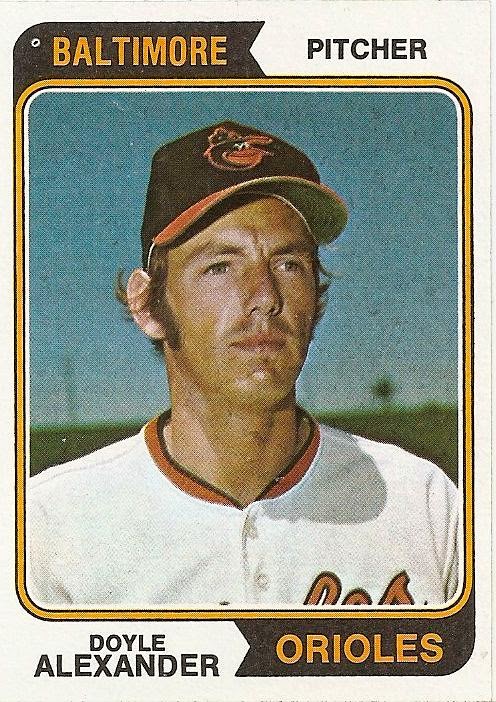
Lanky righthander Doyle Alexander might have felt a bit spooked when he joined the Orioles as a 21-year-old in 1972. He had just been traded (along with three lesser players) for Frank Robinson, the emotional leader of a Baltimore team who had just been to three straight World Series and four Fall Classics since 1966. Doyle pitched to a 2.45 ERA in a mostly relief role in his first season with the Birds, but never really took flight in Charm City. His overall record as an Oriole (1972-1976) was 35-37. But he makes this list because of another headline-making trade. On June 15, 1976, he was one of ten players swapped by the O's and Yankees. Though he would go on to win 194 games in a nineteen-year career, he was a journeyman; meanwhile, the players that came to Baltimore in the deal would become the glue of the next ten years. Tippy Martinez. Rick Dempsey. Scott McGregor. Not too shabby, huh? Alexander had a knack for being trading for big names. Near the end of his career, the Tigers nabbed him from Atlanta for the stretch drive. Heading to the Braves was a minor league pitcher by the name of John Smoltz.
Finally, there's a more recent Oriole pitcher, Rodrigo Lopez. I've talked about him recently, so I don't want to belabor the point. Suffice to say, he rose from relative obscurity (a 26-year-old with just six MLB games pitched) to win 15 games in 2002 and finished a close second to Eric Hinske as A.L. Rookie of the Year.
Well, by the time you read this, Friday the 13th will almost be over. That wasn't so bad, now was it?
Subscribe to:
Posts (Atom)