Thursday, March 29, 2018
Adam Jones, 2015 Topps Heart of the Order #HOR-20
There aren't many better ways to celebrate your 11th straight Opening Day start than by hitting a walkoff home run. That's just what Adam Jones did on Fernando Rodney's first pitch in the bottom of the 11th today, giving the Orioles a 3-2 win over the Twins. The longtime O's center fielder helped take the heat off of Brad Brach, who blew a save and a 2-0 lead by walking a pair and giving up a couple of singles in the ninth. Other standouts were right fielder Craig Gentry, who robbed Eddie Rosario of a home run; starting pitcher Dylan Bundy, who shut out Minnesota for seven innings on five hits, one walk, and seven strikeouts; and catcher Caleb Joseph, whose two-out, two-run triple gave the Birds their first lead in the bottom of the seventh inning. Also worth noting: this was Baltimore's eighth consecutive Opening Day win, all coming under Buck Showalter's guidance. Each of the past three openers have also been walkoff wins, because the Orioles never do things the easy way.
Wednesday, March 28, 2018
Brian Roberts, 2009 Upper Deck A Piece of History #8
One. After a long, cold, impossibly tedious winter, there is one more sleep until baseball. We are 17 hours from Dylan Bundy's first pitch at Oriole Park at Camden Yards, and I'm celebrating with a card of my old favorite (and the newest member of the O's Hall of Fame) Brian Roberts. Sleep well, everybody!
Tuesday, March 27, 2018
Yovani Gallardo, 2017 Topps #308
If you needed another reminder that baseball is a merciless meat grinder of a game, consider poor Yovani Gallardo. A 2010 All-Star with the Brewers, the righty used smoke and mirrors to post a career-low 3.42 ERA (121 ERA+) in his 2015 American League debut with the Rangers. This, despite his K/9 cratering to 5.9 after sitting at 9.0 three seasons earlier. The O's snatched him up for the 2016 season, but perhaps they should've stuck to their guns after noticing some shoulder damage on their notoriously thorough physical exam. Instead, they just downgraded the guaranteed third year of Yovani's deal to an option year and pushed onward. Naturally, after averaging 32 starts with a 3.69 ERA in the previous seven seasons, Gallardo took the mound only 23 times in 2016, pitching to an unsightly 5.42 ERA. In 66.1 fewer innings than he'd thrown in 2015, he allowed one more earned run and seven fewer walks. But hey, his K/9 took a dead cat bounce back to 6.5, so...yay?
Perhaps realizing that Yovani Gallardo hadn't brought much more to Baltimore than an excuse for fans to pronounce his name in an exaggerated Bawlmerese accent, Dan Duquette cut bait that offseason, trading him to Seattle for outfielder Seth Smith. The veteran didn't fare any better in spacious Safeco Field in 2017, seeing his ERA climb higher to 5.72 and even getting demoted to the bullpen for a Mariners club that didn't have many attractive rotation options.
Looking for a fresh start, Gallardo returned to Milwaukee on a modest, partially guaranteed $2 million contract in December. Would a return to the National League and his original team spark a renaissance? Alas, no. In eight games this spring, Yo was touched up for ten runs (seven earned) on twelve hits and eight walks in 13.1 innings. He struck out 12, if you're curious. The Brewers released him yesterday, a couple weeks after telling him that he was out of contention for a starting gig. So there you go; Yovani Gallardo just turned 32 and he looks pretty well cooked.
Perhaps realizing that Yovani Gallardo hadn't brought much more to Baltimore than an excuse for fans to pronounce his name in an exaggerated Bawlmerese accent, Dan Duquette cut bait that offseason, trading him to Seattle for outfielder Seth Smith. The veteran didn't fare any better in spacious Safeco Field in 2017, seeing his ERA climb higher to 5.72 and even getting demoted to the bullpen for a Mariners club that didn't have many attractive rotation options.
Looking for a fresh start, Gallardo returned to Milwaukee on a modest, partially guaranteed $2 million contract in December. Would a return to the National League and his original team spark a renaissance? Alas, no. In eight games this spring, Yo was touched up for ten runs (seven earned) on twelve hits and eight walks in 13.1 innings. He struck out 12, if you're curious. The Brewers released him yesterday, a couple weeks after telling him that he was out of contention for a starting gig. So there you go; Yovani Gallardo just turned 32 and he looks pretty well cooked.
Friday, March 23, 2018
Vintage Fridays: Jim Gentile, 1963 Topps #260
How do you know that Jim Gentile was a beast of a man, intent on punishing baseballs with malice aforethought? Two bats. Not one, but two. Also, check out those short sleeves. He's halfway to a Kluszewski.
Wednesday, March 21, 2018
Zach Britton, 2016 Topps Archives #137
The Orioles' newest pitcher will need to find a new uniform number, because Zach Britton already has a strong claim to the #53 that Alex Cobb wore in Tampa.
That's right. A week after I groused on this blog about the Birds' apparent plan to play musical chairs with their fifth slot in the starting rotation, the team was sufficiently unimpressed by the prospects of Mike Wright Jr., Nestor Cortes, Gabriel Ynoa, and Miguel Castro that they promised four years and $57 million to Cobb. Somehow, some way, one of the best free agent pitchers on the market stayed unsigned until mid-March, and it was the O's who landed him.
In Alex Cobb, Baltimore gets a pitcher who lost all of 2015 and most of 2016 to Tommy John surgery. Post-surgery, he's struggled to use his split-finger changeup effectively, which had been his best pitch prior to injury. That helps explain his career-low 6.42 K/9 IP last year, and his dip to a 3.66 ERA (113 ERA+). Nevertheless, he also walked a career-low 2.2 batters per nine innings last year, and you probably don't need me to tell you that his BB/9 and ERA were better than any of the O's starters in 2017. The better news: if Cobb regains the feel for his split change, these were his combined numbers in 49 starts in 2013 and 2014: 21-12, 2.82 ERA (134 ERA+), 8.2 K/9 IP. As someone who's spent his whole career with the Rays, he's even used to pitching in the pressure cooker of the American League East. You can scale his performance down a bit with the switch from Tropicana Field to Camden Yards as his home ballpark, but the rotation will still look a hell of a lot better with him than without.
Welcome to Birdland, Alex. Thanks for making our starting pitching exponentially less terrible.
That's right. A week after I groused on this blog about the Birds' apparent plan to play musical chairs with their fifth slot in the starting rotation, the team was sufficiently unimpressed by the prospects of Mike Wright Jr., Nestor Cortes, Gabriel Ynoa, and Miguel Castro that they promised four years and $57 million to Cobb. Somehow, some way, one of the best free agent pitchers on the market stayed unsigned until mid-March, and it was the O's who landed him.
In Alex Cobb, Baltimore gets a pitcher who lost all of 2015 and most of 2016 to Tommy John surgery. Post-surgery, he's struggled to use his split-finger changeup effectively, which had been his best pitch prior to injury. That helps explain his career-low 6.42 K/9 IP last year, and his dip to a 3.66 ERA (113 ERA+). Nevertheless, he also walked a career-low 2.2 batters per nine innings last year, and you probably don't need me to tell you that his BB/9 and ERA were better than any of the O's starters in 2017. The better news: if Cobb regains the feel for his split change, these were his combined numbers in 49 starts in 2013 and 2014: 21-12, 2.82 ERA (134 ERA+), 8.2 K/9 IP. As someone who's spent his whole career with the Rays, he's even used to pitching in the pressure cooker of the American League East. You can scale his performance down a bit with the switch from Tropicana Field to Camden Yards as his home ballpark, but the rotation will still look a hell of a lot better with him than without.
Welcome to Birdland, Alex. Thanks for making our starting pitching exponentially less terrible.
Monday, March 19, 2018
Earl Weaver, 2015 Leaf Heroes of Baseball #18
Boy, you'd never know that Leaf (or parent company Panini) had to scrub the Oriole Bird off of Earl Weaver's cap and the Orioles script off of his jersey, would you? What lack of MLB licensing? In all seriousness, I am quite fond of this card for a handful of reasons:
1. C'mon. It's the Earl of Baltimore, and he has an all-time great smirk.
2. The palm trees. The spring training aesthetic is charming, especially from the late 1960s/early 1970s. (Also, we're expecting MORE SNOW here in Maryland over the next couple of days. I better at least get some time off for it.)
3. Paul Blair is just straight-up photobombing over Earl's left shoulder. Also, his stirrups are on point.
4. Leaf just plain didn't bother editing out the logo on Blair's cap. I guess they figured that the image was small and blurry enough that nobody would care.
1. C'mon. It's the Earl of Baltimore, and he has an all-time great smirk.
2. The palm trees. The spring training aesthetic is charming, especially from the late 1960s/early 1970s. (Also, we're expecting MORE SNOW here in Maryland over the next couple of days. I better at least get some time off for it.)
3. Paul Blair is just straight-up photobombing over Earl's left shoulder. Also, his stirrups are on point.
4. Leaf just plain didn't bother editing out the logo on Blair's cap. I guess they figured that the image was small and blurry enough that nobody would care.
Friday, March 16, 2018
Vintage Fridays: "Rod" Hendricks, 1969 Topps #277
There are a few things that I love about this card. First things first, it's Elrod Hendricks' rookie card, and it's incredible to think that a man who spent 37 years in an Orioles uniform was ever a rookie. As fresh-faced and wide-eyed as the longtime O's catcher and coach looks here, he was 27 when he debuted in the majors. He'd been in pro ball since 1959, with minor league stints with the Braves, Cardinals, and Angels, and a swing through Mexico. But what's more, Hendricks is billed simply as "Rod". I've done my homework, and Topps was pretty indecisive when it came to his name. In 1970 and 1971, they went with "Elrod", which is probably the variation on his name that comes to mind for most Baltimore fans. In 1972, 1975, and 1976 (his only other Topps cards), they shortened it to "Ellie". Pick a lane, guys!
Thursday, March 15, 2018
Jonathan Schoop, 2015 Topps Chrome #32
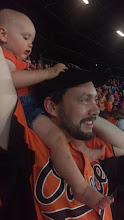
Are you ready for Opening Day? (Two weeks to go!) Here in my humble home, we're doing our level best. Season tickets arrived on our doorstep on Tuesday; for the sixth consecutive season, my sister and I have two seats on a 29-game plan. That means we'll be at Oriole Park at Camden Yards when the O's face the Twins on March 29th. We bought two extra tickets for the opener, so that Janet and my dad can join us as well...and naturally, Finn will be there too, since he's still young enough that he won't need his own seat.
Nobody is doing more to gear up for the 2018 season than our near-21-month-old. Finn's vocabulary has been exploding lately, and some of his favorite new words and phrases are: baseball ("BEEBAW!"), Orioles (and "Oriole hat" - he always wants to wear one of his caps or our replica batting helmet), and "Let's go O's!". That last one comes out sounding like "oh-oh-O's!", but he'll get the hang of it. Any time he sees a piece of Birds memorabilia, he excitedly exclaims one or more of the above phrases. It doesn't even have to include the cartoon bird logo; as long as it's orange and black, he knows the deal. We've indoctrinated - I mean, taught - him right.
A few weeks ago, we even bought Finn his first player tee shirt. It features Jonathan Schoop's name and number six, and it fits him just right. Here he is wearing it in tandem with Janet's adjustable O's cap last weekend, when we met Janet's sister for dinner at Heavy Seas Ale House. He is ready for some beebaw.
Nobody is doing more to gear up for the 2018 season than our near-21-month-old. Finn's vocabulary has been exploding lately, and some of his favorite new words and phrases are: baseball ("BEEBAW!"), Orioles (and "Oriole hat" - he always wants to wear one of his caps or our replica batting helmet), and "Let's go O's!". That last one comes out sounding like "oh-oh-O's!", but he'll get the hang of it. Any time he sees a piece of Birds memorabilia, he excitedly exclaims one or more of the above phrases. It doesn't even have to include the cartoon bird logo; as long as it's orange and black, he knows the deal. We've indoctrinated - I mean, taught - him right.
A few weeks ago, we even bought Finn his first player tee shirt. It features Jonathan Schoop's name and number six, and it fits him just right. Here he is wearing it in tandem with Janet's adjustable O's cap last weekend, when we met Janet's sister for dinner at Heavy Seas Ale House. He is ready for some beebaw.
Wednesday, March 14, 2018
Luis Garcia, 2002 Fleer Box Score #137
One of the benefits of rebooting this blog after a lengthy period of inactivity was reconnecting with some familiar folks. One of those folks is Max, a fellow lapsed blogger who has recently returned. He had a brick of about 35 Orioles cards earmarked for me, and once we touched base, he put it in the mail. The cards arrived with a note assuring me that it was a true random assortment, and much to my delight, that was definitely the case. There were shiny parallel cards from recent Topps sets, a few Cal Ripken minis, and even a pair of 2009 O-Pee-Chee cards I didn't have. I made a halfhearted attempt to collect that set at the time of its release, but I'm still only at 59% complete. So it was nice to tick off a few boxes on the ol' checklist without any effort on my part. But for sheer randomness, this card right here takes the cake.
Luis Garcia was a 19th-round draft pick of the White Sox in 1994 who spent four years in the minors and topped out at high-A. He then returned to his native Mexico and put up some eye-popping numbers for the Mexico City Tigres. Garcia batted .354/.399/.558 with 22 home runs and 81 RBI in 120 games in 2000. In 2001, he batted .332/.396/.582 with 19 homers and 82 RBI in 98 games. That prompted the Orioles to sign him, and he got a couple of cups of coffee with the big league club in 2002. He appeared in six games with the O's, all as a late-innings replacement. In three pinch-hit chances, he reached on an error, struck out, and singled. In 89 games that year for AAA Rochester, Luis did not distinguish himself. The 26-year-old batted only .242/.260/.330 with four home runs and 31 RBI. He went back to the Mexican League in 2003, and played there (and in winter ball) through 2011, though never matching the lofty stats of his first few seasons with the Tigres.
It's strange enough that Luis Garcia was featured on a card in this set, but it makes sense in light of the Orioles' lack of roster depth at that time. You could look at his numbers in Mexico from the previous two seasons, squint, and hope for the best. What's more inexplicable is that Fleer put out a set with serial-numbered base cards; the back of each card is given a number from one to 2,499. (This one is 1,776 of 2,499, for you fans of William Daniels and Howard Da Silva.) There was apparently a parallel "first edition" insert set, with only 100 serial-numbered copies of each card. I hope you can hear my eyes rolling. Anyhow, thanks, Max! Most of these random cards were new to me, and all are appreciated!
Luis Garcia was a 19th-round draft pick of the White Sox in 1994 who spent four years in the minors and topped out at high-A. He then returned to his native Mexico and put up some eye-popping numbers for the Mexico City Tigres. Garcia batted .354/.399/.558 with 22 home runs and 81 RBI in 120 games in 2000. In 2001, he batted .332/.396/.582 with 19 homers and 82 RBI in 98 games. That prompted the Orioles to sign him, and he got a couple of cups of coffee with the big league club in 2002. He appeared in six games with the O's, all as a late-innings replacement. In three pinch-hit chances, he reached on an error, struck out, and singled. In 89 games that year for AAA Rochester, Luis did not distinguish himself. The 26-year-old batted only .242/.260/.330 with four home runs and 31 RBI. He went back to the Mexican League in 2003, and played there (and in winter ball) through 2011, though never matching the lofty stats of his first few seasons with the Tigres.
It's strange enough that Luis Garcia was featured on a card in this set, but it makes sense in light of the Orioles' lack of roster depth at that time. You could look at his numbers in Mexico from the previous two seasons, squint, and hope for the best. What's more inexplicable is that Fleer put out a set with serial-numbered base cards; the back of each card is given a number from one to 2,499. (This one is 1,776 of 2,499, for you fans of William Daniels and Howard Da Silva.) There was apparently a parallel "first edition" insert set, with only 100 serial-numbered copies of each card. I hope you can hear my eyes rolling. Anyhow, thanks, Max! Most of these random cards were new to me, and all are appreciated!
Monday, March 12, 2018
Jake Arrieta, 2012 Topps Heritage High Numbers #H588
Jake Arrieta is a wealthier man than he was last week. After waiting out an unusually slow and austere free agent market, the 2015 NL Cy Young signed a three-year, $75 million contract with the Phillies. While the 32-year-old had an impressive four and a half year stay in Chicago (68-31, 2.73 ERA, 147 ERA+), there is still cause for concern. Firstly, he's a pitcher; they're designed to break. More to the point, in the last two seasons his walks and home runs allowed have risen while his cutter has been less effective. Obviously, he was so absurdly unhittable in 2015 that the backslide of 2016-2017 still saw him pitch better than, say, any Orioles starter. (Grumble grumble groan.) But the pessimist in me was sure that if hell froze over and the O's and Jake agreed to reunite, he would've immediately fallen apart. So I'm perversely relieved that he's staying in the National League. We'll see how I feel in June when the Birds are back to shuffling the likes of Mike Wright, Jr. and Gabriel Ynoa in and out of the rotation.
Saturday, March 10, 2018
J. J. Hardy, 2016 Topps #233
One of the troubling realities of being a baseball fan is that you can form attachments to players, only to see them leave your favorite team. Guys get hurt, they decline, they're released or traded or just sign elsewhere as a free agent. It seemed like a foregone conclusion for a while that J. J. Hardy would not be an Oriole in 2018, but in some ways I'm just coming to terms with it nonetheless. Pedro Alvarez recently re-signed with the O's on a minor league deal, and was assigned jersey number two. As shown above, that was J. J.'s number for the past seven years. But he hadn't topped 115 games played since 2014, and hadn't been even league-average as a hitter since 2013. So at age 35, it's not really surprising that Hardy is no longer in Baltimore. In fact, he hasn't signed anywhere.
But J. J. Hardy will be fondly remembered by O's fans. He contributed to three playoff teams, and was a Gold Glover at shortstop for three straight years (2012-2014), for what that's worth. For me, I'll remember that he scored the go-ahead run on Delmon Young's bases-clearing double in the second game of the 2014 AL Division Series, and I'll remember shouting along to Camden Yards PA announcer Ryan Wagner's distinctive call: "J! J! HARDY!" If his 13-year MLB career is truly over, J. J. should feel a real sense of pride. He totaled 188 home runs, with a 30-homer season in 2011. In addition to the aforementioned Gold Gloves, he was a two-time All-Star (2007 and 2013) and a 2013 Silver Slugger awardee. I hope he can find something else to keep him busy after baseball.
Friday, March 9, 2018
Vintage Fridays: Darold Knowles, 1965 Topps #577
This is an interesting oddity when it comes to Orioles cards. Darold Knowles pitched only five games for the Orioles, all in 1965. He didn't fare so well, coughing up 15 runs in 14.2 innings, but he had a strong enough minor league record (56-33, 2.77 ERA) that Topps featured him on their multi-player rookie cards for three consecutive years: 1964, 1965, and 1966.
Despite his inauspicious debut, Knowles went on to have a 16-season career for eight teams, chiefly the Athletics and Senators. He was a workhouse reliever, averaging 54 games pitched from 1966 through 1979. Overall, he had a record of 66-74 with a 3.12 ERA and 143 saves. He had an impressively bizarre stat line with Washington in 1970: 2-14, 2.07 ERA, and a career-high 27 saves. (Somehow he managed to lead the 70-92 Sens in losses.) In 1973, he set a World Series record by appearing in all seven games for the A's, allowing one unearned run in six and a third innings and picking up two saves. No other pitcher matched that feat until Dodgers reliever Brandon Morrow went seven-for-seven in last year's Fall Classic.
Also worth mentioning: he's the only "Darold" in MLB history.
Despite his inauspicious debut, Knowles went on to have a 16-season career for eight teams, chiefly the Athletics and Senators. He was a workhouse reliever, averaging 54 games pitched from 1966 through 1979. Overall, he had a record of 66-74 with a 3.12 ERA and 143 saves. He had an impressively bizarre stat line with Washington in 1970: 2-14, 2.07 ERA, and a career-high 27 saves. (Somehow he managed to lead the 70-92 Sens in losses.) In 1973, he set a World Series record by appearing in all seven games for the A's, allowing one unearned run in six and a third innings and picking up two saves. No other pitcher matched that feat until Dodgers reliever Brandon Morrow went seven-for-seven in last year's Fall Classic.
Also worth mentioning: he's the only "Darold" in MLB history.
Wednesday, March 7, 2018
Rodrigo Lopez, 2003 Topps Opening Day #104
22 days until Opening Day! We've almost made it, even though there's currently a couple inches of snow and ice out in my yard. It's been fifteen years since Baltimore was hit with a freak snowstorm during their season opener, with Rodrigo Lopez on the mound. Because I've been at this blogging thing for a while, you'd better believe I've written about that game before.
Monday, March 5, 2018
Sammy Stewart, 1981 Donruss #474
Sadly, the Orioles family lost another notable name over the weekend, as Sammy Stewart was found dead in Hendersonville, NC on Friday. He was 63 years old.
Stewart, a powerful 6'3" righthander, burst onto the scene on September 1, 1978. Tabbed to start against the White Sox in his big league debut, he set a rookie record that still stands by striking out seven consecutive batters from the second inning to the fourth. Though he was never able to gain a foothold in the deep Baltimore starting rotation, Sammy pitched effectively in a variety of roles during his seven full seasons with the team, posting a 51-45 record, 42 saves, and a 3.47 ERA (114 ERA+). Most notably, he led the American League with a 2.32 ERA during the strike-shortened 1981 season, when he logged 112.1 innings in 29 games despite making only three starts. In the 1979 and 1983 postseasons, he allowed no runs in 12 innings across six appearances. He even picked up a save in Game Three of the 1983 ALCS, yielding just one hit and one walk in four innings after relieving starter Mike Flanagan. Sammy was by all accounts a good and affable teammate, according to the memories that several prominent ex-Orioles shared in this obituary by the Baltimore Sun.
Sammy's career was short-lived after the O's traded him to Boston for the 1986 season. He spent one year with the Red Sox, followed by a partial season in Cleveland's bullpen. As I've mentioned on this blog before, his life away from the diamond was full of struggles. He lost two children to the effects of cystic fibrosis - son Colin passed away in 1991 at age 11, and daughter Alicia was 34 when she died in 2016. In between these two tragedies his life was derailed by drug addiction, leading to homelessness and an eventual six-year incarceration in his native North Carolina. Stewart was released in 2013, and seemed to have cleaned himself up and found peace. He remarried, and worked to build a better relationship with his daughter. And now, just a few years later, he's gone. I just hope he's truly found that peace that eluded him for so long.
Stewart, a powerful 6'3" righthander, burst onto the scene on September 1, 1978. Tabbed to start against the White Sox in his big league debut, he set a rookie record that still stands by striking out seven consecutive batters from the second inning to the fourth. Though he was never able to gain a foothold in the deep Baltimore starting rotation, Sammy pitched effectively in a variety of roles during his seven full seasons with the team, posting a 51-45 record, 42 saves, and a 3.47 ERA (114 ERA+). Most notably, he led the American League with a 2.32 ERA during the strike-shortened 1981 season, when he logged 112.1 innings in 29 games despite making only three starts. In the 1979 and 1983 postseasons, he allowed no runs in 12 innings across six appearances. He even picked up a save in Game Three of the 1983 ALCS, yielding just one hit and one walk in four innings after relieving starter Mike Flanagan. Sammy was by all accounts a good and affable teammate, according to the memories that several prominent ex-Orioles shared in this obituary by the Baltimore Sun.
Sammy's career was short-lived after the O's traded him to Boston for the 1986 season. He spent one year with the Red Sox, followed by a partial season in Cleveland's bullpen. As I've mentioned on this blog before, his life away from the diamond was full of struggles. He lost two children to the effects of cystic fibrosis - son Colin passed away in 1991 at age 11, and daughter Alicia was 34 when she died in 2016. In between these two tragedies his life was derailed by drug addiction, leading to homelessness and an eventual six-year incarceration in his native North Carolina. Stewart was released in 2013, and seemed to have cleaned himself up and found peace. He remarried, and worked to build a better relationship with his daughter. And now, just a few years later, he's gone. I just hope he's truly found that peace that eluded him for so long.
Friday, March 2, 2018
Vintage Fridays: Nelson Briles, 1978 Topps #717
This is the fifteenth card I've featured from the 1978 Topps set. Believe it or not, that's not the highest card count for any set on this blog. I've posted 19 Orioles from the 1972 Topps set...and of course, 82 from the 1991 Crown/Coca-Cola All-Time Orioles set. That's a pretty good reminder that I've been writing this blog for a shade over ten years, and even with the slowdown in recent years, I've still racked up 2,805 entries. It all stacks up.
Nellie Briles, as I've noted before, is one of two Orioles to share my August 5 birthday. (The other is John Wasdin, a journeyman reliever who pitched in 26 games for the O's in 2001.) Topps scrambled to paint Briles into Baltimore's orange and black threads for their 1978 set; he'd spent most of the 1977 season as a Texas Ranger, joining the Birds on September 19 and making a pair of relief appearances. Nelson's 14-year big league career came to an end in Charm City in 1978. He started eight games, relieved in eight others, and posted a 4-4 record with a 4.64 ERA. Despite those modest results, he had a long and accomplished career, totaling 129 wins, 112 losses, and a 3.44 ERA. He was also a talented singer, often performing in night clubs during the offseason and entertaining teammates over the summer months. How's that for a two-way player?
Tuesday, February 27, 2018
Aubrey Huff, 2009 Topps #45
I picked a card at random tonight, hoping for a little inspiration. Be careful what you ask for, right? Nowadays, when I think of Aubrey Huff, I think of his frequently incomprehensible Twitter feed. It's probably true that nobody should ever tweet, but that goes double for ol' Horseshit Huff.
Saturday, February 24, 2018
Cal Ripken, Jr., 1998 Donruss Elite #123
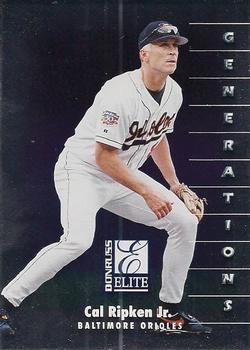
It's been a while since I've highlighted a butt-ugly 1990s Cal Ripken card, and it's the extremely foily Donruss Elite to the rescue! To be fair, this card doesn't scan well. In person, you can see a blue-to-purple gradient in the background, with a speckled effect that is reminiscent of stars in the night sky. But the overbearing Elite logo that takes up all of the space between Cal's legs is an eyesore, and the less said about the "GENERATIONS" wordmark running down the right side of the card, complete with unnecessary horizontal lines between each letter.
The writeup on the back of the card is no great shakes, either. And I quote:
"Cal might not have put up the best numbers of the 90s-although his stats speak for themselves-he has earned the title of Mr. Baseball of the decade."
What the hell? If Cal's stats really do speak for themselves, then why are you downplaying his performance right out of the gate? Also, the grammar is abysmal. There's a conjunction missing somewhere, i.e. "but he has earned the title...". And that aforementioned title. "Mr. Baseball of the decade"? That's not a thing. Come on, guys.
The writeup on the back of the card is no great shakes, either. And I quote:
"Cal might not have put up the best numbers of the 90s-although his stats speak for themselves-he has earned the title of Mr. Baseball of the decade."
What the hell? If Cal's stats really do speak for themselves, then why are you downplaying his performance right out of the gate? Also, the grammar is abysmal. There's a conjunction missing somewhere, i.e. "but he has earned the title...". And that aforementioned title. "Mr. Baseball of the decade"? That's not a thing. Come on, guys.
Friday, February 23, 2018
Vintage Fridays: Bill Wight, 1956 Topps #286
This is another of the 1950s cards that I picked up from COMC's Amazon store last week. I keep chipping away at the 1956 set, picking up lesser names and creased-up cards here and there, because it's just a great-looking design. Here we see Bill Wight bathed in a halo of light, as the smaller Bill shows off his lefthanded pitching form...which looks oddly pigeon-toed. Anyhow, Bill Wight was a true journeyman, squeezing in stints with eight teams in a 12-year career: Yankees, White Sox, Red Sox, Tigers, Indians, Orioles, Reds, and Cardinals. His three-year stay in Chicago was the longest that he ever stayed with one club. It was also with the Pale Hose that Wight had his best season, when he went 15-13 with a 3.31 ERA and 14 complete games in 1949. But he also pitched quite well for the Indians and O's in 1955, with a 6-8 record that belied his 2.48 ERA. He started 14 games and relieved in 22 that year, with all of his starts coming after being traded to Baltimore in mid-July. His 154 ERA+ in 141.1 innings was a career best. Bill continued in a swingman role for the Birds in 1956 and 1957, with middling results. He hung up his spikes after the 1958 season, finishing with a 77-99 record, a 3.95 ERA, and eight saves. He completed 66 of his 198 career starts.
Wight had a notable second act in baseball, serving as a scout for Houston and Atlanta for 37 years total. He signed Joe Morgan, Dusty Baker, Dale Murphy, Bob Horner, and David Justice, among others. Bill died of a heart attack at age 85 in 2007, while vacationing with his wife of 60 years.
Wednesday, February 21, 2018
Chris Smith, 2001 Upper Deck Prospect Premieres #56
I'll cut to the quick: Chris Smith never made it to the major leagues. In an era of top draft pick misfires for the Orioles, the stocky lefty from Cumberland University in Tennessee was one of the most glaring busts. The O's selected Smith with the seventh overall pick in 2001, pegging him as a pitcher despite his strong track record as an outfielder in college. He'd batted .375 with 14 homers and 66 RBI as a sophomore at Florida State, earning second-team All-American honors. He'd taken the mound sparingly, totaling 16.1 innings in two years at FSU. When Seminoles coach Mike Martin rebuffed his request to focus on pitching going forward, he jumped to Cumberland and struck out 115 batters in 84.1 innings. As a hitter, he posted a .414 average, 17 homers, and 67 RBI.
Those 84.1 innings that Chris pitched as a collegiate junior were more than he would total in the Orioles' organization. A left shoulder tear derailed his progress, and he had a cumulative 7.52 ERA in 24 games in the minors. The Birds cut their losses in 2005 after Smith allowed 25 runs in 26.1 innings of relief with the Delmarva Shorebirds. He finished the season - and his pro career - in the independent Atlantic League with the Long Island Ducks, putting up a much more reasonable 4.14 ERA in 25 appearances. The southpaw spent several years as the hitting and outfield coach at SUNY College at Old Westbury, though my Google-fu shows that he's no longer with the school. Meanwhile, the only real success story for Baltimore in the 2001 draft came in the form of fifth-round pick Jim Johnson, a right-handed pitcher from Union-Endicott High School in New York.
Monday, February 19, 2018
Chris Tillman, 2015 Panini Donruss #58
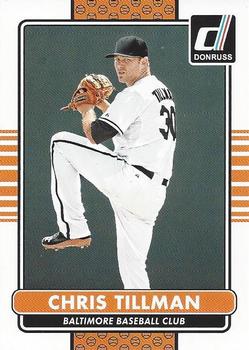
I'd say that the Orioles are getting the band back together, but technically Chris Tillman never left. All the same, I spent much of this offseason figuring that the righty's decade in the Baltimore organization had come to an end. Tilly's 2016 was as disastrous as it gets for an impending free agent. A lingering shoulder injury cost him the first month-plus of the season, and his return on May 7 doubled as his only win of the season. He went 1-7 with a 7.84 ERA, allowing 81 earned runs in 93 innings. Every number you can find was hideous: 24 homers allowed, 51 walks against just 63 strikeouts, 125 hits. Opposing hitters batted .324/.406/.575; essentially, Chris turned every opposing batter into Mike Trout.
But I'm in danger of belaboring the point. Tillman was a 16-game winner with a 3.77 ERA as recently as 2016, he won't turn 30 until April (which I was surprised to learn), and the O's are not exactly flush with strong starting pitching options, even after picking up Andrew Cashner last week. So I don't see the harm in giving Chris a guaranteed $3 million to see if he can return to good form and health in 2018. I won't necessarily be expecting anything like that, but I think it's better to be pleasantly surprised than disappointed.
Subscribe to:
Posts (Atom)